

Early stage teams that need a partner to ship a product before runway runs out. Full path from architecture to live transaction under one engagement.
Payment Software Development Services for Fintech Projects
Ship a production ready platform in months instead of years. PayAdmit delivers payment platform development that combines a white label core with a custom engineering team across the engagement lifecycle. Our team works directly with operators to design, build, and operate the engineering any transaction-heavy business needs. Every engagement runs as a co-led partnership.

What Payment Software Development Covers
Payment software development is the engineering that turns business requirements into a production processing system operators can manage online. The scope covers the core processing engine, the merchant onboarding application, the compliance tooling risk teams manage day to day, the operational dashboards, and the technical connectors to banks, card networks, and alternative rails.
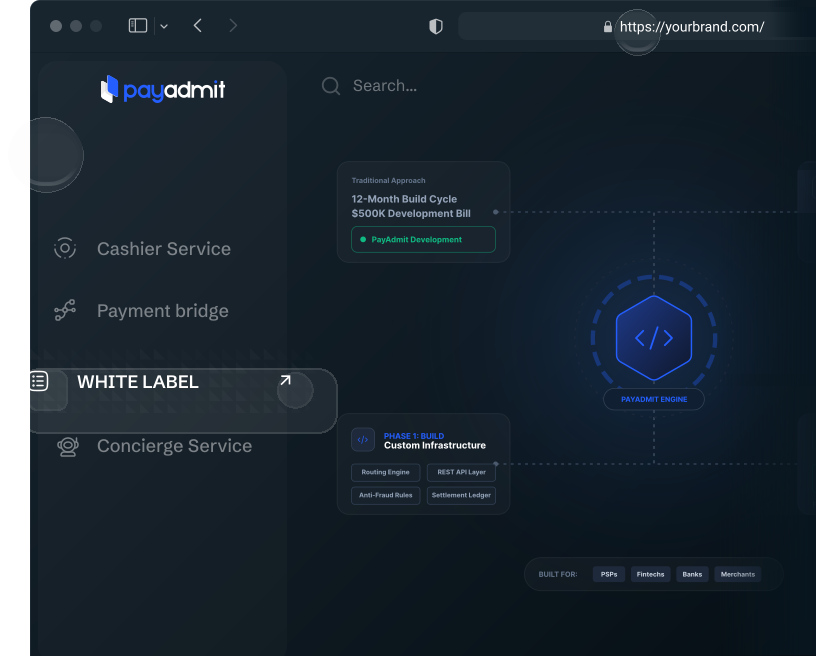
Modern fintech engineering blends two patterns. Operators licence a white label technology platform that handles the well-understood components, then customise the layers that matter for differentiation. PayAdmit operates this model: a white label stack combined with a custom development team that delivers everything around the core, from the onboarding application to the merchant app.
Five engineering pillars a typical fintech rollout covers
- Core processing engine. Authorises, captures, refunds, and reconciles every transaction, with automated retries built in.
- Orchestration layer. Picks the best path on each transaction. Managed from a single console.
- Reporting layer. Real-time visibility into transaction activity across every launch.
- Compliance and risk tooling. KYC, AML, sanctions, automated fraud monitoring. Analysts manage alerts instead of raw data.
- Merchant-facing app and dashboards. Turns the platform into a product real businesses use.
Who Needs a Payment Software Development Partner
Five buyer profiles appear most often. Each uses the engagement differently; the PayAdmit method adapts to each launch context.

Expanding into new markets or new merchant verticals need engineering capacity beyond what the in-house team can deliver alone. Each expansion runs as its own engagement with dedicated management.

Merchant service organisations modernising their service catalogue use the engagement to upgrade the merchant experience without rebuilding from scratch.

SaaS businesses adding transaction capabilities to a vertical product need engineering that integrates cleanly with the existing system and data model.

Banks, neobanks, and large operators bring in development engagement to accelerate specific projects without expanding the in-house team.
Why Building From Scratch Rarely Works
The hiring problem. Senior fintech engineers are scarce and expensive. Building an in-house team large enough to ship a transaction platform takes longer than the entire white label integration cycle. By the time the team is in place, the market window has narrowed.
The compliance burden. Modern engineering needs PCI DSS, KYC, AML, sanctions, and chain analytics baked in from day one. Teams that retrofit compliance later spend more than the original engineering cost. Compliance is a design constraint, not a feature to add later.
The reconciliation reality. Modern engineering is not just about the happy path. Settlement files arrive late, in different formats, with corrections that change historical records. The reconciliation engine ends up more complex than the processing engine.
The operational drag. Production fintech is a service business as much as a code project. Teams that handle engineering without an operational tooling plan struggle when real merchant volume hits the platform. On-call coverage, incident response, change control, and vendor coordination all need professional attention.
PayAdmit Payment Software Development Engagement
One service that combines the white label core, the custom engineering, and the ongoing operational partnership. Covers the engagement from scoping through ongoing management of live processing workloads.
PCI DSS Level 1 ready infrastructure with 400+ methods, multi-acquirer routing, antifraud screening, and the compliance tooling any production system needs. See the white label payment gateway software.

Our team delivers vertical workflows, specific merchant data models, custom orchestration rules, subscription recurring flows, and the merchant-facing view design that fits the operator brand.
Each engagement has a dedicated lead running the workstream against fixed milestones. The team includes a delivery lead, integration developer, compliance tooling lead, and operations specialist.

After launch we continue delivering platform updates, new methods, new acquirer integrations, and any custom engineering the operator scopes quarterly. Not a project, a partnership.

Monitoring, alerting management, observability, configurable reconciliation, and on-call coverage that keep processing workloads running as volume scales.

Real-time visibility into transaction activity, settlement reconciliation, and merchant performance. Configurable exports feed existing analytics and BI tools.
How a Typical Engagement Runs
Four phases with clear deliverables, a dedicated team, and a rollout plan managed against fixed milestones.

Two week phase mapping requirements, target markets, merchant segment, and regulatory perimeter. Output: a specification and rollout plan the operator commits against.

Platform configures for the brand. In parallel, custom engineering ships: vertical workflows, orchestration rules, data models, merchant-facing view, subscription flows. Runs 4 to 6 weeks with daily standups.

KYC, AML, sanctions screening, and fraud tooling integrate. Audit trail design, residency design, and security testing happen before the first real transaction. Runs 2 to 3 weeks alongside Phase 2.
Live under your own domain. We continue delivering platform updates, new acquirer integrations, subscription enhancements, and any custom engineering scoped quarterly.
Capabilities of the PayAdmit Platform
The white label platform ships with the capabilities any modern fintech operation needs. Custom engineering extends the surface where the operator wants differentiation.

Smart routing across acquirers based on authorisation likelihood, cost, and customer preference. The engine learns from declines and adapts continuously. See payment routing infrastructure.
When one acquirer declines, routing cascades through alternatives via the payment bridge. Recovers 10 to 15% of transactions that would otherwise be lost.

Cards, alternative rails, account-to-account, and regional methods across 40+ markets. New methods arrive as part of the ongoing partnership.
Real-time transaction screening through configurable rules, ML models, and external signals. See antifraud and risk management.
Built-in compliance tooling with integrations to Sumsub, Onfido, ComplyAdvantage, and Chainalysis. Workflows configurable per launch.

Automated settlement reconciliation across acquirers, methods, and currencies. Analytics tools surface discrepancies for the operations team.

Document upload, identity verification, business verification, and underwriting in one configurable workflow. Custom fields per launch.
Real-time transaction visibility, settlement reports, dispute queues, and configurable exports. The dashboard rebrands to the operator identity.
Clean REST APIs, idempotency keys, signed webhooks, SDKs in major languages, and full sandbox parity. Engineered for integration teams.

Subscription billing logic, configurable retry rules, and dunning workflows. Integrates with the core processing engine for both subscription and one-time models.
Developer-Friendly Infrastructure & Safety Baseline
Engineered for engineering buyers who care about developer experience. Safety and security built into the foundation, not bolted on. See our security and compliance reference posture and our payment processing developers hiring model.
Consistent REST endpoints, OpenAPI specifications, predictable error handling. Idempotency keys on every transaction endpoint. Reliable webhook delivery with signature verification and event replay. SDKs in Java, Python, Node.js, Go, and PHP.
Infrastructure meets the highest tier of card data security. Card numbers replace with tokens at the earliest touchpoint. Tokens live in a dedicated vault; the rest of the platform operates on tokens, which significantly reduces PCI DSS scope.
Production infrastructure runs across multiple regions with automatic failover and regulatory-aware residency. Every field at rest uses HSM-managed keys; every wire uses TLS 1.3. Service commitments matching tier-one processors.
PayAdmit vs Other Engineering Paths
Operators evaluating engineering paths choose between four options. Understanding the trade-offs early shapes every later decision.
| Path | Trade-off |
|---|---|
| From-Scratch Development | 12 to 18 months, several million dollars, full compliance burden. |
| Generic White Label | Fast and cheap but limits differentiation and vertical fit. |
| Hybrid In-House + Consulting | In-house team plus consultants on defined quarterly deliverables. |
| PayAdmit (White Label + Custom) | 1 to 2 months to live, deep customisation, ongoing partnership. |
How a Payment Software Development Engagement Actually Works
Most teams that ask about payment software development want the same thing: a working solution online in weeks, an app that merchants trust, and a tech partner that will still be there in a year. The engagement below is the shape our payment processing software developers use on almost every project, and it is the shape that consistently ships on time. It combines development, delivery management, and hands-on tech support in one workstream so the operator team can focus on the work only they can do.
Discovery, scoping and project plan. Every engagement opens with a short discovery. The delivery lead maps the target markets, the payment methods, the automated flows the operator wants live in month one, and the tech constraints already in place. Output is a scoped project with fixed milestones, a named team, and a development plan the operator can share internally. Discovery is where most payment development projects quietly succeed or fail. A two-week discovery saves three months of rework.
Configuration and integration development. Our development team configures the white-label core, wires the acquiring connections, sets up the merchant-facing app, and hands the operator team a working sandbox to try. Custom development sits on top: vertical workflows, billing schedules, subscription flows, online checkout tweaks, custom reporting. Every piece of code we ship is reviewed by a senior developer and covered by automated tests before it hits staging.
Compliance tooling, data flows and observability. In parallel, the compliance-tooling lead sets up KYC, KYB and AML workflows, hooks the reconciliation jobs to the operator's bank data, and lands the observability stack that will manage every live transaction end to end. This is where a lot of the development effort quietly goes; a payment solution without deep observability tech is a payment solution that cannot be operated at scale.
Go-live, handover and steady-state operations. After the canary week, the platform opens to real traffic. The engagement does not end there: it flips into steady-state operations. The same tech team keeps shipping updates, adds new payment methods, and helps the operator manage day-to-day incidents. Each quarter the operator scopes new development work; the delivery lead builds the plan and the developer pool executes. Not a one-off project, an ongoing partnership.
What Your Team Gets From Our Payment Processing Software Developers
Working with our payment processing software developers gives an operator team a compact, senior development pod rather than a large body-shop. Every solution we ship (the white-label app, the merchant portal, the subscription billing workflow, the automated reconciliation job) is owned by a named developer who knows the code, the acquirer, the compliance constraint and the operator's business. That ownership is what lets a small tech team manage a large payment solution reliably.
The typical solutions we ship as part of the engagement include: an online checkout that works across cards, wallets and local payment methods; a merchant app that lets the operator manage transactions, users and payouts without a support ticket; recurring and subscription billing tech with automated retries; a reporting solution that plugs into the operator's existing data warehouse; and the developer tooling (SDKs, sandbox, docs) that lets merchants integrate without a phone call.
Every one of these solutions is built on the same tech foundation, which is why the total cost of ownership stays low as the operator adds new payment methods, new markets and new merchant verticals. When a new project is scoped, we do not rebuild the plumbing; we extend the existing solution and let the operator team manage the change with confidence. That is the point of a real payment software development partnership rather than a series of disconnected engagements.
If you want to place this work inside a wider view of the fintech and software development landscape, our companion pages are the fastest read. See fintech software development for the broader service, custom fintech software development for tailored engagements, white-label payment gateway software for the core product, and payment gateway development for the deep-dive on the gateway side.
For a look at the people behind the code, our guide to how you hire fintech software developers covers seniority and rates, and our blog post on fintech software development services puts the wider service catalogue side by side. Together they describe the payment software development partnership our team runs for every operator on the platform.
Use Cases
Six patterns from real projects spanning multiple markets and verticals.
An early stage operator shipped a product in 8 weeks. The white label core handled standard transaction work; our team shipped custom onboarding and vertical-specific reporting. Replaced what would have been a 12 month internal project.
A traditional PSP added new markets and payment methods. PayAdmit handled integration; the PSP team kept merchant relationships. Grew from 3 markets to 12 in 18 months.
A 15 year MSP refreshed its service catalogue. The new platform replaced legacy software while the merchant base stayed under the MSP brand throughout the migration. Merchant churn dropped 30% over six months.
A SaaS business serving healthcare merchants added services through PayAdmit. The engagement covered HIPAA-aware data handling, custom onboarding, and vertical reporting. Delivered a fully integrated solution in 10 weeks.
A large operator brought PayAdmit into a specific engagement where the in-house team needed acceleration. PayAdmit worked alongside the operator team on defined deliverables. Delivered in half the original timeline.

A B2B marketplace added split flows and three-sided transaction logic through PayAdmit. Custom engineering integrated with the marketplace data model and existing tech stack.
Frequently Asked Questions
How long does a typical engagement take?
Most engagements run 1 to 2 months from contract to live transaction. Deeper custom engineering adds 2 to 4 weeks depending on scope.
Who owns the engineering after the engagement?
PayAdmit retains ownership of the white label core. Custom engineering delivered under the engagement is documented in the contract; most engagements give the operator full usage rights for the configured platform under their brand.
Can the platform integrate with our existing systems?
Yes. The API surface, webhooks, and data export tooling integrate cleanly with any existing CRM, ERP, accounting, or merchant management system. Integration scope is part of the discovery phase.
Does PayAdmit handle compliance tooling?
Yes. KYC, KYB, AML, sanctions screening, and the audit trail are built into the white label core. Workflows configurable per launch.
What payment methods are supported?
400+ methods across cards, account-to-account rails, alternative rails, and regional options. New methods are part of the ongoing engagement.
Can we work directly with your engineering team?
Yes. Direct engineering contact is part of the engagement. Your team works with PayAdmit engineers on custom development and integration questions throughout.
Are you a processor or a vendor?
PayAdmit is a software development partner that combines white label with a development team. We are not a processor; we partner with processors and acquiring banks to deliver the end-to-end solution.
Where can I read more?
See our companion guides on how to create a payment processing company, how to build a payment platform, and how to build a payment system.