

PCI DSS Level 1
Highest tier · Card data
PayAdmit delivers white label payment gateways under PCI DSS Level 1 certification, with full Visa and Mastercard PSP registration and AML workflows ready for regulated markets

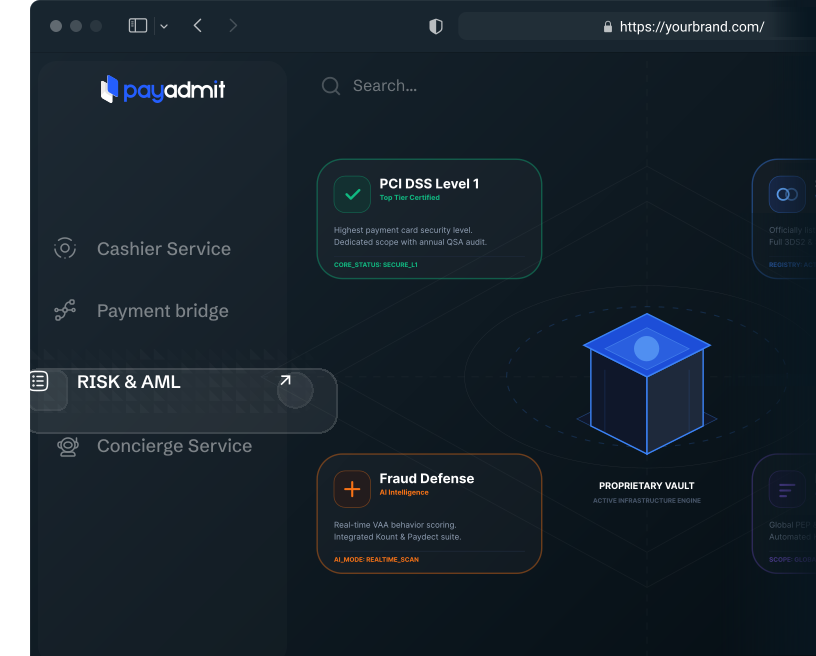
Highest tier · Card data

Listed in Visa GRSP

Listed PSP partner
We treat security and compliance as the starting point of every engagement, not a checklist applied at the end. Our platform is independently audited, registered with major card networks, and designed to satisfy the regulatory requirements of banks, licensed PSPs, and financial institutions across 40+ markets.
Four independently verified credentials cover the full compliance scope your business needs to operate a payment gateway under regulator and acquirer scrutiny.
The highest payment card security certification available. The same level required of Visa, Mastercard, and major acquiring banks. Your gateway operates within its own dedicated PCI DSS scope, not shared with other clients.
Officially listed in the Visa Global Registry of Service Providers. PayAdmit has met every Visa security and operational requirement to process Visa transactions on behalf of merchants and PSPs across regulated markets.
Registered under the Mastercard Registration Program as a verified payment service provider. Your gateway connects to the Mastercard network with full compliance to Site Data Protection requirements and EMV 3-D Secure standards.
Full alignment with the EU General Data Protection Regulation. PayAdmit processes cardholder data, merchant records, and transaction logs under strict residency, consent, and breach notification rules required across European markets.
Every business that processes card payments must comply with PCI DSS. Four levels exist based on transaction volume. PayAdmit covers Level 1, the highest, and brings every gateway we deploy under that same certification scope.
6M+ Visa or Mastercard transactions per year. Annual on-site audit by QSA. PayAdmit operates here.
1M to 6M transactions per year. Annual self-assessment plus quarterly network scan.
20K to 1M e-commerce transactions per year. Annual self-assessment plus quarterly network scan.
Less than 20K e-commerce transactions per year. Annual self-assessment plus recommended scan.
Define which systems handle card data and require PCI DSS coverage. PayAdmit handles the scoping for your gateway environment.
Identify any gaps against the 12 PCI DSS requirements. Address them through architecture changes, controls, or documentation.
Independent qualified security assessor performs the on-site audit. PayAdmit infrastructure already passes this annually.
Receive your Attestation of Compliance. Maintain the controls year-round through monitoring, scans, and policy enforcement.
Visa, Mastercard, and PayAdmit’s own antifraud layer work together to screen every transaction.
No gaps between authentication, scoring, and decision logic.
AI and machine learning score every transaction before authorization. PayAdmit’s gateway integrates VAA scoring directly into routing logic to reduce fraud and protect approval ratios.
Strong customer authentication for both Visa and Mastercard. Frictionless flows for trusted transactions, biometric or one-time-code challenge when risk requires verification.
ZignSec, Kount, and Paydetect integrations add a third antifraud layer on top of card network tools. Configurable rules per merchant. Real-time decision is typically under 200ms.
Visa and Mastercard Zero Liability protections built into the dispute and chargeback workflows. Cardholders are not held responsible for unauthorized transactions.
Real-time monitoring of every transaction passing through your gateway. Unusual volume spikes, decline rate jumps, and unexpected geographies trigger automated alerts.
Card data is encrypted and tokenised at the point of capture. Raw card numbers never persist in your system after the initial secure capture step. PCI scope reduced by design.
You do not configure these capabilities. You do not pay extra for them.
They are part of every PayAdmit deployment from day one.
| Standard | What it covers in your gateway |
|---|---|
| PCI DSS Level 1 | Highest card payment security certification. Dedicated infrastructure within its own certified scope. Card data stays within your perimeter. |
| AML, KYC, KYB | Anti-money laundering monitoring and Know Your Customer or Business verification built into merchant onboarding and transaction workflows. |
| Antifraud monitoring | ZignSec, Kount, and Paydetect integrations. Configurable fraud rules per merchant. Real-time transaction screening on every payment. |
| Travel Rule compliance | FATF Travel Rule monitoring for crypto transactions where required by jurisdiction. Built-in support for licensed crypto operators. |
| Data encryption | End-to-end transaction data encryption. Card data tokenisation at capture. Cardholder data never stored on merchant systems. |
| PSD2 readiness | Strong customer authentication, secure communication, and open banking compatibility for all European market deployments. |

Every PayAdmit deployment runs on infrastructure under its own dedicated PCI DSS Level 1 certification, scoped specifically to your gateway environment. Your business does not have to pursue a separate Level 1 certification for the gateway infrastructure itself. Depending on your operational model, you may still need PCI DSS Self-Assessment Questionnaires for your own internal systems. Our team helps map the exact scope during onboarding.
AML monitoring, KYC (Know Your Customer), and KYB (Know Your Business) verification are built into the platform and configurable per merchant. Onboarding flows can require identity verification, document upload, sanctions screening, and PEP (politically exposed person) checks before activation. Ongoing transaction monitoring flags suspicious patterns based on configurable rules tuned to your business profile. The configuration adjusts to the regulatory expectations of your specific jurisdictions, what works for a UK-licensed PSP differs from what a fintech operating across LATAM markets requires.
Every PayAdmit deployment serving European markets ships with full GDPR alignment. This covers EU data residency on request (transaction data stored within EU jurisdictions when required), a signed Data Processing Agreement with every merchant, configurable consent management flows, and built-in workflows for the right to erasure and data portability requests from end customers. In the event of a security incident affecting personal data, our protocols ensure breach notification within the GDPR-mandated 72-hour window, with full documentation of the impact and remediation steps.
PayAdmit’s antifraud layer covers the majority of real-world fraud patterns out of the box: velocity rules, BIN-IP mismatches, behavioural signals, device fingerprinting, and chargeback prediction. The platform also integrates natively with specialised vendors, so merchants with specific industry requirements (high-risk verticals, complex chargeback profiles, regulated gaming) can layer dedicated tools on top of the built-in engine. For most merchants the integrated antifraud stack is sufficient; for edge cases the architecture is designed to extend, not replace.
PayAdmit’s infrastructure undergoes annual on-site assessment by a Qualified Security Assessor for PCI DSS Level 1 recertification. Beyond the annual audit, the platform runs continuous monitoring across multiple control domains: quarterly Approved Scanning Vendor (ASV) external network scans, internal vulnerability scans, penetration testing on production environments, log monitoring on every system handling card data, and policy enforcement on access controls. The certification is not a once-a-year event, it is a year-round operational discipline that the merchant inherits by running on PayAdmit infrastructure.
Yes. The platform is built for the compliance requirements of regulated industries, with capabilities tuned specifically for high-risk verticals. For licensed crypto operators, FATF Travel Rule monitoring is built into transaction workflows where the jurisdiction requires it. For iGaming and betting, the platform handles the elevated scheme requirements of high-risk MCCs, supports specialised acquirers, and applies the fraud and AML controls that regulated gaming markets demand. For other restricted categories, regional compliance configurations adapt to the specific regulatory regime of each operating market across our 40+ supported jurisdictions.


