

Banks

Expand your digital payment offering with a branded gateway.

Subscription businesses run on recurring revenue. Every failed payment, every payment retry that does not land, every subscriber who churns because their payment method was not updated, these are revenue leaks that compound over time. The payment infrastructure behind this business model is not just a checkout. It is the foundation of recurring payment revenue, subscription payment retention, and sustainable payment growth.
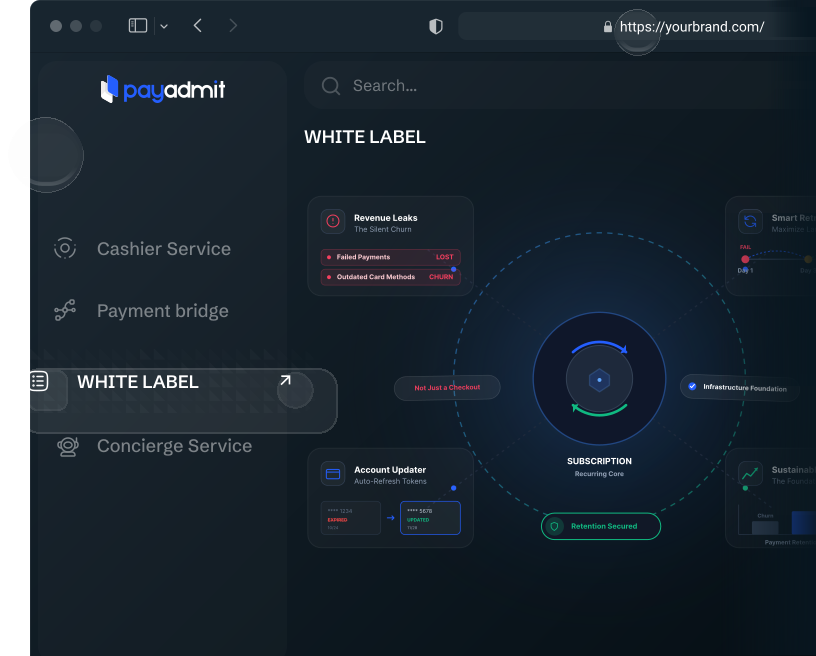

PayAdmit provides a white label payment gateway, a complete subscription billing solution built for businesses running on subscriptions. The white label solution includes native recurring payment processing, tokenized storage, custom billing schedule logic, dunning management, and a white label subscriber portal. It runs on dedicated infrastructure with its own PCI DSS certification. The platform provides the product experience; PayAdmit provides the payment software that makes subscription billing reliable.
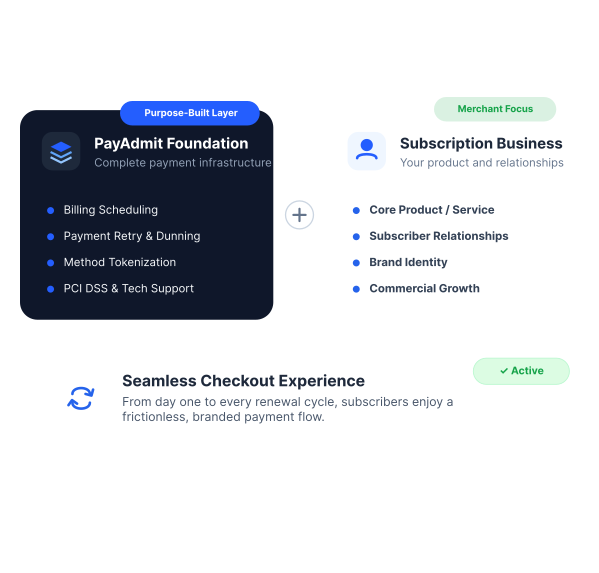
Building subscription payment revenue requires a payment layer purpose-built for recurring billing. A generic payment tool provides one-time payment processing. A white label subscription payment solution provides billing scheduling, payment retry logic, and payment recovery tools, all as a single payment service layer.
PayAdmit’s white label solution provides this payment foundation. The white label solution covers every payment service requirement: subscription billing, branded checkout pages, payment method tokenization, payment retry and dunning, and settlement reporting. This is a complete payment service. The payment solution runs on dedicated infrastructure. PayAdmit provides PCI DSS coverage. PayAdmit continues to provide technical support throughout the engagement.
The subscription business provides the product and the subscriber relationship. PayAdmit provides the payment infrastructure, secured and certified, and continues to provide payment technical support. Together, they provide subscribers with a seamless checkout experience from day one. PayAdmit provides the operator with the subscription payment capability it needs to grow subscription payment volume through reliable processing.
Most payment gateways provide subscription billing as a lightweight add-on to standard payment processing, a payment processing layer designed for one-off payment processing events, not for complex white label payment processing billing cycles. This creates three problems at scale.
Billing schedule flexibility is limited in standard payment tools. A business with multiple plan tiers, trial periods, usage-based components, and mid-cycle transaction logic needs billing infrastructure that can express these rules natively, not a rigid schedule that breaks whenever a subscriber changes plan.
Retry logic is often generic. A platform that applies one retry timing to all failed charges, regardless of failure reason, recovers significantly fewer failed payments. Smart retry scheduling per failure reason is not a premium add-on in subscription billing. It is the baseline requirement.
Card data management requires PCI DSS compliance. Processing regular payment processing charges must store tokenized payment data securely. A shared payment processing environment ties the operator’s payment data to another operator’s compliance scope. Dedicated infrastructure eliminates this. The solution is the right subscription billing solution for any operator: it provides every custom billing feature any operator needs.
Expand your digital payment offering with a branded gateway.
Accept donations in any currency through a trusted, fully branded checkout experience.

Launch your own processing product and grow your merchant portfolio under your brand

Embed native payments into your platform and turn processing into a revenue stream.

Full control over checkout, routing, and payment data with 550+ methods ready from day one.

Process split payments and manage payouts across your entire merchant base from one platform.

Automate recurring billing, manage retries, and reduce churn with a purpose-built payment engine

Handle multi-currency bookings and global payment methods through one branded gateway.

Understanding how a white label subscription payment solution handles the full billing cycle makes the infrastructure decision clearer for any subscription business operator.
The subscriber enters details through the branded payment page on the operator’s domain. The white label layer tokenizes data through PayAdmit’s certified payment environment. Raw card numbers never touch the operator’s infrastructure. The operator receives a webhook confirming successful payment and token registration.
On each renewal date, the billing layer processes each scheduled transaction against the stored token automatically. No subscriber action is required for regular billing. The operator receives a payment webhook for each billing event, and payment records update automatically. If the payment succeeds, the operator triggers service renewal. If the payment fails, the dunning begins.
The billing layer applies the configured dunning sequence. Retry logic applies per failure code, a charge declined for insufficient funds retries differently from one declined for an expired payment method. Subscriber notifications send at configurable stages under the operator’s brand. Dunning recovery rates directly affect subscription business revenue.
Mid-cycle adjustments are supported: billing date resets, upgrade or downgrade adjustments, and proration calculations. A business that offers flexible plan management needs a billing layer that can express this logic. The operator defines the rules; the system executes the process.
Software businesses billing regular monthly or annual plans need a white label solution that handles subscription charges without interrupting the product experience. Custom billing schedules, trial period management, and mid-cycle plan change logic are core requirements for any SaaS operator. Also, subscription businesses with complex billing logic often benefit from fintech software development services that complement the standard subscription gateway capabilities.
Digital content platforms collecting regular subscriber payment charges need a solution that processes billing reliably and provides branded payment pages that reinforce subscription membership identity. A subscriber to a white label content platform should see the operator’s brand at every billing touchpoint, checkout, renewal confirmation, payment receipt, and failed payment notification, all under the operator’s own domain.
eCommerce businesses operating subscription boxes or delivery-on-schedule services need billing tied to fulfillment logic. Payment billing event webhooks from the processing layer trigger fulfillment workflows. A box ships when a scheduled payment succeeds, and holds when a payment fails. The business connects the payment layer to its fulfillment system through the integration API.
Business-to-business platforms that bill regular software licensing fees, usage-based charges, or seat-based fees need a payment solution with high-value transaction processing, transaction-level reporting, and the ability to provide billing documentation under the operator’s brand. B2B payment flows often require billing schedule for B2B service clients that generic payment tools cannot express, the solution provides billing schedule configuration at this level.
| Subscription Requirement | White Label Solution Feature |
|---|---|
| Custom billing frequency | Configurable billing frequency, daily, weekly, monthly, annual, or any interval |
| Trial period management | Free trial with auto-conversion to paid billing, configurable trial length per plan |
| Mid-cycle plan changes | Mid-cycle billing adjustments, proration, usage-based charges, upgrade/downgrade |
| Tokenized payment storage | PCI DSS compliant tokenization on dedicated infrastructure |
| Smart retry logic | Per-failure-code retry schedule, configurable intervals and attempt limits |
| Dunning automation | Subscriber notification triggers, failed payment emails under operator brand |
| Card updater service | Automatic token refresh before renewal, reduces expiry failures |
| Multi-currency billing | Billing in subscriber local currency, settlement in operator base currency |
| Usage-based billing | Metered billing, usage event recording, end-of-period charge calculation |
| Transaction logs | Full payment transaction history per subscriber, exportable for integration |
| Custom plan metadata | Plan labels, descriptions, and custom identifiers stored per account |
Each deployment runs on dedicated servers with its own PCI DSS certification. Payment data for recurring transactions sits in a secure, dedicated environment, not shared with other operators. Data is isolated in a secure, certified environment. The operator’s compliance posture is independent. PCI DSS maintenance and security upkeep are managed by PayAdmit.
The payment page where subscribers enter card details runs on the operator’s domain. Custom CSS, the operator’s typography, and the plan display are all configurable. The subscriber experience is seamless throughout, not a redirect to a third-party payment service. The subscriber stays within the operator’s branded experience, a seamless payment service experience. White label receipt emails and confirmation pages carry the operator’s brand. The first billing interaction, and the first payment, sets the tone for the entire billing relationship.
The software supports unlimited plan types within one deployment. Each plan carries its own billing frequency, trial period, currency, and custom billing schedule. Plan metadata stores per subscriber account, allowing the operator to offer personalized options, loyalty white label payment gateway pricing, and multi-seat billing. Custom plan configuration does not require development work for each new plan
When a regular recurring payment fails, retry schedules apply by failure code. Every payment outcome triggers the appropriate workflow. Subscriber notification emails send at configurable dunning stages under the operator’s brand. Dunning recovery rates directly affect subscription business revenue, the white label solution provides the tools to maximize recovery without manual intervention.
Subscription businesses need to provide payment acceptance across Visa, Mastercard, Amex, JCB, and UnionPay, plus digital wallets including Apple Pay and Google Pay. The operator provides global payment method coverage. PayAdmit provides a complete payment layer. The operator provides subscribers with a seamless checkout experience. Together they provide method coverage across networks and provide digital wallet access through one integration.
Subscribers access a self-service portal on the operator’s domain to update payment details, view payment history, download receipts, and manage billing preferences. The white label subscriber portal lets operators tailor the subscriber’s billing experience. The portal runs under the operator’s brand. Subscribers interact with the operator’s branded payment service, not with a third-party service. Every service touchpoint, and every billing service event, stays under the operator’s brand.
Failed payment charges are the most significant preventable revenue leak in any recurring revenue business. Industry data consistently shows that 10–20% of regular recurring charges fail on the first attempt. Intelligent payment retry logic recovers 50–70% of initially failed payment attempts. The difference between a generic retry schedule and a smart dunning system is a measurable revenue impact. The payment layer provides the dunning infrastructure that gives subscription businesses control over their payment recovery rate:
When a charge is declined for insufficient funds, the optimal retry window is different from a charge declined for an expired payment method. The dunning layer applies configurable retry schedules per failure reason, not one-size retry logic that treats all failures the same.
When a subscriber’s payment instrument is reissued, tokens refresh before the next regular billing cycle. This reduces failures caused by expired payment data, a significant component of involuntary churn.
Notification triggers configure at each retry event. Subscribers receive branded payment failure notifications under the operator’s own identity, with direct links to update payment details in the white label subscriber portal. The communication feels like it comes from the subscription business, not from a payment gateway.
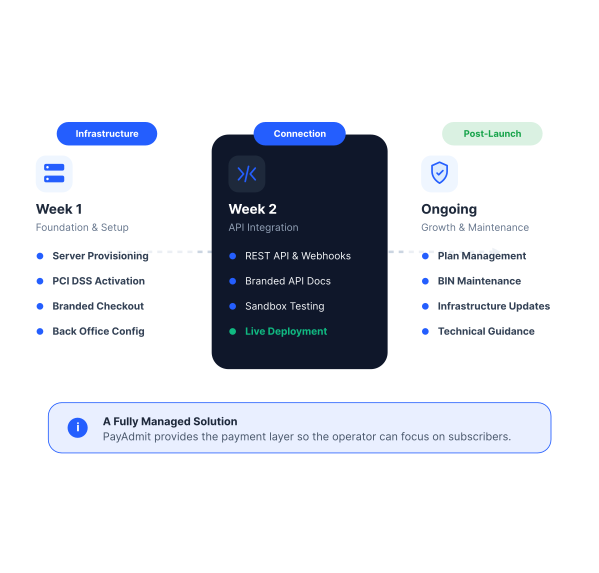
The white label solution deploys in one to two months, covering dedicated infrastructure, billing configuration, and setup. PayAdmit provides a fully managed solution. PayAdmit handles server provisioning and PCI DSS activation in the first week. Branded checkout pages deploy on the operator’s domain. Subscription plan configuration builds in the back office, plans, billing schedules, trial periods, and dunning rules configure before the first live subscriber.
In the second week, the operator’s team connects via the REST API for subscription creation, plan assignment, and webhook configuration. API documentation carries the operator’s brand. PayAdmit provides integration documentation and continues to provide ongoing support. PayAdmit continues to provide technical guidance throughout the engagement. Sandbox testing confirms billing logic before the deployment goes live.
After launch, the business manages plans, subscribers, and billing configuration from the back office. PayAdmit provides the payment layer, provides BIN maintenance, and provides infrastructure updates throughout the engagement. New billing models, usage-based billing, or plan configuration available on request.

The white label payment gateway stores tokenized card data after the initial subscription sign-up. On each renewal date, the billing platform processes the scheduled transaction against the stored card token. No subscriber action is required for regular billing. The operator receives a payment webhook for each billing event, and payment records update automatically on the platform. Every payment event, every payment outcome, triggers the appropriate workflow. The gateway handles the full subscription transaction lifecycle without manual intervention.
Yes. The white label solution supports custom billing frequency configuration per plan. The platform operator defines billing intervals. Trial periods, free billing windows, and custom mid-cycle charge adjustments are all configurable on the platform. Flexible billing schedule logic runs within the same deployment without additional development. Custom billing features are available on request as part of the service.
The software triggers the configured dunning sequence. Retry logic applies per failure code. Subscriber notifications send at configurable dunning stages under the operator’s brand. If the payment does not recover within the dunning window, the operator can apply its own management logic, pause, cancel, or flag a payment account for manual follow-up. The operator defines the outcome; the software executes the process. The gateway ensures every failed transaction follows the configured recovery path without requiring platform-side intervention.
Yes. The white label gateway solution supports multiple tiers and currencies, it scales with the operator. Each plan operates independently with its own billing frequency, currency, and schedule. The operator can provide subscribers in different markets with locally-priced options, provide billing in their local currency, and provide settlement reporting in the base currency automatically. The platform handles multi-currency card billing natively, with no additional software configuration required per market.
All card payment data tokenizes at initial sign-up through PayAdmit’s certified payment environment. Raw card numbers never touch the operator’s infrastructure, the platform never stores or processes raw card data directly. The card token provides the reference for all future billing transactions. The operator’s PCI DSS scope is minimized, card data management is handled within PayAdmit’s dedicated, certified environment. Data is isolated in a secure, dedicated environment with secure access controls. The gateway manages the full card data lifecycle on the operator’s behalf.
Full deployment, dedicated infrastructure, PCI DSS activation, branded checkout on the operator’s domain, payment software configuration, plan setup, and dunning logic, takes one to two months. PayAdmit provides a fully managed gateway solution with all billing software pre-configured for the operator’s platform. PayAdmit provides integration documentation, continues to provide technical guidance, and provides ongoing support throughout the engagement.


