


Routing needs to reflect the eCommerce context, BIN data, amount, customer geography, and live PSP performance data and transaction context factor into routing decisions. A routing engine that ignores this context delivers suboptimal results across the operator’s transaction mix. Smart routing is a prerequisite for payment performance in eCommerce, not a premium option.
White Label Payment Gateway for eCommerce
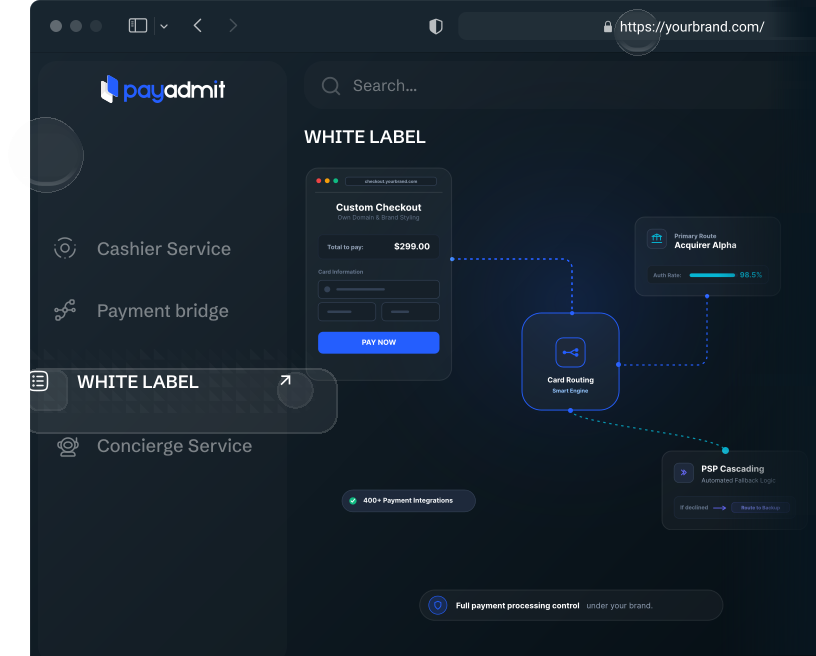
Custom checkout. Card routing. PSP cascading. Full payment processing control under your brand.
ECOMMERCE BUSINESSES LIVE AND DIE BY CHECKOUT CONVERSION.
Every friction point in the payment flow, a redirect to a third-party payment page, an unfamiliar service at card entry, a failed transaction with no cascade recovery, costs revenue directly. Payment experience is not backend infrastructure. For eCommerce operators, it is a front-line conversion driver.
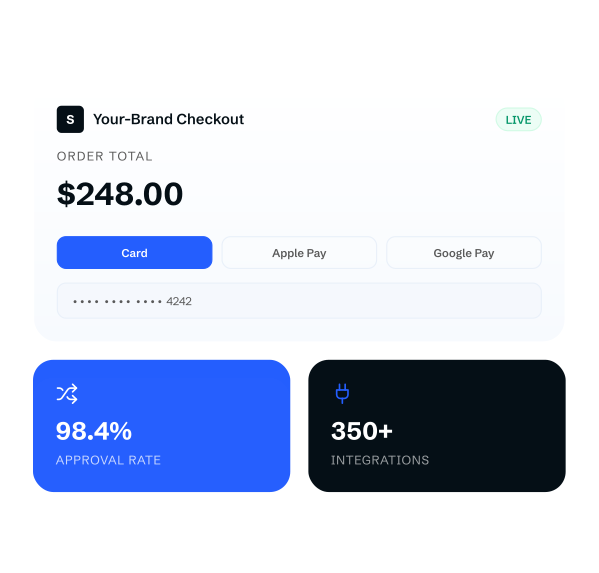
PayAdmit provides a white label payment gateway for eCommerce: a fully branded payment layer the operator deploys under its own identity. Custom checkout pages on the operator’s domain. Smart card routing with real-time PSP cascading. A merchant management back office the operator’s team controls directly. And 550+ payment integrations available from day one, every integration active from deployment, without a single PSP connection built in-house.
International e-commerce operators improve checkout conversion by offering dynamic currency conversion at the buyer side, with the gateway handling the currency mapping and settlement reconciliation automatically.
What eCommerce Payment Infrastructure Demands
Payment flows for online storefronts have different requirements from brick-and-mortar acceptance, and a white label solution is what eCommerce operators need to meet them. The volume of transactions, the diversity of payment methods shoppers expect, the global distribution of card networks, and the direct relationship between checkout UX and conversion outcomes all create demands that generic payment services handle poorly.

An eCommerce service that redirects customers to a third-party payment page at card entry breaks the brand continuity that builds checkout confidence. The white label payment solution keeps the buyer on the operator’s domain throughout the checkout flow, with custom CSS, the operator’s typography, and branded confirmation pages. This is the core advantage of a dedicated payment solution.

When a payment fails at the first PSP, losing the order is not acceptable. The cascading engine routes to the next configured provider within the same session. The operator captures every recoverable payment transaction. The buyer completes the purchase seamlessly. Cascading is a baseline requirement for any serious eCommerce payment service.

A white label payment gateway for an eCommerce platform needs to support multiple accounts, each with its own custom routing logic, processing limits, payment method configuration, and settlement schedule. The operator manages the full account network from one admin panel. A white label solution addresses this at every layer of the eCommerce payment stack.
eCommerce Segments That Use White Label Payment Processing

Multi-tenant eCommerce businesses, from vertical marketplaces to general-purpose storefronts, need a white label payment solution that handles per-merchant routing, per-merchant processing limits, and per-merchant settlement. The eCommerce operator becomes the service provider for its merchant network. Each account onboards through the operator’s branded portal and processes transactions under the white label service. The eCommerce platform earns a platform processing fee on every payment transaction.

Merchants building a branded checkout experience need a payment gateway that keeps the payment flow native to the operator’s domain. Branded entry pages, confirmation emails, and receipt design are all within the solution’s configuration scope. The merchant provides customers with a secure, custom payment experience without building secure payment infrastructure independently.

Operators selling across multiple markets need a payment solution that handles multi-currency processing, automatic currency conversion before transaction routing, and PSP selection optimized per network and geography. The white label payment gateway connects to networks and PSPs across regions, routes each eCommerce transaction through the optimal path, and converts currencies automatically before settlement.

SaaS tools built for online stores, storefronts, product management, or order processing, that want to embed a white label payment service as a core product feature need a payment gateway with a developer-friendly integration layer. The REST API and webhook integration let the SaaS operator embed payment processing natively, surface transaction data within the product, and offer merchants a white label service without building payment infrastructure independently.
Losing sales to declined payments?
Checkout Design as
a Conversion Lever
In eCommerce, checkout design directly affects payment conversion. The service that gives eCommerce operators control over their checkout entry experience gives them a measurable business advantage.
PayAdmit’s payment gateway provides full checkout configuration. The operator designs the payment page to match the eCommerce storefront, same typography, same color system, same button styles. Entry fields, payment method selection, and the order summary display are all configurable through the platform’s CSS configuration layer, giving the platform full visual control.
Important: eCommerce brands needing tailored integration work can pair the platform with PayAdmit’s fintech software development services for bespoke functionality beyond standard configuration.
Checkout configuration extends beyond visuals. The payment flow itself is configurable, one-step, multi-step, guest checkout, registered-account payment, and flexible donation or subscription entry for specific eCommerce models. The operator sets the checkout architecture. PayAdmit’s solution provides the secure white label payment platform layer underneath.
Mobile-responsive layout is standard in the white label solution. Payment transactions increasingly originate on mobile. A custom checkout that renders correctly on mobile, handles Apple Pay and Google Pay natively, and keeps the payment experience consistent across device types is not optional for eCommerce operators at scale.
White Label eCommerce Payment Gateway, Feature Mapping
| eCommerce Requirement | What the White Label Solution Provides |
|---|---|
| Custom branded checkout | CSS config, domain setup, mobile-responsive layout, branded confirmation pages |
| Smart payment routing | Real-time routing by BIN, geography, amount, and live PSP approval statistics |
| PSP cascading | Auto-cascade on failed payment, configurable sequences per account |
| 550+ payment integrations | Card networks, digital wallets, APMs, crypto, active from deployment |
| Merchant portal | White label portal per merchant, reports, settlement, and routing config |
| Processing volume controls | Per-terminal, per-account processing volume controls with auto-deactivation |
| Anti-fraud service | Velocity limits, BIN blocking, ZignSec and Kount integration |
| Recurring payment service | Tokenized card storage, scheduled billing, retry logic |
| Multi-currency processing | Currency conversion before routing, settlement in base currency |
| API and webhook integration | REST API for payment initiation, webhooks for real-time events |
| Settlement reporting | Per-merchant reports, reconciliation exports, portfolio analytics |
From Contract to Live Checkout in 1–2 Months
Deploying the white label payment gateway for an eCommerce platform is a three-stage process. The operator goes from contract signature to live payment transactions in 1 to 2 months.
1
Infrastructure
and Custom
Configuration
(Days 1–10)
PayAdmit provisions dedicated server infrastructure for the white label payment gateway. PCI DSS certification activates for the dedicated environment. The custom checkout pages deploy on the platform’s domain with the operator’s brand applied. Initial card network integrations, card processing connections, and PSP connections activate. The routing ruleset builds to the operator’s specifications.
2
Merchant Onboarding and Integration
(Days 10–18)
The operator connects the gateway to its product via the REST API. Accounts configure in the back office. Each account receives a payment profile, processing limits, and portal access. The integration layer tests across order types, amounts, and PSP connections. Webhook delivery verifies against the operator’s backend.
3
Launch and Ongoing Service
The eCommerce deployment goes live. Transactions process through the white label payment gateway. Merchants manage their data through the custom portal. PayAdmit provides ongoing maintenance, network integration updates, BIN database refreshes, and 24/7 support. New integrations or tailored features are delivered on request.
The Business Case for White Label Over Standard Gateway Integration
The case for a white label eCommerce payment gateway comes down to three factors: brand, control, and revenue.

A white label payment service keeps the operator’s identity intact throughout the payment flow. Customers never encounter a third-party payment brand. The operator’s brand carries through every payment transaction confirmation and receipt. This continuity builds checkout confidence and reduces abandonment at the checkout step.

The operator sets the routing rules, the cascading sequences, the processing limits, and the anti-fraud configuration. The operator manages merchants and accesses settlement data from its own back office. Configurable checkout design, flexible payment flow logic and integration architecture are all within the operator’s control, not gated behind a third-party provider’s roadmap. That is what the solution delivers.

An eCommerce platform operator running a white label payment service earns processing income on every payment transaction processed through. The white label operator becomes a white label payment service provider for its merchant network. For an eCommerce operator with a large account network, service income compounds as revenue grows, independent of subscription or platform fee revenue.
EXPLORE SOLUTIONS FOR OTHER INDUSTRIES
Banks

Expand your digital payment offering with a branded gateway.

Donations
Accept donations in any currency through a trusted, fully branded checkout experience.

PSP
Launch your own processing product and grow your merchant portfolio under your brand

SaaS
Embed native payments into your platform and turn processing into a revenue stream.

eCommerce
Full control over checkout, routing, and payment data with 550+ methods ready from day one.

Marketplace
Process split payments and manage payouts across your entire merchant base from one platform.

Subscriptions
Automate recurring billing, manage retries, and reduce churn with a purpose-built payment engine

Travel
Handle multi-currency bookings and global payment methods through one branded gateway.

Frequently Asked Questions
What makes a white label payment gateway right for eCommerce?

eCommerce payment processing requires checkout control, real-time routing, PSP cascading, and multi-account architecture, capabilities that generic payment services provide only partially. A white label payment gateway gives the eCommerce platform operator full control over every layer: checkout design, routing logic, account management, and settlement. This is what a white label solution provides, the payment experience is native to the operator’s platform, not bolted on from a third-party service.
How does transaction routing work in the white label eCommerce payment gateway?
The routing engine evaluates each payment transaction against configurable parameters: BIN, currency, amount, customer geography, account risk profile, and live PSP approval statistics. The gateway routes each transaction to the provider with the best approval rate for that combination. Provider weights update from live transaction data, routing reflects live performance rather than static configuration.
Can the operator use its own custom checkout design?
Yes. The white label payment gateway provides full CSS configuration for the checkout payment page. The operator applies its own typography, color system, layout, and brand elements. Entry fields, payment method selection, and the order summary display are all configurable. The checkout deploys on the operator’s domain, customers stay in the operator’s environment throughout the payment transaction.
What payment methods and card networks does the solution support?
The white label eCommerce payment solution connects to Visa, Mastercard, Amex, JCB, and UnionPay card networks for card acceptance. Digital wallet integration covers Apple Pay, Google Pay, and PayPal. 550+ alternative payment methods cover regional preferences globally. Cryptocurrency processing is available as an additional integration. The operator activates payment method coverage per merchant or per market from the back office.
How does the gateway handle failed payment transactions?
When a payment fails at the first PSP, the cascading engine automatically routes to the next configured provider within the same checkout session, without interrupting the customer. Cascade sequences and fallback logic are configurable per account. Transaction approval rates and cascade performance are visible from the back office. No sale is lost due to a single PSP failure.
Is the white label payment gateway PCI DSS compliant?
Yes. The white label eCommerce payment gateway runs on dedicated infrastructure with its own PCI DSS certification. Card data does not pass through the operator’s application, it processes within PayAdmit’s certified environment. The operator’s PCI DSS scope is minimized. This protects the platform. PayAdmit manages PCI DSS certification, security monitoring, and the cardholder data environment on the operator’s behalf.