

Payment methods
The cards, wallets, bank rails, and alternative methods customers in each market actually trust and use every day.
Reach more customers in every market you serve. PayAdmit's localization engine adapts your checkout to each region: local payment methods, local currencies, local language, local compliance. Your conversion rates stay high wherever your customers are.
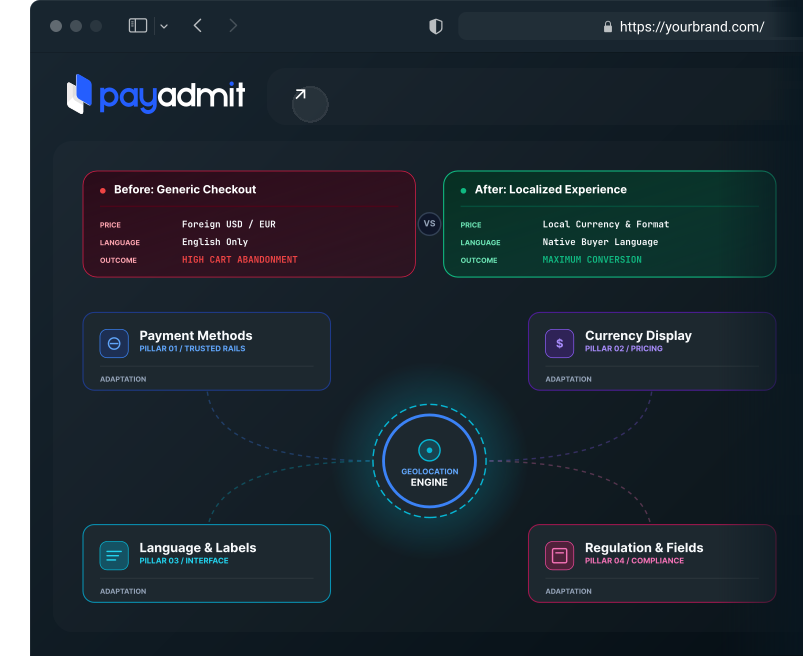
The same buyer, the same product, the same price in two checkouts. The difference is whether your store speaks the buyer’s money, language, and payment habits. With dynamic currency conversion, the buyer sees the price in the currency printed on their own card. Compare what foreign customers see when they reach a generic checkout versus a localized one.


Foreign buyers do not abandon checkouts because the price is too high. They abandon because the price is in the wrong currency, the language is unfamiliar, the payment methods feel foreign, and the form asks for the wrong fields. Localization fixes all four at once.
Payment localization is not one switch you flip. It is four independent dimensions that all need to be adapted for each market you serve. Miss one, and the others lose their effect.
The cards, wallets, bank rails, and alternative methods customers in each market actually trust and use every day.

Prices shown in the local currency the buyer thinks in daily, with the right formatting, separators, and decimal conventions.

The checkout interface, field labels, button copy, and error messages translated into the buyer’s primary language.

Local tax identifiers, regional compliance disclosures, and required form fields that match what the market actually expects.
Translation alone is not localization. A translated checkout still loses foreign buyers if it shows the wrong currency and does not accept the payment methods buyers trust in their home market. Real localization adapts every pillar at once.
Card networks dominate the headlines. Local payment methods dominate the conversions. PayAdmit’s localization engine connects to the methods that move money in each region, not just the global brands, routing them all through one payment bridge.

Strong bank-rail preference

Instant payments & cash vouchers

Mobile wallets and QR codes

Emerging digital infrastructure

Cards-first with wallet adoption

Real-time bank transfers
Tell us which countries you want to reach. We map the payment methods, currencies, and
compliance fields that matter for your buyers in each market.

Local payment methods can be integrated one by one. Currencies can be handled by a separate provider.
Translations can be outsourced to a translation agency. Or all four pillars can run inside one platform that already knows how they connect, which is exactly what you get when you create a payment gateway built for your brand.
Local methods across Europe, LATAM, APAC, MEA, and beyond accessible through a single integration, not a separate contract per region, and surfaced to each buyer in the cashier payment system for their market.
The right payment methods, currency, and language presented automatically based on the buyer’s location and card BIN.
Tax identifier fields, regulatory disclosures, and data-residency settings configured per market. Our team handles the compliance research for you.
A named account manager helps you prioritise markets, sequence rollouts, and avoid the common mistakes of cross-border launches.
One platform replaces four vendors. Methods, currency, language, and compliance all run on PayAdmit. One contract covers every market, with regional integrations maintained centrally by our team.
The business case for localization shows up in three places on every monthly report: conversion rates, average order values, and customer lifetime value. Each one moves in the right direction when the checkout matches the market.

Foreign buyers convert at noticeably higher rates when prices, language, and payment methods match what they expect. Cart abandonment drops the moment unfamiliar friction disappears. For more on lifting approval and conversion at the payment step, read our guide to smart routing and cascading.

Localized checkouts retain customers through the final payment step. Buyers no longer pause at currency confusion, language friction, or missing payment options.

Customers who pay in their local currency, in their language, with their preferred method return more often. Localization is the foundation of cross-border brand trust.
The compounding effect makes the case. Every additional buyer who completes checkout becomes a potential repeat customer. Every repeat customer reduces the cost of the next acquisition. Localization is the input that scales everything downstream.
Many merchants think they have localized their checkout because they translated the interface. The buyer experience tells a different story. Real localization changes the whole transaction, not just the words on the page.
Any business with cross-border buyers benefits, but six categories see the most direct,
measurable impact from full localization.
Three operational patterns where activating full payments localization changes the math noticeably within the first reporting cycle.
If analytics show meaningful foreign visitor volume but stubbornly low conversion rates from those markets, localization is almost always the missing input. Buyers reach the checkout but cannot finish it.
Planned market entry deserves a checkout that matches the market on day one. Launching with a US-centric flow into Brazil, Germany, or Japan wastes the marketing spend that drove buyers to the page.
When approval rates drop on foreign-issued cards, the issue is rarely the buyer. It is usually a combination of currency mismatch, missing tax fields, and the absence of local methods that buyers trust more than their cards.
A short walkthrough with our team: we mock up your checkout with full localization for the market you want to expand into, and show what changes on the buyer experience and the approval side.
The full feature set ships with every PayAdmit localization activation. Every capability listed below works on day one, with all features included in the base service.

Access to local payment methods across major markets, including bank rails, mobile wallets, vouchers, and country-specific schemes presented in their native context.

Prices shown in the buyer’s home currency with correct number formatting, separators, and decimal conventions per market.

Checkout interface, button copy, field labels, and error messages translated into the languages spoken in your target markets.

Tax identifiers (CPF, VAT, GST, PAN, NIE), regional disclosures, and required form fields configured per market on every checkout.

The right currency, language, and payment methods presented automatically based on the buyer’s IP geolocation and card BIN country.

Each market has its own configuration profile: methods, currency, language, and compliance settings tuned independently for each region.

The choice of local payment methods depends on the audience, the geography, and the transaction volume from each market. The right approach is data-driven: study where your buyers come from, which payment methods dominate in those regions, and how your decline rates and abandonment patterns vary by country.
The PayAdmit team helps map the methods that matter most for your specific market mix during the discovery call.
Localizing transactions helps businesses build market loyalty, reduce checkout abandonment, enhance approval rates, and comply with regional regulations. The cost of a generic checkout in a foreign market is invisible on the dashboard but very real in the monthly revenue numbers.
Localization turns foreign visitors into customers who feel like they are buying from a local brand.
Card networks (Visa, Mastercard) dominate in most countries by absolute volume. Bank transfers and digital wallets are also widely used, often surpassing cards in specific regions.
The preferences vary significantly: PIX dominates in Brazil, iDEAL in the Netherlands, UPI in India, Alipay and WeChat Pay in China, Apple Pay and Google Pay everywhere. Each country has preferences that need to be considered when approaching the buyer.
Currency conversion is a major part of payment localization. International customers should clearly understand the cost of their purchases. Merchants offering prices in the buyer’s home currency reduce confusion at checkout and increase the frequency of successful transactions.
PayAdmit’s localization engine handles currency display, exchange rate sourcing, and the conversion process inside the unified payment flow.
It involves market research to assess the audience and its current preferences, language and content adaptation so the brand resonates with the target audience, and technical adjustments so the product or service functions correctly in each region.
Quality assurance maintains accuracy and cultural relevance through testing on the buyer side of the checkout, not just the technical side.
It allows buyers to check the final amount and pay in their familiar currency. This provides a more transparent shopping experience. It also helps avoid confusion over exchange rates or foreign transaction fees that can distract buyers and lead to checkout abandonment at the final step.
Cost depends on transaction volume, target markets, and specific configuration requirements. Translation, regional payment method enablement, and compliance configuration each carry different scopes depending on the market mix.
For a quote tailored to your specific market expansion plan, contact the PayAdmit team and we will scope the engagement during discovery.
To maintain relevant local payment methods over time, merchants should continuously update the payment configuration as regional preferences shift, monitor performance per method and per market, gather buyer feedback on the checkout experience, and apply consistent security measures across every region.
The PayAdmit team handles the ongoing method library updates as new local payment options launch in your markets.
Start with the markets that already send you traffic but underperform on conversion. Layer in the markets where you have explicit expansion plans. The roadmap should reflect the markets your team can support operationally, not just the ones with the largest opportunity on paper.
Your PayAdmit account manager helps sequence the rollout based on real impact and operational readiness.
The popular methods vary significantly by region. In Europe: SEPA Direct Debit, iDEAL (Netherlands), Bancontact (Belgium), Sofort, Multibanco (Portugal), Blik (Poland). In Latin America: PIX (Brazil), Boleto, OXXO (Mexico), SPEI, PSE (Colombia). In Asia Pacific: UPI (India), Alipay and WeChat Pay (China), PayNow (Singapore), PayID (Australia).
The Regional Methods catalogue above shows the full picture across six world regions.
If your checkout already runs on the PayAdmit gateway, localization activates as a simple configuration. Methods, currency, language, and compliance fields surface based on the buyer’s location.
For merchants on third-party checkouts, the integration scope is confirmed during the initial conversation.
Yes. Localization is configured per market, so you can start with the markets where the business case is clearest and add new regions as you grow. Each market has its own configuration profile (methods, currency, language, compliance), so adding a market does not affect the ones already live.

