

Running a marketplace is not the same as running a single-seller business. A marketplace business does not sell one product or operate like a single business, it connects buyers with dozens, hundreds, or thousands of sellers. Every payment transaction that flows through a marketplace involves at least two parties: the buyer paying and the seller getting paid. This is the core of the marketplace business model.
White Label
Payment Gateway
for Marketplace
Split payments. Vendor payouts. Multi-merchant routing. The full marketplace payment cycle under your brand.

THE MARKETPLACE PAYMENT CHALLENGE

This split between payment collection and distribution is where most standard payment gateways break down, because standard payment processing is designed for one seller, one account, one settlement destination.
Built for Marketplace Operators
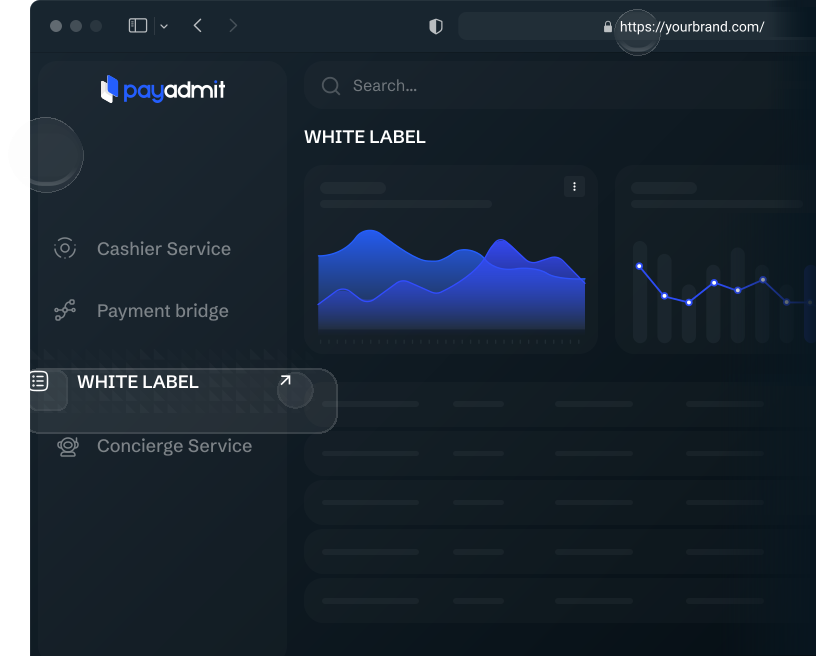
PayAdmit provides a white label payment gateway, a complete solution, built for marketplace operators.

The gateway handles the full payment cycle: buyer payment collection, routing, account management, split payment logic, and payout distribution, all under the operator’s brand.

The payment processing layer runs on dedicated infrastructure, operating under the operator’s own PCI DSS certification, and integrating through a developer-ready API and full integration layer.

No third-party payment brand appears anywhere in the operator’s branded payment flow. Every payment processing decision, routing, cascading, settlement, executes under the operator’s control.
Unified Infrastructure.
Universal Scaling.

For any operator, from early-stage B2B platforms to enterprise multi-merchant storefronts, the solution provides the same infrastructure.

Every merchant account gets independent payment configuration. Every buyer sees a branded checkout. Every seller gets payouts through the branded portal.

PayAdmit continues to provide the complete technical payment processing infrastructure that makes this service possible.
Control Your Payment Destiny
The business controls its payment destiny, and continues to provide a competitive payment service to buyers, merchants, and sellers without depending on a third-party brand.
Request Demo
THE PAYMENT ARCHITECTURE PROBLEM FOR MARKETPLACE PLATFORMS
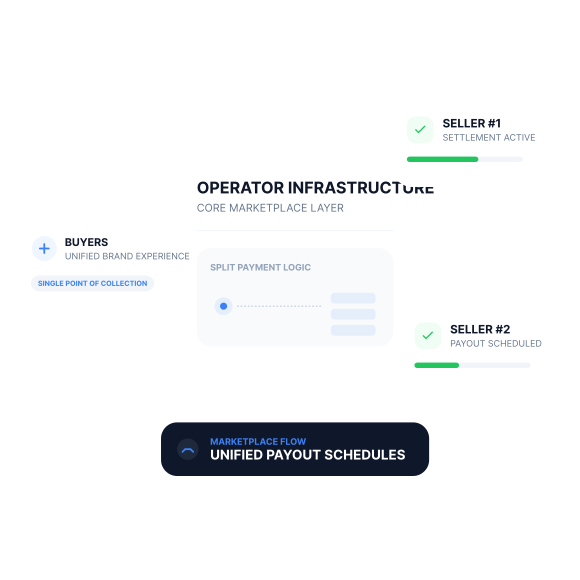
Most payment gateways are built for a single seller collecting money. An operator collecting on behalf of multiple sellers and distributing creates a payment architecture problem that single-seller gateways cannot handle cleanly.
The standard workaround, having sellers connect individual payment accounts and route buyer payments directly, creates fragmented payment experiences, inconsistent checkout design, and an operator that has no unified view of transaction volume, seller performance, or settlement status.
A purpose-built white label solution solves this at the infrastructure layer, and this solution operates as the operator’s own payment infrastructure from day ONE. It is the right fit for a marketplace of any size. The operator becomes the single point of collection. All buyer transactions route through the white label gateway under the operator’s brand. Seller accounts sit within the operator’s infrastructure. Split payment logic and payout schedules run from ONE back office.
Who Uses PayAdmit’s White Label Marketplace Payment Gateway
Payment architecture varies significantly across marketplace business models. Not every marketplace business has the same payment architecture or the same business needs. Understanding the business model is the starting point for any marketplace operator.
Multi-seller product marketplaces, platforms connecting business buyers and consumers with multiple vendors, need a white label payment solution that handles per-merchant routing, per-merchant processing limits, and per-merchant settlement. The operator becomes the service provider for its merchant network. Each merchant account onboards through the operator’s branded portal and processes transactions under the white label service. The operator earns a platform processing fee on every payment transaction.
A service platform business needs escrow-style holding, event-triggered release, and dispute management. The white label solution supports configurable payment hold periods for service platform businesses, partial release logic, and dispute-triggered payment suspension, all managed from the back office. Platforms connecting business buyers with service providers need a payment gateway that fits their business model — and allows the business to scale.
B2B marketplace business platforms, where business buyers transact with business sellers in business-to-business high-value transactions, need a white label payment gateway with enterprise method coverage, high-value transaction handling, and detailed settlement reporting. These B2B business payment and settlement flows often involve invoice-triggered payment, multi-currency settlement, and seller payment terms that require custom payout schedule configuration.
Marketplaces selling digital goods, software, subscriptions, or content need a white label payment gateway with recurring payment processing, tokenized card storage, and instant delivery confirmation tied to completion status. The integration between completion event and delivery trigger is a core requirement that PayAdmit’s API and webhook infrastructure provides natively.
Split Payments —
How the Payment Architecture Works
The Split
Logic
1
Every payment transaction involves a split: the operator takes a commission, and the seller receives the remainder. How that split is calculated, when it is applied, and how it flows into settlement determines the entire seller payment experience.
Automatic Application
2PayAdmit’s gateway provides configurable split payment logic at the transaction level. The operator defines the commission structure, fixed fee per transaction, percentage-based split, tiered commission by seller category, or account-specific. The gateway applies the split automatically at transaction time. No manual calculation or reconciliation is required.
Payout
Schedules
3
Payout schedules are equally configurable. The operator sets payout frequency, daily, weekly, monthly, or event-triggered, per seller or per segment. Each seller sees their pending balance, upcoming payout date, and payout history through the branded portal on the operator’s domain. The finance team accesses consolidated settlement data and per-seller reconciliation exports from the back office. For operators handling international transactions, the payment gateway applies currency conversion before routing so buyer currency, base currency, and seller payout currency can all differ.
Managing Sellers Inside the White Label Payment Gateway
Managing dozens or hundreds of sellers through the back office is a core operational requirement for any multi-merchant platform. PayAdmit’s payment solution provides a full merchant management layer for the operator.

Merchant seller accounts are created and managed from one admin panel, with full visibility. Each merchant account owner sees their own merchant data and transaction reports, without visibility into other merchant accounts, and each merchant within the operator’s network needs independent merchant-level configuration. The operator assigns routing rules, sets processing limits, and configures payout parameters per account.

Sellers access a dedicated branded portal on the operator’s domain. Each merchant account holder sees their own merchant transaction reports, settlement summaries, payout schedules, and payment statistics. The portal runs under the operator’s brand. Sellers interact with the operator’s service, not with PayAdmit. When a seller’s volume exceeds configured thresholds, the system automatically applies limit controls and notifies the operations team.
Unified Infrastructure.
Universal Scaling.

A product platform business needs split payment logic, multi-merchant management, and payout management for every merchant.

A service platform needs escrow-style holding, event-triggered release, and dispute management.

A B2B platform business needs high-value transaction handling and enterprise method coverage.

A digital content platform needs instant delivery confirmation tied to completion status.

What the White Label Gateway Includes for Marketplace Operators
| Component | What the Marketplace Gets |
|---|---|
| Branded buyer checkout | Custom checkout on operator domain, CSS config, mobile-responsive, branded confirmations |
| Split payment engine | Commission rules per seller, auto-split at transaction time, configurable tiers |
| Vendor payout management | Configurable payout schedules, bulk payouts, automated retry, seller portal access |
| Seller merchant portal | White label portal per merchant account, reports, settlement, routing config |
| Multi-currency processing | Currency conversion before routing, multi-currency settlement, vendor payout currency config |
| Payment routing engine | Real-time routing by BIN, geography, amount, and live PSP approval statistics |
| PSP cascading | Auto-cascade on failed payment, configurable sequences per seller category |
| Anti-fraud service | Velocity limits, BIN blocking, ZignSec and Kount integration at transaction + account level |
| 550+ payment integrations | Card networks, digital wallets, APMs, crypto, every integration active from deployment |
| REST API + webhooks | Full integration layer: payment initiation, payout, refund, real-time event delivery |
| Settlement reporting | Per-merchant reports, portfolio analytics, reconciliation exports |
Payment Routing and
Approval Rate Optimization
Marketplace payment flows involve a wider diversity of transaction types than single-seller business models. This diversity means routing decisions have a larger impact on approval rates, and those differences compound across a large seller network.
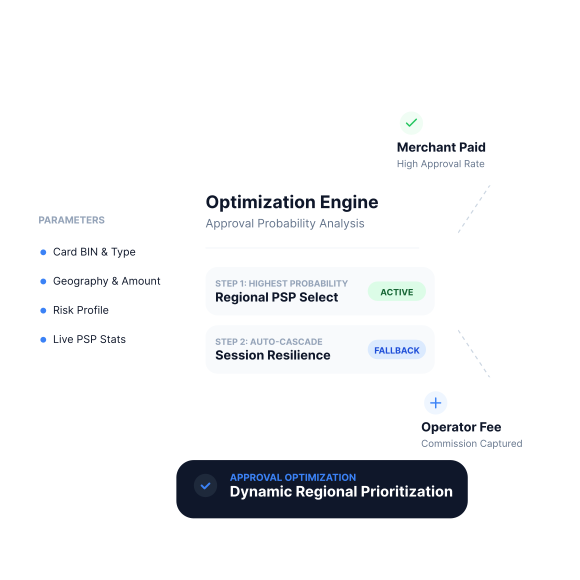
PayAdmit’s routing engine evaluates each buyer transaction against multiple parameters: card BIN and card type, currency and amount, buyer geography, account risk profile, and live PSP approval statistics. The routing engine selects the PSP with the highest approval probability for that specific context. When a payment fails at the selected PSP, the gateway cascades automatically to the next configured provider within the same session. The buyer does not restart. The merchant seller receives the payment. The operator captures the merchant commission.
For marketplace businesses processing across multiple geographies, PSP prioritization by region is critical. A PSP with strong approval rates for European transactions may underperform for Asia-Pacific payments. The white label routing layer handles this per-transaction without requiring manual configuration updates
Build vs. Deploy, The Marketplace
Payment Infrastructure Decision

Building this infrastructure in-house, split payment logic, multi-account management, PSP integrations, PCI DSS certification, and payout management, is a significant technical and financial commitment. Most marketplace business operators, whether consumer-facing or B2B, that have attempted the build route find the real cost exceeds the initial estimate by a wide margin.

The scope of a full build includes: dedicated server infrastructure, PCI DSS certification and maintenance, routing engine development, split payment logic, seller portal development, individual PSP integrations, anti-fraud tooling, settlement and reconciliation systems, and ongoing maintenance. The typical timeline before the first live transaction is 18 to 24 months. The typical cost is $500,000 to $1,000,000 for the MVP alone.

PayAdmit’s white label solution delivers all of this on dedicated infrastructure in 1 to 2 months, as a complete, ready-to-deploy solution. The operator provides the brand, the vendor network, the commercial terms, and the vendor portal identity. Each vendor account belongs to the operator’s infrastructure. PayAdmit provides the technical vendor payment infrastructure, continues to provide PSP updates, provides BIN maintenance, and will continue to provide the full payment infrastructure stack throughout the engagement.
EXPLORE SOLUTIONS FOR OTHER INDUSTRIES
Banks

Expand your digital payment offering with a branded gateway.

Donations
Accept donations in any currency through a trusted, fully branded checkout experience.

PSP
Launch your own processing product and grow your merchant portfolio under your brand

SaaS
Embed native payments into your platform and turn processing into a revenue stream.

eCommerce
Full control over checkout, routing, and payment data with 550+ methods ready from day one.

Marketplace
Process split payments and manage payouts across your entire merchant base from one platform.

Subscriptions
Automate recurring billing, manage retries, and reduce churn with a purpose-built payment engine

Travel
Handle multi-currency bookings and global payment methods through one branded gateway.

FREQUENTLY ASKED QUESTIONS
How does the white label payment gateway handle marketplace split payments?

The split payment engine applies commission rules at transaction time. The operator defines the commission structure, fixed, percentage, tiered, or account-specific. The gateway calculates the operator commission and the vendor payout amount automatically with each transaction. Vendor payout schedules run on a configurable timeline. The operator manages split rules and payout configuration from the back office without developer involvement.
Marketplaces with unusual multi-party flow requirements can engage PayAdmit’s fintech development team for custom logic on top of the core platform.
Can the marketplace manage hundreds of accounts within the white label gateway?
Yes. The white label payment solution supports unlimited seller accounts under one marketplace deployment. Each account is independently configurable, routing rules, processing limits, payout schedule, and portal access. The operator creates and manages merchant seller accounts from one admin panel. Each seller accesses their own portal with their own payment data. The solution scales with the seller network without additional infrastructure.
What payment methods can buyers use on a marketplace powered by the white label gateway?
The white label gateway supports card payments, Visa, Mastercard, Amex, JCB, and UnionPay for merchant card acceptance globally, covering every major merchant method, plus Apple Pay, Google Pay, PayPal, and 550+ regional alternative payment methods. Cryptocurrency payment processing is available as an additional integration. The operator activates the methods relevant to its buyer base and geography from the back office.
How does the white label solution handle failed payment transactions?
When a buyer payment fails at the first PSP, the cascading engine automatically routes to the next configured provider within the same checkout session. The buyer does not need to restart the payment. The operator captures the transaction. PSP cascade sequences are configurable per seller category. Approval rates and cascade performance are monitored from the back office dashboard.
Is the white label marketplace payment gateway compliant with PCI DSS?
Yes. The white label payment gateway runs on dedicated infrastructure with a PCI DSS certification specific to the operator’s environment. Card data processes within PayAdmit’s certified environment, it does not pass through the operator’s application layer. PCI DSS maintenance, security monitoring, and cardholder data environment management are handled by PayAdmit. The operator’s compliance scope is minimized.
How long does it take to deploy the marketplace payment gateway?
Full deployment, dedicated infrastructure provisioning, PCI DSS activation, branded checkout configuration, seller portal setup, PSP connections, payment integrations activation, and routing ruleset, takes 1 to 2 months. The marketplace goes live with a production-ready white label payment gateway within the agreed timeline. PayAdmit provides and continues to provide technical support, integration assistance, and ongoing software maintenance throughout the engagement.