

Risk scoring on every transaction. A fraud probability score calculated before the payment is authorised.
Payment Antifraud & Risk Management
Stop fraudulent payments before they hit your books, without blocking the legitimate ones that pay your bills. PayAdmit's antifraud engine scores every transaction in real time, flags risk patterns, and lets you tune the rules that fit your business, not someone else's.
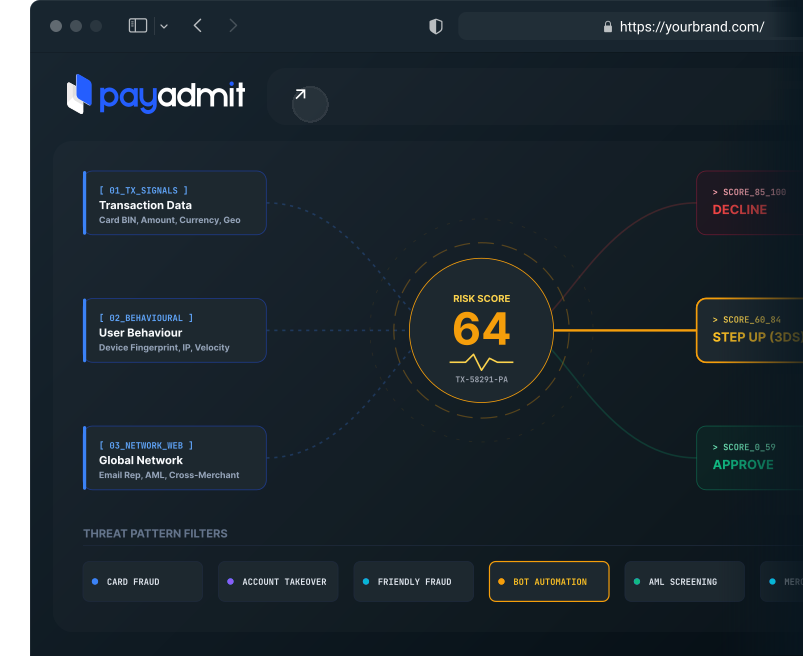
Every Payment Is a Decision.
The Wrong One Costs Twice
Approve a fraudulent transaction and the chargeback lands on your account weeks later, with fees attached. Decline a legitimate one and the customer walks, often for good. Most antifraud tools optimise for one side of that equation. PayAdmit’s engine is built to get both right, combining real-time risk scoring with insight screening so fraud is stopped before it clears without turning good customers away.
The engine is built on four principles:
Configurable rules per business. Tune thresholds, add custom rules, override defaults for your specific patterns.
Three-decision logic. Approve, decline, or step up to additional verification. Not just yes or no.
Full audit trail. Every decision logged with the signals and rules that drove it.
The best antifraud tool is the one your team controls. Black-box engines flag what they want and explain nothing. PayAdmit shows the score, the signals behind it, and the rule that triggered the decision, then lets you change them.
Example decision (transaction TX-58291-PA, risk score 64): card BIN check passed, geolocation mismatch, device fingerprint known, velocity check flagged three attempts in ten minutes, email reputation clean. Action: step up to a 3DS challenge.
Four Steps From Payment Intent
to Safe Authorisation
Every transaction passes through four decision points before authorisation. Each step gathers signals, each signal feeds the risk score, and the score drives the action: a cleared payment is routed on through the payment bridge to the best acquirer, while a risky one is held or declined. No transaction is approved blindly. No transaction is declined without explanation.
Signal capture
Card BIN, geolocation, device fingerprint, IP reputation, velocity, email history, and dozens more signals captured at the moment of payment intent.
Risk scoring
Signals run through your configured rule set and produce a numerical risk score. Each rule contributes a weight, each signal adjusts the total.
Decision logic
The score maps to one of three actions: approve, decline, or step up to 3-D Secure or additional verification. Thresholds tuned per business.
Action and audit
Transaction proceeds or stops based on the decision. The full signal trail is logged for review, dispute response, and ongoing rule optimisation.
Six Fraud Patterns
the Engine Is Built to Catch
Payment fraud is not one problem. It is a category of overlapping patterns, each with its own signals and its own response.
The PayAdmit engine handles them through a unified risk model, with the rules tuned per pattern.

Card fraud
Stolen card details
Cards reported lost or stolen, tested through small purchases before large ones, or used in patterns that match known fraud databases.

Account fraud
Account takeover and synthetic identities
Logins from new devices, fabricated identities built from real and fake data, and accounts created in bulk for downstream abuse.

Friendly fraud
Chargeback abuse
Logins from new devices, fabricated identities built from real and fake data, and accounts created in bulk for downstream abuse.

Bot & automa-tion fraud
Automated attack traffic
Credential stuffing, card testing at scale, and bot-driven checkout abuse. Behavioural signals separate scripts from humans.

Money laundering risk
Suspicious transaction patterns
Transactions structured to avoid reporting thresholds, rapid in-out flows, and patterns that trigger AML screening requirements.

Merchant-side risk
Refund abuse and collusion
Internal refund manipulation, collusion between staff and customers, and refund-claim patterns that drain merchant accounts.
Losing more revenue to false declines than to actual fraud? Tell us about your chargeback rate, your decline rate, and your current rule set. We come back with a baseline review and a configuration that targets both problems at once.
Why Merchants Run
Antifraud Through PayAdmit
Standalone fraud tools exist. So do bolt-on services from generic providers. PayAdmit’s engine is built directly into the payment gateway, which changes what it can see, how fast it decides, and how cleanly it explains itself. When you create a payment gateway built for your brand, the antifraud comes with it, not as a separate integration to wire up.

Decision at gateway speed. Risk scoring runs inside the authorisation flow. The decision is made before the issuer ever sees the transaction.

Rules you can read. Every rule visible in the merchant portal. Edit thresholds, add custom logic, see the impact before going live.

Velocity tracking across the network. Card-testing patterns spotted across multiple merchants on the gateway, not just inside your own traffic.

3-D Secure 2 step-up integrated. Borderline transactions routed to SCA automatically. Liability shifts to the issuer when authentication passes.
One platform, one signal pool. Fraud signals share the same data layer as payment routing and reporting.
No external integrations to maintain, no signal gaps between systems.
What the Engine Evaluates on Every Transaction
The risk score combines three independent signal layers. None of them works alone. Together they give the engine
the context it needs to make a confident decision.
Transaction signals: what this payment looks like
The data inherent to the transaction itself. Card, amount, currency, geography, and the relationships between them. Anomalies surface against historical baselines.

Card BIN and issuer country
Amount versus typical basket size
Currency pair and geographic origin
Time of day and day-of-week patterns
Cart composition and product mix
Behavioural signals: how this customer behaves
The data inherent to the transaction itself. Card, amount, currency, geography, and the relationships between them. Anomalies surface against historical baselines.

Device fingerprint and browser context
IP address reputation and proxy detection
Session journey through the checkout
Typing cadence and interaction patterns
Returning device versus first contact
Network signals: what the wider ecosystem says
The data inherent to the transaction itself. Card, amount, currency, geography, and the relationships between them. Anomalies surface against historical baselines.

Email address reputation
Card velocity across the network
Known fraud database matches
Sanctions and PEP screening
Cross-merchant pattern detection
No single signal triggers a decline. The engine weighs signals against each other and against your configured rules.
One mismatch is noise. Three correlated mismatches is a pattern. The score reflects the difference.
Three Ways Businesses Handle Payment Fraud
Most merchants settle into one of three approaches over time. Each has a profile, each has a real cost.
Only one of them treats fraud as a problem with a measurable solution.

React after
the fact
The default for early-stage merchants. Chargebacks are reviewed weekly or monthly, cards are blacklisted manually after losses, there is no risk scoring on incoming transactions, and fraud cost is treated as a cost of doing business.

Real-time scoring at the gateway
PayAdmit Antifraud & Risk Management. Every transaction is scored before authorisation, rules are configurable and tuned per business pattern, three-decision logic applies (approve, decline, step up), and a full audit trail supports ongoing optimisation.

Bolt on a third-party tool
A separate vendor on top of the gateway. Signal data is fragmented across two systems, external API calls add latency, reporting lives on a separate dashboard, and you carry two contracts, two support queues, and two invoices.
Compliance, Security, and Regulatory Alignment
Antifraud sits at the intersection of card scheme rules, data protection law, and anti-money-laundering frameworks.
PayAdmit’s engine is built to satisfy all three without forcing trade-offs.

PCI DSS Level 1 ready
Card data on every scored transaction processes inside a PCI DSS Level 1 ready environment. Tokenisation handles sensitive data, raw card numbers never touch merchant systems.

3-D Secure 2 step-up
Borderline transactions routed automatically to Strong Customer Authentication. Liability shifts to the issuer on successful authentication, reducing chargeback exposure.

AML screening built in
Sanctions list matching, politically exposed person screening, and anti-money-laundering pattern detection run alongside the fraud signals on every transaction.

GDPR-compliant data handling
Behavioural signal processing follows GDPR requirements on lawful basis, data minimisation, and retention. Audit logs preserved with documented retention windows.

Full decision audit trail
Every fraud decision logged with the signals captured, the rules triggered, and the resulting action. Audit trails support chargeback disputes and regulatory inquiries.

Scheme rule alignment
Decision logic aligned with Visa and Mastercard fraud programmes. Threshold management to stay below scheme monitoring programmes for chargebacks and fraud ratios.
When Antifraud Moves From Nice-to-Have to Urgent
Three operational signals where adding a real fraud engine produces measurable improvement within the first month of operation.
Chargeback rate climbing toward scheme thresholds
Visa and Mastercard run monitoring programmes that escalate when a merchant’s chargeback or fraud ratio crosses defined limits. Once inside a programme, fees rise and exit becomes difficult. Early intervention prevents the spiral, which is why the cashier payment system applies 3-D Secure and step-up authentication at the point of payment, stopping suspect transactions before they ever count against your ratio.
Customer support drowning in dispute work
When the support team spends meaningful time investigating chargebacks, fighting friendly fraud, and refunding contested transactions, the real cost is much higher than the disputed amount. Decision logs and audit trails change the economics.
Decline rates eating into conversion
If legitimate buyers are getting blocked alongside fraudsters, the cost of false declines compounds over time. Tunable rules and step-up logic recover those buyers without lowering the overall risk posture.
Who Benefits the Most
Three operator profiles that consistently see antifraud become a measurable contributor
to both revenue protection and conversion rate.
High-risk verticals: iGaming, betting, and digital goods
Industries where fraud volume is high and scheme scrutiny is constant. The engine handles velocity attacks, account takeover, and friendly fraud while keeping legitimate buyers moving through the checkout.
Network-wide card velocity detection
Account takeover and synthetic identity screening
Threshold management against scheme monitoring
Cross-border ecommerce: merchants selling internationally
Industries where fraud volume is high and scheme scrutiny is constant. The engine handles velocity attacks, account takeover, and friendly fraud while keeping legitimate buyers moving through the checkout.
Geographic risk modelling per market
BIN-based threshold adjustments
3DS step-up routing for borderline cases
Subscription and SaaS: recurring revenue businesses
Industries where fraud volume is high and scheme scrutiny is constant. The engine handles velocity attacks, account takeover, and friendly fraud while keeping legitimate buyers moving through the checkout.
Recurring token monitoring
Subscription chargeback pattern detection
Stolen-card detection on renewal cycles
No single signal triggers a decline. The engine weighs signals against each other and against your configured rules.
One mismatch is noise. Three correlated mismatches is a pattern. The score reflects the difference.
What's Inside the Antifraud Engine
The full feature set ships with every PayAdmit antifraud activation. No add-ons, no per-feature pricing later.
Every capability listed below works on day one.

Real-time risk scoring
Every transaction scored before authorisation. Numerical score with full signal breakdown available per transaction in the merchant portal.

100+ adjustable filters
Pre-built filter library covering card, behavioural, geographic, and velocity signals. Filters can be enabled, disabled, or tuned per merchant configuration.

Custom rule
builder
Build merchant-specific rules without code. Combine signals with AND/OR logic, set thresholds, and assign actions per rule outcome.

Device
fingerprinting
Persistent device identification across sessions. Known-device whitelist for trusted customers, anomaly detection for new device fingerprints on existing accounts.

Geolocation & IP reputation
IP-based geolocation matched against card BIN country, proxy and VPN detection, and reputation scoring against known fraud sources.

Velocity
Monitoring
Card, email, device, and IP velocity tracked across time windows. Configurable thresholds catch card-testing and rapid abuse patterns.

3-D Secure
2 integration
Borderline transactions automatically routed to SCA. Frictionless flow for low-risk, challenge flow for borderline, liability shift on successful authentication.

AML & sanctions screening
Real-time screening against sanctions lists and politically exposed person databases. Patterns matched against money-laundering typologies.

Decision
audit log
Every fraud decision stored with full context: signals captured, rules triggered, score calculated, action taken. Available for chargeback disputes and regulatory review.
The PayAdmit Advantage
Standalone fraud vendors exist. Generic provider plug-ins exist. PayAdmit consolidates antifraud, payment processing,
and reporting into one platform with one team that knows your business.

Native to the gateway
Risk scoring runs inside the authorisation path, not as an external API call. Decisions made in microseconds, with no additional latency added to the checkout flow.

Named risk specialist
Every merchant works with a dedicated risk specialist alongside the account manager. Rule changes, configuration reviews, and incident response handled by people who know your setup.

Network-wide visibility
Patterns spotted across the PayAdmit merchant network feed back into individual configurations. Card-testing attacks blocked on one merchant inform the rules protecting others.

Explainable decisions
No black-box scoring. Every decision includes the signals evaluated, the rules triggered, and the contribution to the final score. Disputes and reviews backed by audit-quality logs.

Proactive monitoring
Anomalies in approval rates, decline patterns, or chargeback ratios surface to the account team automatically. Issues identified before they hit your settlement statements.

Built on PayAdmit core
Antifraud inherits routing, tokenisation, reporting, and compliance from the broader PayAdmit gateway. Same platform reliability, same merchant portal, same support team.
Frequently Asked Questions
How does the PayAdmit antifraud engine actually decide on a transaction?

The engine captures transaction signals (card, amount, geography), behavioural signals (device, session, IP), and network signals (email reputation, velocity, sanctions) at the moment of payment intent. Each signal feeds into the configured rule set. The rules produce a numerical risk score, and the score maps to one of three actions: approve, decline, or step up to additional verification. The decision happens inside the authorisation path of your white label payment gateway software, before the issuer sees the transaction. The full signal trail is logged for audit and dispute purposes.
What kinds of payment fraud does the engine catch?
Six main pattern categories: card fraud (stolen card details), account fraud (takeover and synthetic identities), friendly fraud (chargeback abuse), bot and automation fraud (credential stuffing, card testing), money laundering risk (structured transactions), and merchant-side risk (refund abuse and collusion). Each pattern has its own signal weighting inside the rule set. Configurations can prioritise the patterns most relevant to a specific business.
What does activating antifraud cost?
The antifraud engine is part of the PayAdmit gateway service. There is no separate activation fee. Pricing follows the standard PayAdmit commercial model based on transaction volume and configuration complexity. For most merchants, the chargeback reduction and false-decline recovery from a properly configured rule set pay for the service multiple times over.
Can the rules be tuned for our specific business?
Yes. The pre-built filter library handles common patterns, but the real value comes from tuning. Every merchant works with a risk specialist who configures rules against actual traffic patterns, baseline behaviour, and known fraud vectors specific to the vertical. Custom rules can be added without code through the merchant portal, combining signals with AND/OR logic, threshold values, and per-rule actions.
How does 3-D Secure 2 fit into the decision flow?
3DS2 acts as the step-up authentication for borderline transactions. When the risk score sits in the uncertain zone (neither clearly safe nor clearly fraudulent), the engine routes the transaction to 3DS2 for cardholder authentication instead of declining outright. Successful 3DS2 authentication shifts liability to the issuer for most card-present chargebacks, reducing the merchant’s exposure on the transactions that would otherwise be lost.
What happens if a legitimate customer is wrongly declined?
False declines are tracked alongside true declines in the merchant portal. When a customer disputes a decline or completes a successful authentication later, the engine learns the pattern and the configuration is reviewed. The risk specialist regularly reviews decline data with the merchant team to identify rules producing excessive false positives and tune them down.
Is the antifraud engine compliant with GDPR and data protection rules?
Yes. Behavioural signal processing follows GDPR requirements on lawful basis (legitimate interest for fraud prevention), data minimisation (only the signals needed for the decision), and retention (documented retention windows aligned with regulatory and dispute timelines). Audit logs are preserved separately from operational data and can be exported on request for regulatory inquiries or data subject requests.
Does antifraud work for recurring and subscription payments?
Yes. Recurring billing flows include token monitoring on every renewal. Sudden changes in the payment profile (new device, new geography, unusual amount) flag suspicious renewals before they hit the customer’s statement. Subscription chargeback patterns also surface earlier: when a card starts producing chargebacks on multiple subscription merchants, the network-wide signal feeds back into the rules protecting other merchants.
What reporting do we get on antifraud performance?
The merchant portal includes a dedicated fraud dashboard with decline rate, false-positive estimates, chargeback ratio, top-triggered rules, and signal-level breakdowns. Reports filter by time window, currency, business line, or specific rule. Monthly performance reviews with the risk specialist surface trends, rule optimisation opportunities, and emerging fraud patterns relevant to your business.
How does the engine handle new fraud patterns we have never seen?
Two ways. First, network-wide visibility: patterns active across multiple PayAdmit merchants are spotted quickly and rule updates propagate. Second, ongoing rule optimisation: the risk specialist reviews recent disputes and incidents with the merchant team to add new rules targeting emerging patterns. The engine is designed to be tunable, not static. New patterns become new rules.
Can we integrate the antifraud engine with our existing systems?
Can we integrate the antifraud engine with our existing systems?
The antifraud engine is built into the PayAdmit gateway. If you already run on PayAdmit, activation is a configuration switch. Risk signals, rule actions, and audit logs surface through the same API and merchant portal as the rest of the platform. For merchants on a third-party gateway, the antifraud engine is available alongside our white label payment gateway software, with risk scoring, transaction-level monitoring, and configurable rules out of the box.
What risks does payment fraud pose to my business?
Three layers of cost. Direct: chargebacks return the disputed amount plus scheme fees, often weeks after the transaction. Operational: support and finance teams absorb investigation and dispute work. Strategic: when chargeback or fraud ratios cross scheme thresholds, the merchant enters monitoring programmes that raise fees, restrict acquirer options, and in extreme cases can lead to account termination. Early antifraud intervention prevents the spiral. Once a merchant is inside a scheme monitoring programme, exit takes months.