

Fintech companies that want to offer branded payment gateway services to merchants need a custom platform they own and control. We develop the full payment software stack, from gateway core to merchant management system, so PSPs can launch their own processing product, or build a payment gateway on their own terms.
Fintech Software Development
Payment Infrastructure for the
Financial Technology Sector
Financial Technology Sector
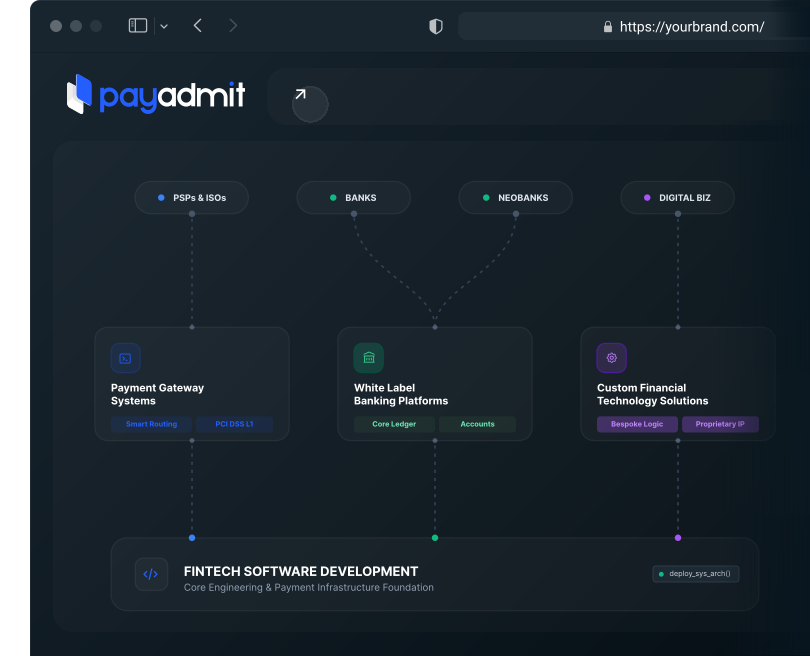
PayAdmit is a fintech software development company that builds payment gateway systems, white label banking payment platforms, and custom financial technology solutions for PSPs, banks, neobanks, and high-volume digital businesses.

What Is Fintech Software Development
Fintech software development is the process of building digital applications and platforms that power financial services. It covers the full spectrum of technology that connects financial institutions, payment systems, and customers, from core banking platforms and digital wallets to payment gateway software and regulatory compliance systems.
For a fintech business, payment software development is the most commercially critical layer of the technology stack. A payment platform that processes transactions reliably, routes intelligently, and reports accurately is the operational foundation of any fintech business model, whether that business is a PSP, a neobank, a trading platform, or an embedded finance product.
Modern fintech software development combines deep financial domain knowledge with engineering expertise in security, compliance, API integration, and real-time data processing. Any fintech platform that handles financial data must meet strict regulatory standards, PCI DSS for payment data, AML/KYC requirements for customer verification, GDPR for data privacy, from the first line of code, not as an afterthought.
The Fintech Development Challenge
Generic software development companies can build applications. Fintech software development requires a different skill set: understanding payment rails, financial data standards, regulatory compliance, fraud detection logic, and the operational realities of processing millions of financial transactions at scale. This is why fintech businesses need a software development company with specific payment and financial technology expertise, not a generalist agency.
A structured process from discovery to deployment, see How to Develop a Payment Gateway step by step.
The Fintech Technology Landscape
For payment-focused fintech businesses, this growth creates both opportunity and pressure. The opportunity: a massive addressable market of merchants, businesses, and consumers who need reliable digital payment processing. The pressure: more payment methods, more regulatory requirements, more geographies, and more sophisticated fraud that payment software must handle.
Payment fintech software must handle crypto deposits, stablecoin settlement, and fiat conversion. Cross-asset payment processing is now a mainstream fintech requirement.
| Fintech Trend | What It Means for Payment Software Development |
|---|---|
| Real-time payments | Banking and payment platforms must process transactions in milliseconds. Software architecture must handle high-throughput data with zero tolerance for latency. |
| Open banking | Fintech software must integrate with banking APIs across multiple financial institutions. Payment platforms need flexible API architecture that connects to any banking system. |
| Embedded finance | Non-financial software platforms are embedding payment processing natively. Any SaaS product can now provide payment services if the underlying fintech software is built right. |
| AI fraud detection | Machine learning fraud scoring is replacing static rule systems. Fintech development increasingly requires AI integration in the transaction processing layer. |
| Crypto and stablecoins | Payment fintech software must handle crypto deposits, stablecoin settlement, and fiat conversion. Cross-asset payment processing is now a mainstream fintech requirement. |
| Regulatory expansion | PSD2 in Europe, RBI guidelines in India, FATF Travel Rule globally, payment software must embed compliance for each regulatory environment it serves. |
Ready to build the fintech infrastructure
that scales with your business?
that scales with your business?
PayAdmit Fintech Software Development Services
PayAdmit’s fintech software development capabilities are concentrated in payment technology, see the full list of Fintech Software Development Services.
| Service | What We Build |
|---|---|
| White Label Payment Gateway | Full custom payment gateway deployed on your domain with separate infrastructure, branded payment pages, custom admin system, PCI DSS Level 1 certification, and 550+ payment method integrations. |
| Payment Gateway Software | Core transaction processing engine, smart routing and cascading logic, API layer, webhook system, and all payment software components needed to run a production gateway. |
| Cashier Service Platform | Hosted payment cashier solution with custom checkout branding on PayAdmit's PCI DSS infrastructure, ideal for fintech and e-commerce businesses that want to launch without managing server infrastructure. |
| Payment Bridge Middleware | Custom API middleware that connects existing fintech systems to 550+ payment providers through a single integration. The fastest path to expanding payment method coverage without rebuilding core systems. |
| AML/KYC/KYB Systems | Compliance software modules built into the payment platform, merchant verification, customer identity checks, transaction monitoring, suspicious activity reporting, and regulatory reporting workflows. |
| Antifraud Software | Configurable fraud detection systems integrated with ZignSec, Kount, and Paydetect. Rule-based screening, real-time risk scoring, and transaction pattern analysis built into the payment software stack. |
| Reporting and Analytics | Custom financial data reporting dashboards with real-time transaction monitoring, settlement reconciliation, approval ratio analytics, and custom report generation by merchant, currency, or payment method. |
Fintech Businesses We Build Payment
Software For
PayAdmit’s fintech software development is focused on companies that need to process, manage, or offer payment services at scale.

Traditional banking institutions expanding into digital payment services need fintech software that integrates with existing banking systems while meeting modern payment technology standards. We develop custom payment platforms that sit alongside existing banking infrastructure.

High-volume fintech verticals like iGaming need payment software that handles thousands of transactions per minute, routes across multiple acquiring banks, and maintains regulatory compliance in multiple jurisdictions. Our fintech development includes custom anti-fraud and AML systems designed for high-risk payment processing environments.

Large digital commerce platforms need payment software that manages split payments, multi-currency processing, automated merchant payouts, and full transaction data ownership. Custom fintech software development gives marketplace operators control over the payment layer that generic solutions cannot provide.

Neobank fintech businesses need payment software that processes real-time transactions, integrates with card issuing systems, supports digital wallet functionality, and scales to millions of banking customers. Our fintech software development provides the payment technology foundation that digital banking products require.

Fintech trading platforms and financial services companies need payment software that handles deposits, withdrawals, settlement, and multi-currency financial data with precision. Regulatory compliance, real-time reporting, and financial data accuracy are built into every development project.
Fintech Software Development Technology Approach
Building fintech software requires making technology choices that balance security, scalability, compliance, and speed to market.
Every fintech software system we develop is built API-first. REST API architecture with webhooks and SDKs ensures the payment platform integrates with any web application, mobile banking app, or existing system. API versioning, rate limiting, and multi-tenant isolation are standard. API-first design means your fintech platform connects to any downstream system without custom integration work.
Fintech software handles financial data subject to strict regulatory requirements. PCI DSS compliance, data encryption at rest and in transit, tokenisation of sensitive financial data, and secure coding practices are built into every layer of development, not added after the fact.
Payment software development requires custom transaction routing, approval optimisation, and settlement management. Our development includes configurable smart routing engines that direct each transaction to the optimal acquiring bank based on card type, currency, and approval history. Cascading logic retries failed transactions automatically to protect approval ratios.
Fintech platforms generate large volumes of transaction data that must be accessible in real time. Our development includes custom data pipelines, real-time reporting dashboards, and financial reconciliation systems. Accurate, current data drives merchant management, routing decisions, and system performance monitoring.
Fintech software must handle transaction volumes that spike unpredictably. Payment software is deployed on scalable cloud infrastructure with automatic load handling, redundant systems, and high-availability architecture, so fintech platforms process millions of transactions without performance degradation.
Custom Fintech Software Development
vs. Off-the-Shelf Solutions
Fintech businesses regularly face this decision: invest in custom software development or use an existing fintech platform. The right answer depends on business model, scale, and strategic positioning.
| Factor | Off-the-Shelf Platform | Custom Fintech Software |
|---|---|---|
| Time to launch | Days to weeks | Weeks to months |
| Feature fit | Generic, built for average use case | Exact, built for your business model |
| Brand control | Provider brand visible | Your brand only |
| Data ownership | Shared or licensed | Full ownership |
| Routing logic | Fixed or limited | Fully configurable |
| Compliance tooling | Standard, may not fit your market | Custom to your jurisdiction |
| Scale | Provider infrastructure limits | Scales with your business |
| Cost model | Per-transaction fees at scale | Controlled, own the technology |
PayAdmit’s fintech software development delivers a third option: custom-configured software on pre-built, pre-certified infrastructure. You get the launch speed of an off-the-shelf platform and the ownership and control of custom development, deployed in 1–2 months at a fraction of the cost of a full bespoke build.
Regulatory Compliance in Fintech
Software Development
Compliance is the most demanding aspect of fintech software development. Every payment system that processes financial transactions must meet multiple overlapping regulatory standards, and the compliance requirements differ by market, payment method, and transaction type.

PCI DSS Level 1
The highest payment card security standard. Required for any fintech system processing card transactions at scale. PayAdmit’s development platform is PCI DSS Level 1 certified, included in every deployment, not sold as a separate compliance add-on.
AML / KYC / KYB
Anti-money laundering, Know Your Customer, and Know Your Business compliance are built into every fintech software development project. Custom workflows for merchant verification, customer identity checks, and suspicious transaction reporting, configurable per regulatory jurisdiction.
Data Protection (GDPR)
Financial data handling in European markets requires GDPR-compliant software architecture. Data residency configuration, user consent management, and data retention controls are standard components of fintech software development for EU markets.
Antifraud Systems
Fraud detection software integrated with ZignSec, Kount, and Paydetect. Rule-based transaction screening, behavioural pattern detection, and real-time risk scoring built into the fintech payment platform.
Financial Reporting
Regulatory reporting requirements vary by jurisdiction and financial product type. Custom reporting modules in our fintech software development handle settlement reconciliation, financial data exports, and compliance report generation.
PCI DSS Level 1
The highest payment card security standard. Required for any fintech system processing card transactions at scale. PayAdmit’s development platform is PCI DSS Level 1 certified, included in every deployment, not sold as a separate compliance add-on.
AML / KYC / KYB
Anti-money laundering, Know Your Customer, and Know Your Business compliance are built into every fintech software development project. Custom workflows for merchant verification, customer identity checks, and suspicious transaction reporting, configurable per regulatory jurisdiction.
Data Protection (GDPR)
Financial data handling in European markets requires GDPR-compliant software architecture. Data residency configuration, user consent management, and data retention controls are standard components of fintech software development for EU markets.
Antifraud Systems
Fraud detection software integrated with ZignSec, Kount, and Paydetect. Rule-based transaction screening, behavioural pattern detection, and real-time risk scoring built into the fintech payment platform.
Financial Reporting
Regulatory reporting requirements vary by jurisdiction and financial product type. Custom reporting modules in our fintech software development handle settlement reconciliation, financial data exports, and compliance report generation.
How PayAdmit Delivers Fintech Software Development Projects
| Phase | What Happens | |
|---|---|---|
| 01 | Discovery | We assess your fintech business model, target markets, transaction volumes, compliance requirements, and existing system architecture. Together we define the right fintech software development scope and timeline. |
| 02 | Generic, built for average use case | Exact, built for your busineWe design the payment software architecture: API structure, data flows, routing logic, security layers, and compliance modules. All architecture decisions are documented and reviewed before development begins. |
| 03 | Custom Configuration | The core payment software platform is configured to your specifications, custom branding, routing rules, payment method selection, compliance parameters, and admin panel design. Custom development work is completed for any bespoke requirements. |
| 04 | Integration and Testing | All payment method integrations are connected and tested. Security testing, compliance workflow validation, and full transaction flow QA across every connected pa |
| 05 | Deployment | Your fintech software goes live in production. Transaction monitoring begins. A human technical support is active from day one. |
| 06 | Ongoing Development | PayAdmit maintains and evolves your fintech software, security patches, payment method updates, compliance changes, and feature development. No in-house tech team required. |
WHY FINTECH BUSINESSES CHOOSE PAYADMIT FOR SOFTWARE DEVELOPMENT
The fintech software development market has no shortage of providers. Here is why payment businesses specifically choose PayAdmit:
Payment-Specific Expertise
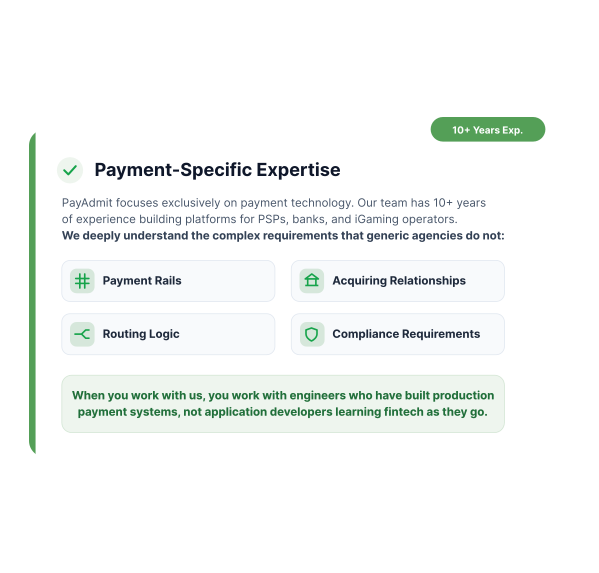
PayAdmit focuses exclusively on payment technology. Our fintech software development team has 10+ years of experience building payment platforms for PSPs, banks, and iGaming operators. We understand payment rails, acquiring relationships, routing logic, and compliance requirements that generic software development companies do not. When you work with us, you work with engineers who have built production payment systems, not application developers learning fintech as they go.
What Sets PayAdmit Apart in Fintech Software Development

We build payment software only. No generalist development work. Every engineer, every system, every decision is informed by 10+ years of payment and fintech industry experience.

1–2 months to a production payment system is fast. But we do not sacrifice compliance, security, or quality to hit that timeline. Our fintech software is pre-certified, production-tested, and deployed on hardened infrastructure.

Off-the-shelf fintech software imposes its own logic on your business. Our development approach starts with your business requirements, routing rules, compliance parameters, merchant categories, and target markets, and builds the system around them.

Fintech software development does not end at deployment. We provide ongoing development, integration updates, compliance maintenance, and a human technical support. Your in-house team manages the business, we manage the technology.
Speed, compliance depth, and payment-specific expertise are the three reasons fintech businesses choose PayAdmit. We deliver custom-configured payment software in 1–2 months, not years, with PCI DSS Level 1 certification, 550+ payment integrations, and full compliance tooling included in every development project.
If your project sits outside the standard playbook, our dedicated custom fintech software development service is built for those tailored, from-scratch financial products.
FREQUENTLY ASKED QUESTIONS
What does a fintech software development company build?

A fintech software development company builds the technology platforms that power financial services. For payment-focused fintech, this includes payment gateway software, transaction processing systems, merchant management platforms, digital wallets, compliance and KYC systems, and financial reporting tools. PayAdmit specialises in payment software, everything a PSP, bank, or fintech business needs to process, route, and manage payment transactions at scale. Each solution covers the full transaction lifecycle from initiation to settlement.
How long does fintech software development take?
Timeline depends on the scope. A custom payment gateway deployment on PayAdmit’s platform takes 1–2 months. A bespoke software development fintech project from scratch takes 6–18 months depending on complexity, compliance requirements, and integration scope. PayAdmit’s approach, custom configuration on pre-built, pre-certified software infrastructure, gives fintech businesses a production-ready payment solution in a fraction of the time of a full custom build.
What compliance standards does fintech payment software need to meet?
Payment fintech software must meet PCI DSS requirements (Level 1 for high-volume processors), AML and KYC regulatory requirements by jurisdiction, data protection standards (GDPR for European markets, CCPA for US markets), and fraud prevention standards required by card networks and acquiring banks. PayAdmit builds all these compliance requirements into every fintech software development project, they are not add-ons or separate integration work. The result is a solution that ships compliance-ready from day one.
Can PayAdmit integrate fintech software with existing banking systems?
Yes. PayAdmit’s fintech software is built API-first, it connects to any existing system that supports standard REST API integration. This includes existing banking platforms, ERP systems, CRM tools, and third-party fintech services. The Payment Bridge product specifically addresses the scenario where a business already has banking infrastructure and needs to expand it without rebuilding existing systems. It works as a connective solution between legacy banking architecture and modern payment flows.
What is the difference between a fintech software development company and a payment gateway provider?
A payment gateway provider delivers a finished product, a gateway ready to deploy and use. A fintech software development company builds custom technology tailored to a specific business model. PayAdmit operates at both levels: we provide a pre-built white label payment platform that deploys quickly, and we do custom fintech development work for businesses with specific technical requirements beyond what a standard platform solution covers.
Does PayAdmit provide fintech software for high-risk industries?
Yes. PayAdmit has specific fintech software development experience in iGaming, online gaming, crypto payments, and other high-risk merchant categories. Our payment platform includes antifraud monitoring, AML compliance workflows, and smart routing logic that are specifically designed for high-volume, high-risk payment environments. Every solution we deliver for high-risk verticals is built around regulatory compliance and transaction security from the ground up.