
A senior developer runs $180K–$280K in total compensation in the US and Western Europe, $80K–$140K in Eastern Europe, $60K–$120K in Latin America, and $40K–$90K in South-East Asia. Fully loaded in-house cost is typically 1.4–1.7 times base salary once benefits, tax, equipment, and management overhead are counted. Partner rates for fintech development bundle most of that overhead already.
HOW TO HIRE FINTECH SOFTWARE DEVELOPERS: A 2026 GUIDE
Hiring fintech developers in 2026 is harder than hiring general engineers, because the development work combines deep technology, financial domain knowledge, and compliance discipline. This guide covers the engagement models that actually work, the cost of fintech software development across markets, the technical skills that separate production-ready engineers from generalists, and the evaluation framework product leaders use to build development teams that ship.
30.07.2026
Updated:
The Fintech Talent Market in 2026
The fintech talent market in 2026 looks very different from three or four years ago. Demand has concentrated at the experienced end of the development talent pool, where firms compete for senior developers who can ship production payment software and the compliance solutions wrapped around it, while entry-level roles have become far more competitive on the candidate side. The gap between what a general software engineer can do and what a financial technology product needs on day one has widened, and that gap is what makes this kind of hiring genuinely difficult.
Three forces drive the current state of the fintech market.
First, regulatory tightening. MiCA in Europe, the FCA framework in the UK, and PSD3 implementation have all pushed compliance technology to the centre of every fintech roadmap. Companies now need development teams that understand the technology and the rules in parallel, because a compliance solution designed after the fact rarely survives an audit. Taking a generalist engineer and training them on financial compliance takes longer than most competitive windows allow, which is why domain experience commands a premium that keeps rising.
Second, the embedded finance wave keeps pushing payment functionality into non-financial businesses. Retailers, healthcare platforms, marketplaces, and SaaS companies all need development capacity they cannot build internally, and payment solutions they can adopt without becoming a financial institution themselves. That drives demand for engineers who can integrate payment solutions into an existing software stack without taking on the full operational burden of running a regulated financial business.
Third, the global distribution of talent has rebalanced. Eastern Europe, Latin America, and South-East Asia now host major development centres serving Western fintech firms. The price arbitrage that drove offshoring between 2015 and 2020 has narrowed considerably, but the depth of the talent pool in these regions makes them competitive on quality alone. Firms that built development capacity in Kyiv, Krakow, Buenos Aires, or Manila during 2020–2023 now run stable, productive teams operating production payment systems.
The result is that hiring financial developers has become a strategic activity touching procurement, compliance, product, and engineering leadership at once. Firms that use a deliberate development approach ship faster and capture share in fast-moving verticals. Firms that treat development hiring as a commodity purchase end up with the slowest roadmaps and the heaviest technical debt in their cohort.
The companies that get this right tend to share a pattern. They define the engagement model before they post the first job spec. They scope the budget around total ownership rather than hourly rates, and they know which parts of the product they intend to build and which they intend to buy as a ready solution. They weight compliance experience alongside technical skill during evaluation. And they treat a supplier of development services as a strategic partner rather than a transactional vendor. None of that is complicated, but it is the difference between a development team that ships and one that spends its first year finding its footing.
What Fintech Software Developers Actually Build
Fintech engineers build the software that moves money, manages financial data, and enforces the rules financial regulators set across markets. Day to day, the development work spans payment processing platforms, account management software, compliance tooling, reporting infrastructure, and the customer-facing apps that handle financial transactions. Knowing which of these categories your product sits in tells you a great deal about which developers you actually need, and which parts of the solution you should license rather than build.
Payment Processing Platforms
The software that captures payment instructions, routes them through acquirers and networks, handles settlement, and reports the result back to merchant apps. Modern payment platform development covers cards, account-to-account rails, e-wallets, and emerging local payment methods behind one unified merchant interface. This is the densest engineering category in fintech, and the one where production experience is hardest to fake. Most teams that ship here use a licensed platform for the regulated core and build only the differentiating software on top.
Banking and Account Software
Core banking systems, ledger software, account opening flows, KYC and KYB onboarding, and the back-office tooling that supports compliance operations. Banking-as-a-service platforms have made this category more accessible to non-bank teams, but the underlying technology complexity has not gone anywhere; it has simply moved behind an API that somebody still has to use correctly.
Lending and Credit Technology
Loan origination software, underwriting engines, credit decisioning systems, and the servicing technology that handles the full lifecycle of a credit product. This category has grown sharply as BNPL providers and embedded credit solutions multiplied across e-commerce and SaaS, and most of those solutions were assembled rather than written from nothing.
Wealth and Investment Platforms
Brokerage software, robo-advisor apps, portfolio management tools, and the tax-reporting technology that serves retail investors and wealth managers. The retail investing surge between 2020 and 2024 pushed development demand for these solutions to new highs, and it has not fully receded.
Insurance Technology
Policy administration software, claims processing services, actuarial tooling, and customer-facing insurance app design. The convergence of insurtech with mainstream financial technology has blurred the boundary between these categories, and engineers increasingly move between them because the underlying software solutions rhyme.
Crypto and Digital Asset Platforms
Wallets, exchanges, custody software, on-chain analytics, and the bridges between traditional payment systems and blockchain rails. This is where the technology evolves fastest, where off-the-shelf solutions are thinnest, and where development teams need the most specialised skills.
Across every one of these categories the development work shares the same themes: tight regulatory constraints, high reliability requirements, strict security expectations, and a need for engineers who understand both software engineering and the financial domain they are building inside. That combination is rarer than the raw supply of software developers would suggest, and it is the reason fintech development hiring behaves differently from general technology hiring. It is also why so many teams use a hybrid approach: buy the regulated software solutions, hire for the product layer above them.
Core Technical Skills These Engineers Need
The technical skill set for fintech developers extends well beyond standard software practice. The mix that defines a production-ready specialist combines deep technology fluency, domain understanding, sound software design instincts, and the operational discipline that only comes from running money-handling solutions in production. Companies that use a clear picture of this skill set write sharper job specs and waste less time on unsuitable candidates.
Backend Engineering Depth
Most fintech software is backend-heavy, and the development workflow centres on the backend stack. Teams build APIs that handle financial transactions, integrate with third-party financial services, and enforce business rules under high transaction volume. Java, Kotlin, Go, Python, and TypeScript dominate. Strong engineers understand database internals (PostgreSQL, MySQL, occasionally specialised financial databases), message queue technology such as Kafka and RabbitMQ, and the event-driven architecture patterns that fit financial software constraints. These are the building blocks of nearly every payment solution in production today.
API Design for Financial Services
Financial APIs face stricter requirements than typical web APIs. The development team has to design for idempotency, so retries never duplicate a payment; for strong consistency, so a balance update is never lost; and for traceability, so every financial transaction can be reconstructed for audit. Engineers who have shipped production payment APIs understand these constraints intuitively. Generalists usually need six to twelve months of mentored work to internalise them and the broader software contract that financial APIs imply. An API is a solution other developers have to use, so its design outlives whoever wrote it.
Distributed Systems Reliability
These teams ship services that need to run at 99.99% uptime or better. That requires fluency with circuit breakers, retry logic, idempotent operations, saga patterns for distributed transactions, and the operational tooling that makes a high-reliability solution observable in production. Experience with cloud-native infrastructure (AWS, GCP, Azure), container orchestration, and modern software delivery pipelines is now table stakes, as is comfort with the observability solutions teams use to run them. Development teams that ship reliable distributed software treat observability as a first-class part of every design rather than something added after the first outage.
Security Engineering
Every line of fintech software touches data or money that somebody wants to steal. Strong engineers understand the security implications of each design choice: TLS configuration, secrets management, encryption at rest and in transit, secure key storage, authentication and authorisation patterns, and the operational practices that prevent credential leakage. In mature development teams security is not a separate role; it is part of every engineer's daily work, and the security solutions they use are chosen as deliberately as the application framework. Our own security and compliance posture describes what that baseline looks like on a certified platform.
Frontend and Mobile App Engineering
Although the heavy lifting is on the backend, a modern fintech product still needs a clean customer-facing app. Engineers who can build trustworthy, accessible, fast web and mobile app experiences with React, Next.js, React Native, Swift, or Kotlin are in high demand. The frontend development team works closely with backend engineers to keep the customer-facing software consistent across platforms. The app matters because financial trust is built on a clean user experience as much as on backend reliability, and a polished app is frequently what wins users in a crowded category. Users judge a financial product by the app long before they ever see the software behind it, so app quality is a development priority rather than a finishing touch. Fintech teams that treat the app as an afterthought lose users they never learn about.
Data Engineering for Financial Reporting
Development work extends into the data pipelines that feed regulatory reporting technology, business intelligence, and risk management services. SQL fluency, dbt experience, and familiarity with the warehouse solutions teams use — Snowflake, BigQuery, Databricks — round out the modern fintech development skill set.
The bar is high because financial software is unforgiving. A bug in a payment system means lost money, regulatory exposure, and customer trust that is expensive to rebuild. Engineers who have internalised that reality ship more carefully than generalists working in lower-stakes domains, and companies should test for that mindset as deliberately as they test for technical skill.
Compliance, Security, and Regulatory Expertise
Compliance and security expertise is where general engineers diverge most sharply from production fintech developers. Financial software runs inside a regulatory perimeter that shapes every architecture decision, every data model, every integration point, and every operational practice. Engineers who understand that perimeter ship faster, because they design compliance into the solution from day one instead of retrofitting it after the auditors arrive.
PCI DSS for Payment Software
Any development team handling card data needs to understand the Payment Card Industry Data Security Standard. Level 1 is the highest tier and applies above six million card transactions a year; most production payment solutions run on PCI DSS Level 1 ready software infrastructure. The development practices this requires — segregated network zones, encrypted data flows, tokenisation at capture, strict access controls, thorough audit logging — are now baseline expectations for any engineer working on payment services.
KYC and KYB Technology
Know Your Customer and Know Your Business technology is a deep specialty in its own right. Development teams building account onboarding integrate with providers such as Sumsub, Onfido, Jumio, or Trulioo, build verification pipelines handling document upload and biometric checks, and design an app experience that balances regulatory thoroughness against conversion friction. Strong engineers understand both the technology solutions they integrate and the regulation underneath them.
AML and Travel Rule Compliance
Anti-money-laundering monitoring runs across every financial transaction. Development teams integrate AML services from providers such as Chainalysis or ComplyAdvantage, build transaction monitoring solutions with configurable rules, and design the case management software that compliance teams use to investigate flagged activity. Travel Rule obligations add a further layer for crypto and cross-border payment teams. The engineering discipline behind this sits close to antifraud and risk management.
Data Protection and Privacy
GDPR in Europe, CCPA in California, PIPL in China, and dozens of comparable regimes shape how engineers handle customer data. Strong developers understand data minimisation, retention policy implementation, right-to-deletion technology, and the cross-border transfer rules that constrain how financial services architectures get designed. Privacy is an engineering skill now, not only a legal one.
Regulatory Reporting Infrastructure
Banks, payment institutions, and regulated financial services businesses file reports that pull data across their entire transaction history. Development teams build the pipelines, the report generation software, and the audit trail solutions that support regulator inquiries. This area combines data engineering with genuine regulatory knowledge, and few engineers arrive with both.
Security Operations and Incident Response
Engineers contribute to security operations as part of normal development work: designing services that are observable for security events, writing runbooks for incident response, joining tabletop exercises with the security team, and keeping the patching discipline tight enough that production solutions stay out of the headlines.
Weight compliance experience as heavily as raw technical skill. A senior developer with five years on a payment platform and direct exposure to PCI audits is more valuable than a stronger generalist from an unregulated background. The cost of mistakes in regulated fintech software is high enough that domain experience justifies a meaningful premium, and the market has priced that in. Treat PCI DSS, KYC, and AML fluency as engineering skills rather than as separate compliance roles.
Technology Stacks and Platform Choices
The technology stacks that fintech development teams work with have converged on a familiar set of patterns over the past five years. Companies starting greenfield development today pick from a fairly small menu of well-understood technology solutions. Companies running legacy financial systems face the harder problem: modernising an older stack while keeping production services running.
Cloud-Native Infrastructure
AWS, Google Cloud, and Azure dominate fintech development infrastructure. AWS remains the most common, Google Cloud grows fastest in data-heavy segments, and Azure leads in markets where enterprise banks already run Microsoft technology. Multi-cloud solutions are frequent at the larger end of the market and rare below it, largely because the operational cost only makes sense at scale.
Backend Languages
Java and Kotlin lead in enterprise fintech development, particularly inside banks and large payment firms. Go is the second most popular choice for performance-critical payment processing software. Python dominates data science, machine learning, and rapid development. TypeScript with Node.js handles many newer APIs, especially where teams share staff between backend and frontend app development. Rust is gaining ground for the highest-performance components but remains a specialist choice that few teams use across a whole platform.
Frontend and Mobile Stacks
React with Next.js dominates web app frontends. React Native and Flutter are the two main cross-platform mobile app choices, with native Swift and Kotlin reserved for performance-critical or platform-specific app development. Choosing between cross-platform and native app engineering depends on team size, performance requirements, and how much the app relies on platform-specific features. Cross-platform solutions let a smaller team ship both app targets; native app work buys performance and platform depth.
Databases and Data Infrastructure
PostgreSQL is the default operational database for most fintech development teams. MySQL persists in older systems and particular use cases. Specialised financial databases such as kdb+ appear in capital markets, and Oracle in enterprise banking. For analytical workloads Snowflake, BigQuery, and Databricks compete for attention, while Redis handles caching and rate limiting across most solutions in production.
Messaging and Event Streaming
Apache Kafka is the dominant choice for financial event streaming. RabbitMQ remains common for simpler messaging. AWS SQS, Google Pub/Sub, and Azure Service Bus appear in cloud-native designs. The pattern that has settled is an event-driven solution with Kafka at the centre and services producing and consuming financial events asynchronously.
Gateways, Observability, and Delivery
Kong, Apigee, and AWS API Gateway are typical API management choices, with service mesh adoption growing as architectures mature into microservices. Datadog, New Relic, and Grafana with Prometheus dominate observability; thorough monitoring is non-negotiable because financial services must detect problems in seconds rather than minutes. GitHub Actions, GitLab CI, and CircleCI handle most pipelines, Terraform leads infrastructure as code, and Kubernetes is standard for orchestration at any meaningful scale.
The technology stack matters because it shapes recruiting, retention, and time to market all at once. Firms that use mainstream technology find engineers faster and onboard them quicker. Firms that use unusual technology pay a premium in both time and salary, and should be confident the capability advantage is real before accepting that trade. The stack is a hiring decision as much as a technical solution.
Engagement Models for Fintech Development
Companies hiring fintech developers in 2026 choose between several development engagement models. Each carries different cost implications, control levels, and operational footprints, and each suits a different kind of software solution. The right choice depends on company stage, project type, and the long-term plan for the fintech product.
In-House Full-Time Hiring
The traditional model: recruit engineers as employees, manage them internally, own the full operational responsibility. It gives the deepest control and the strongest knowledge retention, and it keeps the technology knowledge inside the company, but it costs the most in absolute terms and takes longest to scale. In-house development works well for long-term financial solutions with multi-year roadmaps, and struggles when needs spike unpredictably or when a specialised skill is needed for a short engagement.
Dedicated Teams From an Outsourcing Partner
A growing model: engage a dedicated development team from a financial technology services partner. Engineers work full-time on your product but are formally employed by the development partner. This solution combines the focus of in-house development with the flexibility of outsourcing, which is why so many growth-stage companies use it. Such teams typically run five to fifteen engineers plus a tech lead, a project manager, and sometimes a product manager or designer. Cost usually lands 40–60% below fully loaded in-house expenses in high-cost markets. Our overview of fintech development outsourcing covers how these arrangements are structured in practice.
Project-Based Services
The classic outsourcing model: define a project, sign a statement of work, pay the development partner to deliver against agreed milestones. It fits well-defined, time-bounded software work with a clear solution specification. It struggles with long-term products needing continuous iteration, because contracting overhead becomes friction at every change.
Staff Augmentation
Engage individual developers from a staffing services partner who join your existing team and report to your tech lead. This fills a specific skill gap without the overhead of standing up a new development team, and it works best when the solution architecture is already settled. It works well when in-house engineering is strong but capacity-constrained, and poorly when there is no technical leadership structure to integrate augmented staff into.
Specialist Contractors
Engage senior contractors for concentrated, high-value work: compliance architecture, security review, payment platform design, regulatory technology integration. These are solution-shaping engagements rather than delivery capacity. These contractors are expensive hourly but deliver disproportionate value in short engagements. The cost-effectiveness comes from buying senior expertise for exactly the slice of time you need it.
White Label Platform Partnerships
Rather than building fintech software, license a white label platform and configure it for your use case. The development work shifts from building from scratch toward integrating and configuring an existing solution, which cuts both project cost and time to market for teams that need standard financial functionality. It constrains firms with genuinely unusual requirements. See white label payment gateway software for what that layer typically includes.
Hybrid Models
Most mature firms end up running a hybrid. A familiar pattern: core engineering in-house, expansion projects with dedicated teams from outsourcing services partners, specialist work with contractors, and white label services for pieces where building offers no strategic advantage. The craft of engineering leadership is allocating each piece of work to the right solution model.
The engagement model has a far larger effect on cost and outcome than the choice of any individual engineer. A poorly chosen model staffed with excellent developers will underperform a well-chosen model staffed with average ones, whatever technology they use. Decide the model deliberately, before the search starts.
Cost of Fintech Software Development by Region
Senior developer compensation and typical partner rates across the four regions that supply most fintech development capacity in 2026.
| Region | Senior Developer Cost |
|---|---|
| US & Western Europe | $180K–$280K total comp; $100–$300 per hour on contract. |
| Eastern Europe | $80K–$140K total comp; $35–$70 per hour through a partner. |
| Latin America | $60K–$120K total comp; $40–$80 per hour, aligned to US hours. |
| South-East Asia & India | $40K–$90K total comp; $25–$60 per hour through a partner. |
Those headline figures need three layers of context before they become a budget.
Fully loaded cost. In the US and Western Europe, benefits, taxes, office, equipment, recruiting fees, and management overhead typically bring the real cost of a full-time developer to 1.4–1.7 times base salary. Comparing an in-house salary against a partner's hourly rate without that multiplier is the single most common budgeting error in fintech development planning.
Total project cost. A small project (three to six months, three to five engineers) generally runs $200K–$800K. A medium project (six to twelve months, five to ten engineers) runs $600K–$2.5M. A large platform build (twelve to eighteen months, ten to twenty engineers) runs $1.5M–$6M. White label platform licensing as an alternative typically runs $50K–$500K annually for comparable functionality, which is why the build-versus-buy decision deserves attention before any custom development work is commissioned. A licensed solution and a bespoke solution rarely cost within an order of magnitude of each other. Our page on fintech software development breaks these engagements down further.
Hidden cost drivers. Compliance work adds 15–30% over general software development. Specialist roles — security engineers, compliance architects, payment platform leads — cost 30–60% more than general developers. Long onboarding cycles make turnover expensive. And technical debt accumulated in cheap-but-fast development cycles becomes a serious expense a year or two after launch, usually at the exact moment the product needs to scale.
The cheapest path is almost never cheapest in total ownership. Firms that optimise purely on hourly rates routinely pay two to three times the headline figure once rework, compliance gaps, and platform rebuilds are counted. The right target is the lowest total cost of ownership across the planned product lifecycle. For most companies the cost of fintech software development is large enough to justify a clear scoping document, a realistic timeline, an honest assessment of in-house capability, and a defined budget envelope before recruiting begins.
How to Evaluate Candidates
Evaluating fintech developers demands more rigour than general software recruiting, because the cost of a bad hire is higher. A developer who ships a bug into payment production costs the company an order of magnitude more than the same mistake in a non-financial context. The evaluation framework mature fintech companies use focuses on several dimensions beyond a standard engineering interview, and most of them test judgement rather than recall of technology trivia.
Technical Screening for Domain Skills
The first round should test domain-relevant ability: API design with idempotency requirements, distributed transaction patterns, error handling for payment flows, and security awareness in financial software. Generic algorithmic puzzles have far less predictive value than scenario questions about real engineering trade-offs in a financial solution.
Domain Knowledge Assessment
A strong engineer can discuss double-entry accounting, settlement cycles, the difference between authorisation and capture in card payments, the regulatory environment of your target market, and the operational realities of running financial services in production. Depth of domain knowledge correlates strongly with how quickly a developer becomes productive on real financial software, whatever technology the team uses.
Compliance and Security Awareness
Test this directly. Ask how a candidate would handle personal data in a database design, implement audit logging for financial transactions, approach access controls in a payment system, and what they know about the regulatory framework relevant to the role. Candidates who treat these as administrative overhead rather than engineering substance are not ready for senior work on a regulated solution.
Code Review and Architecture Exercise
A take-home or live exercise asking a candidate to review domain-relevant code or design a small piece of a financial system reveals far more than abstract whiteboard questions. Look for engineers who notice security issues, idempotency gaps, error handling problems, and observability shortcomings unprompted, and who explain what solution they would use instead. The habits that surface here predict on-the-job behaviour better than any other signal in the process.
System Design at Scale
A senior developer should be able to design a payment processing system, a fraud detection pipeline, or a regulatory reporting platform end to end within 60–90 minutes. The quality of that conversation reveals how much genuine production experience the candidate brings. Strong candidates raise reliability, security, compliance, and operational concerns naturally, and sketch the technology solutions they would use for each, rather than waiting to be prompted.
Communication and Collaboration
Development teams in this space work across regulatory, product, operations, and engineering boundaries constantly. Engineers who cannot explain a technical solution to a compliance officer create real problems. Evaluate this directly through behavioural questions about prior cross-functional work.
Reference Checks and Cultural Fit
Take references seriously; use calls with prior tech leads to ask how the candidate handled production incidents, compliance gaps, and the pressure of running financial services. References reveal patterns interviews cannot, particularly around how a developer behaves when the software fails at three in the morning. Finally, assess comfort with constraint. Engineers here work under stricter rules than developers in lower-stakes domains. Candidates who chafe at compliance requirements or push back on security practice will struggle; those who treat the constraints as engineering problems with elegant solutions tend to thrive.
Common Mistakes and How to Avoid Them
Companies hiring fintech developers make a fairly predictable set of mistakes. Avoiding them is often worth more than any single good recruiting decision.
Optimising for Hourly Rate Instead of Total Cost
The most common and most expensive error. Firms that select development partners on the lowest hourly rate pay the difference back in rework, missed deadlines, and technical debt. The cheapest solution on paper is seldom the cheapest solution in production. Target total ownership across the project lifecycle: onboarding time, productivity ramp, quality outcomes, and the cost of fixing what surfaces after launch.
Treating Fintech Work as Commodity Software
General engineers can usually be redeployed across product domains with reasonable success. Financial software is different, because the domain knowledge takes twelve to eighteen months to build. Firms that hire generalists and expect immediate productivity get frustrated quickly. Either look for relevant background, or invest in a structured ramp-up solution and plan the timeline around it.
Underinvesting in Compliance and Security Skills
These are not separate roles in modern development teams; they are part of every engineer's work. Development teams built without them accumulate compliance gaps that surface in audits and security issues that surface in incidents, and both are expensive to solve late. Weight both heavily in your evaluation criteria.
Choosing the Wrong Engagement Model
The model shapes outcomes more than the individual developers within it. Project-based contracting when the work is continuous, staff augmentation when a whole team is needed, in-house building when a white label platform would serve better — each of these underperforms regardless of the talent you use. Choose the model deliberately before the search begins.
Skipping Reference Checks and Ignoring Time Zones
References reveal patterns interviews miss; budget 30–60 minutes per finalist. And distributed development teams need genuinely overlapping hours to handle production incidents and compliance escalations, whatever collaboration technology they use. Design the team around a defined collaboration window rather than optimising purely for cost.
Underestimating Onboarding and Over-Building
Engineers here typically need three to six months to reach full productivity on a new platform; expecting output in month one produces stress and poor-quality software. Separately, many companies build fintech software they could license as a finished solution at a far lower total cost. Make the build-versus-buy call during development planning, not after the team has started looking for problems to solve.
Build vs Buy: Developers vs Platforms
The build-versus-buy decision is one of the most consequential strategic choices in fintech product development. The right answer is rarely "build everything" or "buy everything". It is usually layered: build the software that differentiates the product, buy the fintech technology that is already commoditised.
What to build in-house. Use your development team for the parts customers see, the proprietary business logic, the elements that create genuine competitive advantage, and anything that must evolve quickly on customer feedback. For most firms that means the customer-facing app, the proprietary rules engine, the data and analytics that inform product decisions, and any capability no fintech platform vendor offers. If your app is the reason customers choose you, it belongs to your own development team.
What to buy from white label services. Buy the commoditised layers: the ones requiring expensive compliance certification, carrying regulatory complexity, and creating no competitive advantage. For most firms that means payment processing infrastructure, KYC services, AML monitoring, regulatory reporting plumbing, and banking-as-a-service rails — all software somebody else has already certified.
A worked example. A new BNPL provider might build a custom underwriting engine (differentiator), buy payment processing rails from a white label platform (commodity), build the merchant-facing app (customer experience), and buy KYC and AML services (compliance overhead). A neobank might build its savings product app experience, buy core banking technology at low scale, build the budgeting app, and buy the card issuing platform. For a deeper treatment of that trade-off, see our guide on how to build a payment gateway, and the wider architectural view in how to build a payment system.
When to revisit. The balance shifts as a company grows. Early stage, buy almost everything you can and use the development team on the product itself. Growth stage, start building the pieces platforms cannot serve well. At scale, evaluate whether bringing previously-bought layers in-house creates real advantage. Revisit at each stage transition rather than treating the first decision as permanent.
Risk-weighted comparison. A full comparison weights technology risk, compliance risk, and time-to-market risk against operational expense. Building everything carries high technology and compliance risk, because the development team must master every layer of the software itself. Buying everything carries vendor lock-in risk and constrains differentiation. The layered approach manages both.
Capability building. When building in-house, grow the development capability gradually. Start with a small senior team that defines architecture and ships an MVP. Add mid-level developers once the platform stabilises and the patterns are clear. Add specialists in compliance, security, and platform engineering as the fintech services scale. Staffing a full team before the architecture is settled reliably creates churn and rework.
The decision affects recruiting directly. Firms that build need larger, more senior development teams with broad skill coverage. Firms that buy need smaller development teams focused on integration, customisation, and the app layer their customers actually use. If you are weighing a custom build, our page on custom fintech software development sets out where bespoke work genuinely pays.
Verticals Where Demand Is Highest
Development demand concentrates in verticals where business growth, regulatory change, and technology evolution combine to drive sustained recruiting. These account for most fintech hiring activity in 2026 and offer the strongest career paths for senior software developers — which matters, because candidates evaluate you on exactly this.
Embedded Finance and Payments
The dominant growth area. Embedded finance brings payment functionality, lending, and other financial services into non-fintech products. Retailers, SaaS companies, marketplaces, and vertical software platforms all need development capacity to ship embedded financial features inside an app their customers already use. The technology is well understood, the compliance frameworks are mature, and demand is broad-based.
Payment Infrastructure and Orchestration
PSPs, payment gateways, and orchestration platforms continue to recruit aggressively. Competitive pressure pushes every operator to ship faster, integrate more rails, and add capability. This is a mature field with stable patterns and strong career paths for specialists; our work on payment routing infrastructure is representative of the engineering involved.
Crypto and Digital Assets
After the 2022–2023 correction, crypto development has settled into a more disciplined market. Surviving companies recruit fewer engineers but pay more for relevant experience. Stablecoin infrastructure, regulated exchange apps, custody platforms, and on-chain analytics technology drive most crypto development hiring in 2026.
Banking-as-a-Service and Core Banking
BaaS platforms that let other companies ship banking products keep growing. The work is deep infrastructure: ledger services, account software, card issuing technology, and the operational tooling that supports scale. Technical depth requirements are high and compensation reflects that.
Insurtech, Wealthtech, and Lending
Insurance technology has matured from niche to major recruiting category, needing developers for policy administration software, claims processing apps, actuarial tooling, and customer-facing insurance app experiences. Robo-advisors and brokerage platforms keep recruiting as they add asset classes and portfolio tooling. And BNPL providers, embedded credit platforms, and SMB lending services drive steady demand in credit, where the technology stack is well understood and the business models are profitable.
Regtech, Treasury, and Cross-Border
Regtech is now a fintech category in its own right, with companies building compliance software for banks and finance teams recruiting developers who have real regulatory depth. Corporate treasury technology, B2B payment services, and supply chain finance tools have grown into a meaningful enterprise segment. And cross-border payments keep attracting investment as banks lose share to specialists, combining payment software with currency conversion, multi-jurisdiction compliance, and the local payment methods each destination market uses.
The vertical shapes the cost, the engagement model, the technology choices, and the skill set recruiting should target. Firms operating across several fintech verticals usually need development capability that spans them, which favours larger software teams with diverse coverage.
Whichever vertical you recruit into, write the job spec around the technology the team will actually use and the app surface they will actually own. Candidates read a fintech development spec closely, and a vague one attracts generalists rather than the specialists the work demands.
Working With PayAdmit and White Label Partners
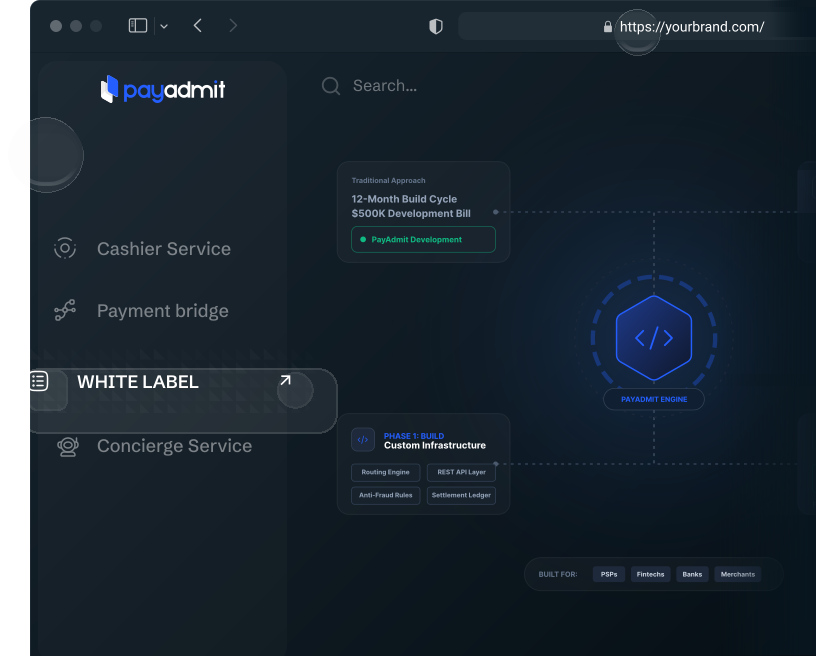
PayAdmit sits on the buy side of the fintech build-versus-buy decision. The platform provides white label payment gateway software with the compliance, orchestration, and operational capability that typically takes twelve to eighteen months to build in-house. Development teams that integrate it ship sooner and spend their capacity on the product and the app rather than on payment software infrastructure.
The platform covers the layers most teams cannot economically build from scratch: PCI DSS Level 1 ready infrastructure, multi-acquirer payment routing, 400+ payment methods, fraud screening services, compliance integrations, a built-in payment bridge, and the operational tooling that supports financial services at scale. The integration surface is designed for development teams that want to ship product features and app experiences without running payment software directly.
A typical engagement runs through a discovery phase, an integration phase, and an ongoing partnership. Discovery aligns the product plan against platform capability and identifies the customisation a given use case needs. Integration runs one to two months and takes the development team to production with a fully branded payment gateway. The ongoing partnership covers platform updates, compliance support, and engineering collaboration as the product evolves. It suits embedded finance apps, vertical fintech platforms, marketplaces with three-sided payment flows, iGaming operators, and established payment service providers extending their technology without building everything themselves.
The economics work because the platform investment is spread across many customer teams. What a single development team would spend a year building, and then maintaining forever, arrives as a configured app surface they can use in weeks.
Key Takeaways
The financial technology hiring landscape in 2026 rewards companies that approach the problem strategically. A few principles separate the firms that build effective fintech development teams from the ones that rebuild every eighteen months.
- Senior fintech developers cost more and take longer to recruit than general software engineers, but the productivity gap on real financial software justifies the premium.
- The engagement model affects outcomes more than the individual developers chosen within it, so pick the model deliberately before starting the search.
- Measure the cost of fintech software development as total ownership across the product lifecycle, not as headline hourly rates or salaries.
- Compliance and security expertise is baseline for production fintech work; weight it as heavily as raw technical capability.
- The build-versus-buy decision shapes the whole recruiting plan. Make it before the development team is hired, and revisit it at each growth stage.
- Dedicated teams from outsourcing services partners offer the best balance of focus and flexibility for most growth-stage companies.
- Engineers with direct PCI, KYC, or AML experience save twelve to eighteen months against training generalists in the domain.
- The strongest 2026 demand sits in embedded finance, payment software infrastructure, banking-as-a-service technology, and crypto rails.
- Time to productivity for a new developer is three to six months on unfamiliar fintech software; plan development timelines accordingly.
- White label technology partnerships sharply reduce project cost for software layers that create no competitive advantage.
Firms that use these principles ship better fintech products faster. Firms that ignore them rebuild their development teams every eighteen to twenty-four months, as gaps in discipline compound into problems no amount of extra software can paper over.
Frequently Asked Questions
What does it cost to hire fintech software developers?
How long does it take a new developer to become productive?
Three to six months on an unfamiliar financial platform, even for strong engineers. A generalist without domain background needs twelve to eighteen months to build the compliance and payment software knowledge a fintech specialist already has, which is why domain experience commands a premium.
Which engagement model suits a growth-stage company?
A dedicated team from an outsourcing services partner usually offers the best balance of focus and flexibility. It gives the continuity of in-house development without the fixed cost and hiring lead time, and it scales up or down more easily than employment contracts allow, whatever technology the product uses.
Should we build our payment infrastructure or license it?
License it, unless payment mechanics themselves are your differentiator. A white label platform typically costs $50K–$500K annually against $1.5M–$6M for a comparable custom build, and the licensed technology arrives with the compliance certification that would otherwise consume a year of development time.
What technical skills matter most in fintech development?
Backend depth, API design with idempotency and strong consistency, distributed systems reliability, and security engineering. Data engineering for regulatory reporting and clean frontend or mobile app development round out the set, since the app is what customers use. Compliance fluency is now a technical skill rather than a separate role.
How do we test for compliance knowledge in an interview?
Ask directly and concretely: how would you handle personal data in this schema, how would you implement audit logging for a financial transaction, how would you design access controls for a payment system. Candidates who treat these as paperwork rather than engineering are not ready for senior work in the domain.
Is offshore fintech development still cheaper in 2026?
Cheaper, yes, but the gap has narrowed and quality is now the stronger argument. Eastern Europe, Latin America, and South-East Asia host deep talent pools running production financial services. Choose your development partner on time-zone overlap and fintech track record rather than rate alone.
How large should a fintech development team be at launch?
Smaller than most teams expect. Start with a senior group that settles the architecture and ships an MVP, add mid-level developers once the patterns are stable, then add compliance, security, and platform specialists as the software scales. Staffing fully before the architecture is settled creates churn.
ADDITIONAL RESOURCES
Fintech Software Development Services
What the services layer actually covers, and how to scope an engagement before you sign anything.

Fintech Product Development
From first architecture decision to a financial product that survives contact with real transaction volume.

Fintech Software Developers
Who these engineers are, what separates them from general software developers, and where they come from.