

The most comprehensive payment gateway development option. PayAdmit deploys a fully branded gateway on dedicated servers under your own domain. Custom branding, custom admin panel design, custom payment pages, and separate data infrastructure, all built on our PCI DSS Level 1 certified software. You own the entire payment stack. Your merchants interact only with your brand. PayAdmit handles the technical development, certification, and ongoing software maintenance.
Payment Gateway Development: Build, Launch, and Own Your Payment Software
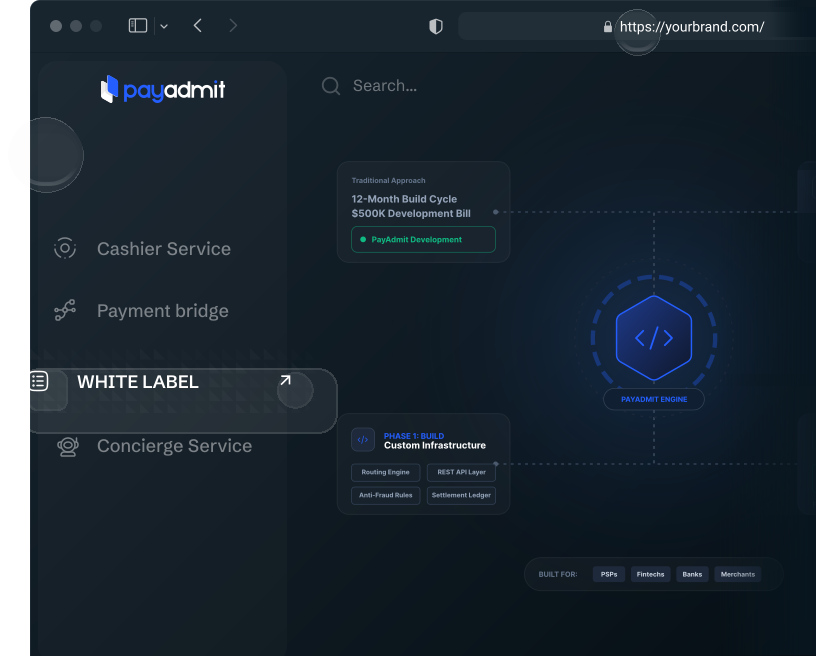
PayAdmit is a payment gateway software development company that helps PSPs, fintech businesses, banks, and merchants develop, deploy, and manage custom payment infrastructure, without the 12-month build cycle or the $500K development bill.

What Is Payment Gateway Development?
Payment gateway development is the process of building software that captures, encrypts, and routes payment data between a customer, a merchant, and the financial institutions that process the transaction. Every time a cardholder pays online, the gateway makes it work, securely, in milliseconds, within the compliance rules of card schemes and regulators.
For any company that processes payments at scale, a PSP selling gateway services to merchants, a bank extending digital payment capabilities, or an e-commerce platform handling millions of web transactions, owning the gateway software means owning the margin, the data, and the business relationship. Third-party gateways charge per-transaction fees, limit routing options, and put their brand at your checkout. Custom payment gateway development gives you full ownership of that layer.
Build vs. Buy: The Core Tradeoff
Building a custom payment gateway from scratch costs $500K–$1.2M and takes 12–18 months. If you want to understand exactly what that process involves, our detailed guide on how to build a payment gateway walks through every stage from architecture to certification. Licensing and customising a pre-built white label gateway software from PayAdmit costs a fraction of that and deploys in 1–2 months. Both paths give you a gateway you own. Only one is commercially viable for most fintech businesses. PayAdmit’s development model gives you the customisation of a bespoke build at the speed of a SaaS solution.
Who Needs to Develop
a Payment Gateway
Payment gateway development is relevant to any company that manages payment flows on behalf of others, or processes enough transactions that owning the infrastructure makes commercial sense.
| Business Type | Why They Develop a Gateway |
|---|---|
| Payment Service Providers (PSPs) | To own the gateway software they sell to merchants, eliminating third-party dependency and increasing margin per transaction |
| Fintech Companies and Startups | To build custom payment software for a specific vertical, subscription billing, crypto settlement, cross-border fintech, where generic solutions fall short |
| Banks and Financial Institutions | To extend digital payment capabilities to business clients through branded gateway software on compliant infrastructure |
| iGaming and Online Gaming Operators | To develop a high-volume payment gateway with smart routing, multi-provider redundancy, and AML/KYC compliance |
| E-commerce Platforms and Marketplaces | To own payment data, reduce per-transaction costs, and build checkout flows the web platform controls end-to-end |
| Software Companies and SaaS Platforms | To embed payment processing natively in their software and launch a new revenue stream without building from scratch |
Three Ways to Develop
a Payment Gateway
with PayAdmit
PayAdmit offers three distinct payment gateway development paths. Each delivers a fully functional gateway solution, the difference is the customisation level, infrastructure model, and time to launch

A payment gateway development path for businesses that want a custom checkout experience without the overhead of managing their own server infrastructure. PayAdmit provides a hosted cashier solution with 400+ payment method integrations, custom branding on the checkout page, real-time reporting, and full transaction management tools. The gateway software runs on PayAdmit’s PCI DSS infrastructure. Your business controls the merchant relationships, the routing rules, and the payment data.

Banks whose clients include fintech businesses need to provide more than a payment account. These clients need a complete white label solution, card gateway access, management tools and a secure service, that integrates into their own products. The bank that provides this retains the client relationship and the revenue. PayAdmit’s white label payment gateway for banks ships with the management tools and compliance modules banking clients expect.
CUSTOM PAYMENT GATEWAY DEVELOPMENT: WHAT IT INCLUDES
Every payment gateway development project with PayAdmit includes a defined scope of custom software work. The level of customisation in each layer depends on the development path you choose.

Transaction processing engine that captures, encrypts, and routes payment data between web checkout, acquiring banks, and card networks. Supports any transaction type: one-time, recurring, split, refund, chargeback.

Custom connectors to 400+ payment methods, card processing, digital wallets, internet banking, SEPA, local APMs, and crypto payment gateway integrations. Each integration is tested and certified before deployment.

REST API with webhooks, SDKs, and documentation. Enables any web platform, mobile app, or merchant system to connect via a single integration. API-first, every function accessible programmatically.

Custom payment pages, checkout flows, and admin panel interfaces. White label development includes custom domain, brand assets, and payment page templates.

Custom transaction routing rules directing each payment to the optimal provider by currency, card type, geography, or cost. Cascading logic retries failed transactions automatically.

PCI DSS Level 1 compliant data handling, tokenisation, and encryption. AML, KYC, and KYB workflow development. Antifraud integration via ZignSec, Kount, and Paydetect.

Real-time transaction monitoring, approval ratio reporting, settlement reconciliation, and custom report generation with role-based access control.
Technical Architecture of a PayAdmit Payment Gateway
Understanding the technical architecture behind payment gateway software development helps businesses make better decisions about the development scope, infrastructure requirements, and integration approach. Here is how a PayAdmit gateway is structured:

Every PayAdmit gateway is built API-first. The REST API layer handles all external communication: transaction submission from web or mobile checkout, merchant onboarding data, refund requests, and webhook notifications. The API layer supports versioning, idempotency keys, and multi-merchant data isolation. Any web platform or software system integrates via a single API endpoint.

The processing engine receives transaction data, applies configurable routing logic, communicates with acquiring banks and payment providers, and returns authorisation responses. Routing rules, cascading logic, and provider preferences are manageable from the admin panel without additional development work after launch. Every failed transaction automatically cascades to a backup provider, reducing approval losses without manual intervention.

PCI DSS Level 1 compliance is built into the development process from the start. All cardholder data is encrypted at capture and tokenised before storage. The security layer handles 3DS2 authentication and AML transaction monitoring. PayAdmit’s compliance module manages merchant KYB onboarding, customer KYC flows, and reporting thresholds, configurable per jurisdiction without custom development work. No sensitive payment data is ever stored on merchant web systems.
Develop a Payment Gateway from Scratch vs. PayAdmit: Full Comparison
When a company decides to develop a payment gateway, it faces a fundamental choice: build custom software from scratch or license and customise a pre-built development platform. Here is an honest comparison:
| Factor | Build from Scratch | PayAdmit Development Platform |
|---|---|---|
| Development time | 12–18 months minimum | 1 to 2 months to live gateway |
| Development cost | $500K–$1.2M | Fixed service fee |
| PCI DSS certification | 6–12 months + $50K–$200K | Included, Level 1 certified |
| Payment method coverage | Each integration requires custom dev | 400+ pre-built and ready |
| Routing and cascading | Custom software development required | Configurable out of the box |
| Compliance tooling | Separate dev or third-party | AML/KYC/KYB built in |
| Ongoing development | In-house team required | PayAdmit maintains the software |
| Branding / white label | Custom design, adds to timeline | Custom domain, brand, pages included |
| API documentation | Separate development deliverable | Complete docs from day one |
The case is clear: for any company that needs to develop a payment gateway and go live within a business quarter, custom development from scratch is not viable. PayAdmit’s model delivers the same ownership and customisation with a timeline and cost structure that works. For a detailed breakdown of pricing models, see our white label payment gateway price overview.
Payment Gateway Software Development and Compliance
Compliance is not an optional add-on to payment gateway development, it is a prerequisite for operating. Any company that wants to develop a payment gateway and process real transactions must meet the security and regulatory standards required by card schemes, acquirers, and financial regulators. PayAdmit builds compliance into every development project from the start.

PCI DSS Level 1 is the highest security standard in card payment processing, required for any business processing more than six million card transactions per year. PayAdmit’s entire development platform is PCI DSS Level 1 certified. When you develop a gateway on PayAdmit’s infrastructure, that certification covers your solution. No separate programme, no dedicated compliance team required.

Any gateway that onboards merchants must implement AML and KYC workflows. PayAdmit’s software includes built-in KYC merchant onboarding, KYB company verification, and AML transaction monitoring, configurable to the regulatory requirements of any target market.

Web payment gateway development requires that card data captured on a checkout page is encrypted before it reaches the merchant’s server. PayAdmit’s architecture handles this through tokenisation and direct-to-gateway data capture, the merchant web platform never handles or stores raw card data. This protects merchants from PCI DSS scope creep and reduces web environment data risk.
For businesses developing a payment gateway for European web markets, GDPR compliance and data residency must be designed into the software architecture before development begins. PayAdmit’s gateway includes configurable data residency, transaction data is stored in compliance with the regulatory requirements of your target market.
Payment Gateway Software Development for Fintech: Real Use Cases
Fintech businesses have the most to gain from owning payment gateway software. Generic gateways serve generic needs. For a broader look at building fintech infrastructure beyond gateways, our fintech software development practice covers the full scope.
Here are the fintech use cases where custom development delivers the clearest return:

A fintech company that wants to offer payment processing to merchants needs its own gateway software. PayAdmit’s white label development gives fintech PSPs a fully branded, custom gateway to sell under their own name, complete with merchant onboarding, transaction management, and real-time reporting. The fintech earns on every transaction. Development timeline: weeks, not months.

Fintech businesses operating across multiple markets need payment gateway software with multi-currency routing, local payment method coverage, and jurisdiction-specific compliance. PayAdmit’s gateway development supports any combination of currencies and local APMs, with routing logic that selects the optimal provider for each transaction based on currency, card type, and geography.

SaaS and subscription fintech companies need gateway software that handles recurring billing natively. PayAdmit’s development platform includes a recurring payment engine with custom billing cycles, failed payment retry logic, and dunning management, all configurable without post-launch development work. Learn more on our white label payment gateway for SaaS page.

iGaming operators need payment gateway software that handles high transaction volumes, multi-currency processing, chargeback management at scale, and AML compliance for regulated gaming markets. PayAdmit’s gateway development for iGaming includes smart routing optimised for approval ratios and antifraud monitoring tailored to gaming transaction patterns.
Payment Methods Included in Every
Gateway Development Project
One of the most significant advantages of developing a payment gateway with PayAdmit is the 400+ payment method library that is pre-integrated and available from day one. Connecting to payment methods individually through custom development takes months per provider. PayAdmit’s platform gives you the full library through a single integration.
| Category | Payment Methods Included |
|---|---|
| Card Processing | Visa, Mastercard, all card types, any geography. 3DS2, tokenisation, one-click, recurring. |
| Digital Wallets | Apple Pay and Google Pay on all deployments. PayPal, Skrill, and major e-wallets. |
| Bank Transfers | SEPA, SWIFT, and domestic bank transfers. Direct debit and account-to-account payment. |
| Local APMs | MB Way, iDEAL, Sofort, Bancontact, and 50+ local payment methods by market. |
| Crypto Payments | Cryptocurrency processing with fiat settlement. BTC, ETH, and stablecoin support. |
| Cash Solutions | Cash payment methods for markets where physical cash remains significant. |
WHY CHOOSE PAYADMIT FOR PAYMENT GATEWAY DEVELOPMENT
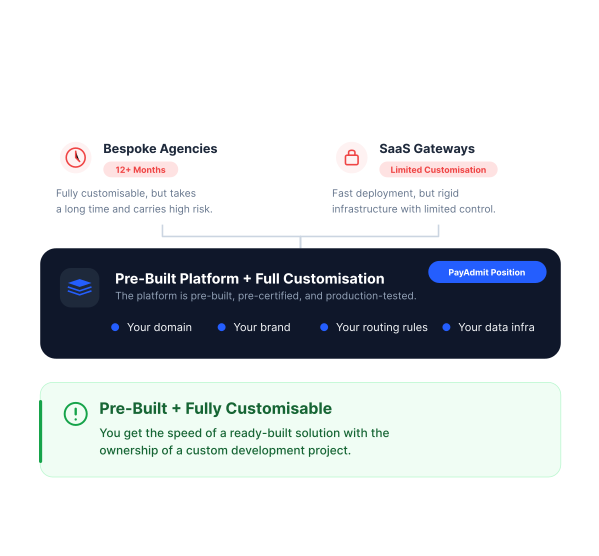
The payment gateway software development market falls into two categories: bespoke agencies that take 12+ months, and SaaS gateways with limited customisation. PayAdmit sits in a different position, pre-built, pre-certified, and fully customisable.
Pre-Built + Fully Customisable
PayAdmit’s gateway platform is pre-built, pre-certified, and production-tested. But every deployment is custom, your domain, your brand, your routing rules, your data infrastructure. You get the speed of a ready-built solution with the ownership of a custom development project.

A few weeks to a live payment gateway. Custom builds take 12–18 months. Competitors take 4–8 weeks.

PCI DSS Level 1 included in every project. No separate certification programme or compliance overhead.

400+ payment method integrations available from launch day. No per-integration development cost.

Full custom branding, routing logic, admin panel, and payment pages, standard in every development scope.

Three development paths, White Label, Cashier Service, Payment Bridge, to match any business model.

Real human support from real transaction managers and payment engineers, not a ticketing system.

Ongoing software updates and integration maintenance handled by PayAdmit post-launch.
The PayAdmit Payment Gateway
Development Process
Here is exactly what the payment gateway development process looks like when you work with PayAdmit, from initial
requirements to live production software:

We assess your business model, target markets, transaction volumes, and compliance requirements. Together we define the right development path and document the specific customisation requirements for your gateway software.

We identify payment methods and acquiring providers from the 400+ library relevant to your markets. Routing logic and cascading rules are defined based on your transaction mix, currencies, and approval ratio targets.

For White Label: dedicated servers are provisioned and your custom domain is configured. For all paths: gateway software is configured with routing rules, compliance parameters, branding assets, and admin panel customisation.

Full API documentation is available in your admin panel. Any web platform, merchant system, or existing software connects to the gateway using our REST API and SDKs. Developer support is included during this phase.

Full transaction flow testing across all connected payment methods. Security testing on the web-facing checkout and API layer. Compliance workflow testing across KYC, KYB, and AML modules. You sign off on the test suite before production launch.

The gateway goes live in production. Your team manages business operations from the admin panel. PayAdmit handles all ongoing software development, integration updates, security patches, and platform evolution.
Gateway work is one slice of a broader discipline: our payment software development page covers the full engineering surface, from ledgers to compliance tooling.
Frequently Asked Questions
Payment Gateway Software Development

Payment gateway software development is the process of building the technical infrastructure that captures, encrypts, routes, and settles payment data between a customer, a merchant, and the financial institutions involved in a transaction. It includes the API layer that web platforms connect to, the processing engine that handles routing, the security layer that protects card information, and the admin service software that merchants use to manage payments. Creating your own custom solution allows for total control over the transaction flow.
How Long Does It Take to Develop a Payment Gateway?
Building a service from scratch takes 12–18 months and costs $500K–$1.2M. Developing a gateway with a white-label solution takes 1–2 weeks. The difference is that this service software is pre-built and pre-certified, development time covers web customisation and configuration, not core infrastructure construction. This solution provides a faster route to market for any payment service provider.
What Does Custom Payment Gateway Development Include?
Custom payment gateway development includes a comprehensive service package:
- Core Infrastructure: A high-performance transaction processing engine.
- User Interface: Custom branding and web payment page development to maintain a seamless service experience.
- Global Reach: Integration with 400+ payment methods as part of the solution.
- Optimization: Smart routing and cascading logic to ensure every service remains reliable.
- Security & Compliance: PCI DSS Level 1 security layer and an AML/KYC/KYB compliance service module.
- Connectivity: REST API with full documentation for a robust service integration.
- Analytics: A real-time reporting dashboard to monitor every service interaction.
- Support: Ongoing software maintenance is included in this solution to ensure a high-quality service.
By choosing a managed service, you receive a professional service that functions as a complete solution for modern financial needs.
Do I need my own PCI DSS certification?
No. When you develop a payment gateway on PayAdmit’s platform, the PCI DSS Level 1 certification of our infrastructure covers your solution. For businesses deploying on dedicated servers, our team guides the certification process and the development scope already meets Level 1 requirements.
Can any web platform integrate with a PayAdmit gateway?
Yes. PayAdmit’s gateway software is built on a REST API with webhooks and SDKs. Any web platform, mobile app, or existing software system that supports standard API integration can connect to the gateway. Full API documentation is available from day one, with developer support included during the web integration phase.
What is the difference between a payment gateway and a payment processor?
A payment gateway is the software that captures and transmits payment data, it sits between the merchant’s web platform and the financial system. A payment processor handles the technical communication with banks and card networks. PayAdmit provides gateway software development. Acquiring and processing relationships connect through the 400+ provider integrations in the PayAdmit payment library.
Does PayAdmit serve businesses outside the UK?
Yes. PayAdmit is headquartered in the UK and provides payment gateway software development to businesses in the UK, USA, EU, and 40+ additional markets. Gateway deployments include local payment method coverage, multi-currency support, and compliance configurations for each target market.
What ongoing maintenance is included after launch?
PayAdmit handles all ongoing software development after go-live: payment method integration updates, security patches, compliance updates, and API documentation. You manage the business from the admin panel. We maintain the software, no in-house development team required.