
Legal entity verification
Confirmed registration, ownership structure, and beneficial owner identification.
Know exactly who you are doing business with before the first contract is signed. Insight Screening is a counterparty due diligence service that combines deep data analysis, expert review, and reputation checks. Verify your partners, vendors, payment providers, and clients with a complete intelligence report in your hands.
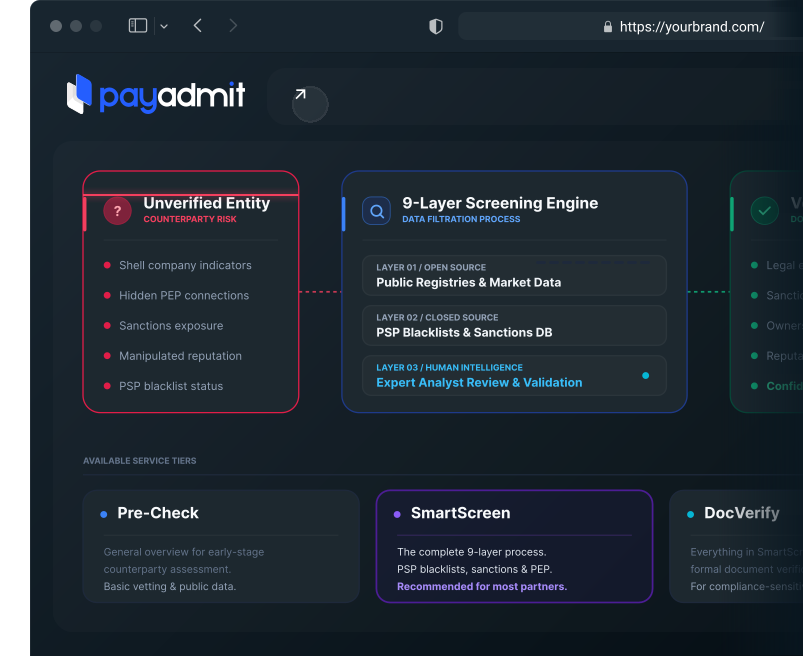
Onboard a bad partner and the damage hits in three layers: financial losses, regulatory penalties, and reputational fallout that follows your team into the next deal. Counterparty screening exists so that decision is informed, not a leap of faith. Insight Screening from PayAdmit gives you the complete intelligence picture before you commit, and pairs with antifraud risk management to keep watching once the deal is live.
Confirmed registration, ownership structure, and beneficial owner identification.
Public trust signals, internal blacklist checks, market reputation review.
Cross-reference against global sanctions lists and politically exposed persons.
A summary report delivered to you and you only. Not sold, not redistributed.
A summary report delivered to you and you only. Not sold, not redistributed.
The cost of skipping screening is always higher than the cost of doing it. A single fraudulent counterparty can wipe out months of growth. Insight Screening converts that risk into a documented decision before money changes hands.

Verified

Partial

Clear

Mixed signals

Not listed

Clear
Insight Screening goes beyond a quick API check. Each report runs through nine independent verification layers, performed by specialists using a tailor-made set of data analysis methods. The result is a complete picture, not a single binary score, the same control you get when you create a payment gateway built for your brand and decide who runs on it.

Comprehensive overview based on publicly available data, registry information, and known business profile.

Verification of the counterparty’s legal status, registration, and the reality of all participants in the corporate structure.

Multi-angle website assessment, evaluated both from a technical expert perspective and from the perspective of a real customer.

Collection and verification of the counterparty’s official contact data, communication channels, and listed representatives.

Detailed analysis of the counterparty’s actual scope of business activity, product portfolio, and operational footprint.

Public reputation review, market trust signals, and cross-reference against internal blacklists maintained by payment service providers.

Review of contract terms, reliability indicators, risk levels, and compliance with established industry business practices.

Identification of possible risks, red flags, and negative facts that could affect the counterparty’s standing or future cooperation.
A final assessment of the advantages and disadvantages of cooperation, with documented recommendations for next steps.
Any business that enters commercial relationships with external parties carries counterparty risk.
Six business profiles see the most direct payoff from systematic screening before signing.
Tell us about the company you want screened. We come back with a scoping
confirmation and a recommended package within one business day.

Not every counterparty needs a full document audit. Not every check is a quick lookup.
Insight Screening comes in three packages, each scoped to a different level of decision risk.


Not sure which package fits your case? Our team scopes the right tier during the initial conversation, based on the
counterparty profile, the decision value, and the regulatory exposure involved.
Insight Screening combines three independent data layers. Each layer answers
a different question about the counterparty. Together they give the report its depth.
Government business registries, regulatory filings, trade databases, news media, and other publicly accessible records that establish the counterparty’s official footprint.
Sanctions lists, PEP databases, and internal blacklists maintained by payment service providers across the industry. These reveal risk signals that open data does not surface.
Direct review by experienced analysts who validate findings, cross-reference signals against industry context, and filter out false positives created by manipulated reviews or competitor noise. To see how risk patterns differ from one sector to the next, you can read our guide to high-risk business industries and how to navigate them.
Pure API screening misses what people catch. Automated tools flag mismatches. Trained analysts decide whether a mismatch is a real risk or noise. Insight Screening combines both.
Counterparty risk does not come from one obvious problem. It comes from patterns that only appear when multiple data points line up. Six red-flag categories that Insight Screening systematically checks for.

Recently registered entities with no real operational footprint, paper-only addresses, or ownership structures designed to obscure beneficial owners.

Suspiciously uniform positive reviews, coordinated promotional content, or patterns suggesting the counterparty has actively managed its online image to hide concerns.

Direct or indirect connections to sanctioned jurisdictions, sanctioned individuals, or politically exposed persons that create regulatory liability.

Patterns of court proceedings, regulatory actions, contractual disputes, or chargeback claims that reveal an unstable operational track record.

Presence on internal blacklists maintained by payment providers, acquirers, or other industry participants. A strong signal of past misconduct invisible in open data.

Mismatches between the counterparty’s stated business model and its actual website, products, traffic patterns, or contractual obligations on offer.
Most organisations settle into one of three approaches. Each has a real cost. Only one of them treats counterparty
screening as a strategic input instead of a checkbox.
Real situations where running Insight Screening before the decision saves
the business from cost it would otherwise carry for months or years.
Before integrating with a payment provider, verify their licensing, ownership, market reputation, and standing inside PSP networks. The wrong integration can mean lost transactions, stuck settlements, or compliance exposure.
For PSPs and acquirers signing larger merchants, the screening prevents reputational and chargeback damage from onboarding a counterparty that turns out to be in a different business than they declared.
Entering a new market through a local partner carries the partner’s reputation along with the contract. Screening confirms regulatory standing, ownership, and the absence of sanctioned jurisdiction ties before market entry.
A short walkthrough with our team: we look at the counterparty profile, recommend the right
package, and confirm the screening scope before any commitment.
Generic KYB tools exist. Internal teams exist. Insight Screening sits in a different position: a counterparty due diligence service built by payment industry specialists, using data sources and review processes that pure-software tools cannot replicate, the same specialist-led approach behind how to own a payment gateway rather than wiring one together yourself.
Every report reviewed by experienced specialists who validate findings, filter false positives, and provide context-aware recommendations.
Built by a payment company for payment industry use cases. Access to internal PSP blacklists and industry network signals generic KYB tools never see.
The final report is an intellectual property product, delivered to you exclusively. Not resold, not redistributed, never shared with third parties.
Counterparty screening across 40+ markets. Access to corporate registries, regulatory databases, and sanctions sources worldwide.
One report. One screening team. One contract. No multi-vendor stack to manage, no API integration overhead, no analyst hiring cycle. Insight Screening is delivered as a service, not a tool to operate, the same single-integration logic behind our payment bridge, which replaces a multi-vendor stack with one connection.
The output of every screening engagement: a structured set of business outcomes that translate directly into
safer commercial decisions.

Fraudulent or high-risk partners surfaced before any contract is signed, any integration is built, or any payment volume is exposed.

Adherence to AML standards, sanctions requirements, and counterparty due diligence obligations across your operating jurisdictions.

Documented risk assessment for every counterparty: red flags identified, severity classified, recommendations clearly stated.

Reports are intellectual property products delivered only to you. Not published, not resold, not shared with the counterparty being assessed.

One unified screening process across all counterparties. Consistent methodology means consistent decisions, faster onboarding, fewer surprises later.

Every screening creates an audit-grade record of the diligence performed. Useful for internal governance, regulatory inquiries, and board reporting.

You receive a complete summary report covering every layer of the screening process. The report is an intellectual property product delivered exclusively to you. It is not published, resold, or distributed to third parties.
The depth of the report depends on the package selected: Pre-Check, SmartScreen, or DocVerify.
The screening helps your business detect fraud, manage counterparty risks, comply with AML and sanctions regulations, and maintain confidentiality throughout the diligence process. It turns counterparty risk from a guess into a documented decision, the same logic that drives antifraud risk management on every live transaction.
The cost depends on the selected service package. Pre-Check covers a general overview, SmartScreen runs the complete nine-layer process, and DocVerify adds formal document verification on top.
Talk to our team for a quote tailored to your specific counterparty profile and screening scope.
Red flags are documented warning signals that emerge during the screening process and indicate potential fraud, regulatory exposure, or operational risk. They allow your business to keep pace with AML standards and identify problems before they affect operations.
As a result of the Insight Screening process, you get a complete profile of the counterparty. If there are signs of fraud, scam patterns, or sanctioned ties, this is clearly indicated in the final report.
The biggest challenge is data quality. During the screening process, a large array of information is processed, much of which may be false, unreliable, or planted by competitors or other parties trying to tarnish a reputation.
The counterparty itself may have flooded the internet with manipulated positive reviews and promotional posts. Producing an accurate report requires significant analyst time and a methodology that filters noise from signal, all while meeting legal regulations and delivery deadlines.
The choice depends on your business needs and the risk profile of the counterparty.
For a general overview of a counterparty at the early vetting stage, request Pre-Check. For complete nine-layer screening before signing, request SmartScreen. When the engagement requires formal document verification, choose DocVerify.
If you are not sure which package fits your specific case, our team scopes the right tier during the initial conversation.
No. Insight Screening serves an informational and analytical function based on in-depth data processing. The report provides the intelligence layer your legal and compliance teams need to make their decisions, but it does not replace formal legal due diligence required for specific transactions.
The screening complements legal review by surfacing risk signals earlier in the process.
The screening allows your business to assess and manage potential risks by giving you deep, structured knowledge of the counterparty before commitment. Detecting and mitigating risks as early as possible helps maintain a safe business environment and prevents reputational, financial, or regulatory crises.
Yes. The screening covers OFAC, EU, and UN sanctions lists, politically exposed person databases, and direct or indirect connections to sanctioned jurisdictions, including the Russian Federation and other restricted countries.
Closed-source verification combines with open-source data and analyst review to produce a complete sanctions exposure assessment.
Absolutely. Small businesses face many of the same counterparty risks as large companies, and often have less internal capacity to investigate. Even the Pre-Check package can help avoid unreliable or risky partners and ensure regulatory compliance.
For larger or more complex engagements, the SmartScreen and DocVerify packages provide proportional depth.
Delivery timing depends on the package selected and the complexity of the counterparty. Pre-Check engagements typically deliver fastest. SmartScreen and DocVerify involve deeper analysis and require additional time to complete the full nine-layer process.
The exact timeline is confirmed during the initial scoping conversation with our team.
Automated KYB tools provide fast, shallow data lookups: registry checks, sanctions list cross-references, and basic document verification through an API. Insight Screening combines that automated data layer with analyst review, payment industry network intelligence, and reputation analysis that pure-software tools cannot replicate.
For high-stakes counterparty decisions where context matters, the human review layer is the difference between a flagged result and an informed verdict.

