

Payment service providers adding local transaction methods, new acquiring relationships, or vertical specific app features without slowing the broader roadmap.
Custom Fintech Software Development for PSPs, Banks, and Fintech Operators
PayAdmit builds custom fintech software on top of a production ready white label transaction platform. Get the developer depth of a dedicated software engineering team and the launch speed of a configured solution, in one service engagement. Our development services combine bespoke financial software with the proven core that handles transactions, compliance, and reporting.

What Is Tailored Fintech Engineering
Bespoke fintech engineering is the development work that adapts a payment solution to the specific needs of a business. It combines two layers. The core financial software handles transactions, compliance, and reporting, and it is the same software dozens of operators use. The bespoke development layer reflects the business model, the target market, and the differentiating features that set the product apart.
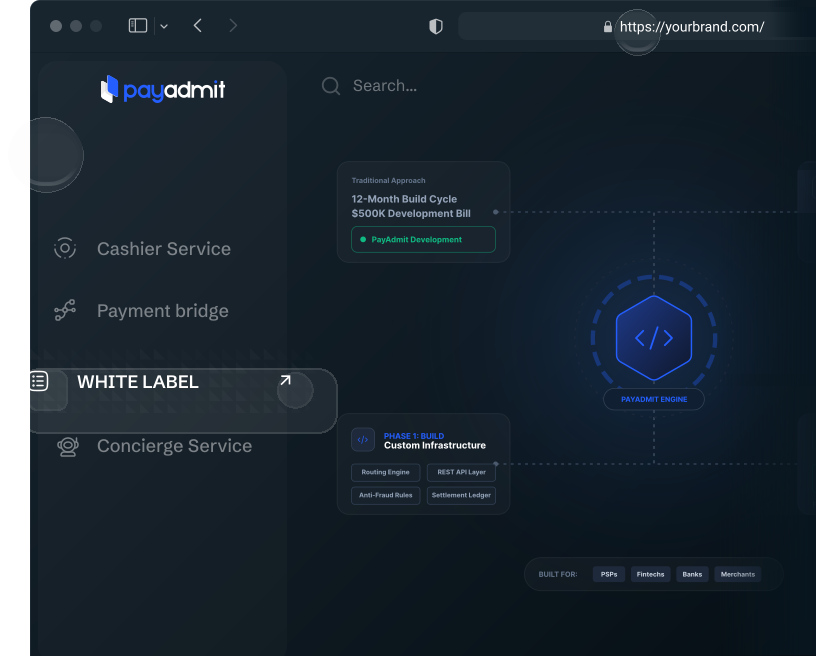
For most operators, a full from-scratch build takes 12 to 18 months and several million dollars. The alternative is bespoke development on top of a white label payment solution. The core software ships pre-built and pre-certified, while the bespoke development layer fits the operator brand, the app experience, and the workflow the team actually uses. This pattern combines the speed of configured solutions with the flexibility of custom financial software development.
Paired service model
PayAdmit delivers fintech software development as a paired service. The white label payment gateway software handles the commodity layers, and our software team handles the customisation that makes the system specifically yours. The result is a transaction app that ships fast, looks unique, and scales without the operational debt that kills cheaper alternatives.
Who Needs Bespoke Financial Engineering
Custom fintech development fits operators with a clear business model who want to ship a differentiated product faster than a from-scratch build allows.

Regulated financial businesses with existing infrastructure that use bespoke engineering to ship new transactions, lending, or wallet products without changing the underlying core.

Vertical SaaS apps, marketplaces, and non-financial businesses adding transactions functionality that integrates cleanly with the existing app.

Operators with specific regulatory, fraud, and conversion requirements that need production grade performance from day one.

Early stage businesses with a vertical thesis that need to validate the market before committing to in-house infrastructure.

Teams operating across regions that need a single engineering partner covering compliance, local methods, and multi-currency settlement.
Why Tailored Engineering Matters
Most fintech development projects fail because the development approach does not match the business stage. A from-scratch software build takes too long and burns too much capital for early stage products. Pure configuration of white label solutions leaves no room for the differentiating features that turn a product into a business, and no room for the app work that makes it usable.
The cost of slow development. A product that ships 12 months late loses the market window. Bespoke development on a pre-built platform cuts time to market from years to months.
The cost of generic solutions. A product that looks like every other white label launch wins no merchants. Tailored services on a proven core deliver the brand identity and workflow depth that drive adoption.
The cost of compliance gaps. Fintech products built without compliance discipline face expensive retrofits. Bespoke development on a PCI DSS Level 1 ready platform inherits the compliance baseline and security architecture from day one.
PayAdmit Fintech Development Services
A packaged service engagement that combines white label payment software with bespoke engineering. Operators get the launch speed of a configured solution and the flexibility of a bespoke build.

PCI DSS Level 1 ready core handling card processing, 400+ methods, multi-acquirer payment routing, antifraud and risk, and the compliance rails your business runs on.

Our software team handles the customisation: brand-specific checkout flows, branded merchant dashboards, vertical-specific risk rules, tailored reporting, and workflows that reflect each operator's business model.
1 to 2 months from contract to live transactions. The team handles platform configuration, third-party connectors, compliance documentation, and merchant onboarding.

After launch, PayAdmit continues engineering across the lifecycle: platform updates, new transaction methods, compliance changes, vertical expansions, and features that emerge from real production data.

Advisory on transaction platform architecture, security, compliance, and the operational practices mature operators use. The team is available for scoped strategic engagements.
How It Works
Four phases with clear deliverables and timelines. Across all four, the operator has a dedicated PayAdmit team: a delivery lead, a platform engineer, a customisation engineer, and a compliance specialist.

Two week scoping engagement mapping the business model, target market, regulatory perimeter, and differentiating features. Output: a development plan and customisation specification.

Platform configured for brand, market, and methods. In parallel, the custom team builds checkout flows, dashboard app, integrations, and vertical workflows. Runs 4 to 8 weeks.

Bank connectors, payment method providers, KYC and AML services, and third-party tools integrated. Compliance certification and security testing. Runs 2 to 4 weeks.

The operator goes live with a fully branded transactions system. Engineering and operational services continue across the product lifecycle.
Development Capabilities Out of the Box
The platform supports a broad set of custom fintech capabilities out of the box. Bespoke development handles the gaps that make each operator unique.

Cards, account-to-account rails (SEPA Instant, Pix, UPI, Open Banking), e-wallets, and 400+ local methods across 40+ markets.
Multi-acquirer routing based on real-time authorisation rates and processing cost. Cascading logic handles failover automatically.
Built-in fraud screening with configurable rules, ML models, and integrations with leading fraud data providers.
Integrated onboarding with document upload, biometric verification, and the monitoring service regulated operators use every day.
Branded dashboard and app with real-time transaction data, reporting, and operational software your merchants use every day.

Automated reconciliation, multi-currency support, FX handling, and financial reporting for accounting and audit.
Clean REST APIs and SDKs, comprehensive webhook delivery, libraries for major languages, and documentation developers use.
Third-party connectors for accounting, ERP, CRM, identity providers, and vertical-specific tools operators pair with the transaction app.
Developer-Friendly Infrastructure & Security
Built for engineering teams. The infrastructure decisions reflect what modern fintech teams use day to day, and security is baseline rather than a feature.
REST endpoints with consistent design, comprehensive OpenAPI specs, and SDKs for Java, Python, Node.js, Go, and PHP. Every payment endpoint accepts an idempotency key. Sandbox mirrors production for safe testing.
Operator engineers work directly with PayAdmit engineers rather than through generic support queues. Custom development questions get specialist answers, and documentation is written for developers who need to ship.
PCI DSS Level 1 ready. Encrypted data at rest and in transit, tokenisation at capture, strict access controls, key rotation, and audit logging that regulators and bank partners use during due diligence. 99.99% uptime SLA.
PayAdmit vs From-Scratch Fintech Development
The choice comes down to four dimensions. For most operators, the PayAdmit development model delivers faster, cheaper, and lower risk outcomes than from-scratch software alternatives.
| Dimension | From Scratch | PayAdmit Bespoke |
|---|---|---|
| Time to market | 12 to 18 months from project start to live transactions | 1 to 2 months for core deployment, bespoke layers added in parallel |
| Total cost of ownership | $1.5M to $5M in initial engineering plus ongoing maintenance | $100K to $500K annually in platform services plus customisation scope |
| Compliance & security risk | Full PCI DSS certification, security architecture review, and compliance documentation on you | Certified software baseline inherited from day one |
| Long-term flexibility | Full ownership of every layer, but a large ongoing maintenance burden | Full flexibility on the customisation layer; PayAdmit maintains the core |
The exception is operators with truly unique core payment logic that no white label solutions can serve, however much custom development is layered on top. For those, the alternative is to build a payment gateway from scratch with full ownership.
Use Cases
Bespoke financial software development through PayAdmit covers a wide range of operator profiles, whatever form the app finally takes.
A European PSP expanded into Latin America and added Pix, Boleto, and regional acquiring in 8 weeks from contract to first live transaction.

A vertical SaaS app serving healthcare providers added card, ACH, and wallet payments under the platform brand through PayAdmit bespoke development.
A regulated iGaming operator added new methods, vertical fraud rules, and high-volume capacity in a 12 week project that tripled transaction capacity.
A neobank shipped the local transactions, KYC, and compliance stack for a new geography in 10 weeks versus a 14 month from-scratch estimate.
A B2B marketplace added split payments via a payment bridge, escrow flows, and supplier payouts without disrupting existing customer experience.
A crypto exchange added fiat off-ramps for retail customers, integrating bank rails with the existing crypto app under a compliant settlement design.
Scoping a Custom Fintech Software Development Project
Separate the platform from the product. The first scoping decision in any fintech software development project is which development layer the work belongs to. Certified payment infrastructure, ledger software, and the compliance baseline are commodity development that dozens of financial operators use in the same form. The customer-facing app, the pricing rules, and the data model that describes your merchants are where custom fintech development actually earns its cost. Our overview of fintech software development covers how those two layers are usually split.
Write the data model before the interfaces. Financial software development lives or dies on the data model. Transaction records, settlement data, merchant hierarchies, and audit data all outlive whichever app consumes them, and reshaping them later is a migration rather than a refactor. Development teams that agree the data contracts first ship faster in month six, even when it feels slower in month one.
Separate the solutions you buy from the solutions you build. Most financial products end up as a stack of bought solutions with a thin custom development layer on top, and the operators who use that split deliberately spend far less than the ones who discover it late. Certified solutions cover the regulated plumbing; custom software development covers the parts your customers actually notice in the app they use every day. Financial operators who get that boundary right spend their development budget once.
Decide who does the development. An in-house software team, a development partner, or a mix of the two all work; what fails is leaving the question open past the architecture phase. Practical guidance on that choice sits in how to hire fintech software developers, and the delivery-side view in fintech software development services.
Design the app surface early. Most operators ship at least two: a merchant app and an internal operations app, both consuming the same APIs. Each app needs its own development track, its own data views, and its own security model, because an operations app that exposes raw customer data is a compliance finding waiting to happen. Fintech teams routinely underestimate how much development the second app costs. Deciding whether each app is a native build or a web application keeps the development estimate honest.
Budget for the work that never ends. Custom financial software development never really stops, and the recurring work is predictable: card scheme rule changes, new payment methods, certification renewals, and the security patching that regulated solutions require. Operators who plan only the initial build discover this in year two. Our breakdown of payment software development sets out where that ongoing effort lands.
Plan how the software is used, not just what it does. A financial app that support staff cannot use at speed generates cost on every ticket, and one that merchants find confusing generates churn. Budget development time for the internal tooling, the reporting an operations team uses daily, and the app states nobody demos: failed transactions, partial settlements, and stale data. These are the details that separate financial software people trust from software they merely tolerate, and they are cheap to build during development and expensive to retrofit.
Prove the fit before you commit. Before signing a software development contract, run a short discovery against real data and real transaction volumes rather than a slide deck, and let the development team use the actual integration surface. If a configured platform plus a thin custom development layer covers the requirement, that is the cheaper answer for most financial products, and the comparison in white label payment gateway software is the honest place to test it. If it genuinely does not, a fintech solutions software development company is the right partner for the full software build, and the development scope should be written down before anyone starts.
Frequently Asked Questions
How long does the engagement take?
Platform deployment runs 1 to 2 months. Bespoke scope adds time depending on depth: simple brand customisation runs in parallel with deployment; deep vertical workflows add 4 to 8 weeks.
What is the cost through PayAdmit?
Platform service typically runs $100K to $500K annually depending on transaction volume and feature set. Bespoke development scope varies; most engagements run $50K to $300K for initial customisation, with ongoing services scoped quarterly.
Does PayAdmit handle regulated fintech operators?
Yes. The platform serves transactions service providers, regulated fintech operators, and licensed financial services businesses across 40+ markets. The security and compliance baseline supports regulated use cases out of the box.
Can bespoke development extend the platform with proprietary features?
Yes. The platform exposes extension points for tailored risk rules, branded checkout flows, custom merchant dashboards, and bespoke integrations.
What happens after launch?
PayAdmit continues to deliver engineering and operational services across the product lifecycle, including platform updates, compliance changes, new market expansions, and feature additions.
How does this compare to hiring an in-house team?
In-house teams cost more, take longer to assemble, and require ongoing recruiting investment. The PayAdmit service model delivers developer depth without the recruiting cost or the multi-year build cycle. Most operators use the combined model.