
From scratch, 12 to 18 months to a production payment system. On a licensed core, one to two months for the technology, with the banking and licensing workstreams running three to six months in parallel either way.
HOW TO BUILD A PAYMENT SYSTEM: A 2026 ARCHITECTURE AND LAUNCH GUIDE
Building a payment system in 2026 means choosing an architecture, integrating bank rails and card networks, and engineering for the security, scale, and compliance that real payment volume demands. This guide walks through the components of a payment system, the order to build them in, and the operational discipline the system needs once payments are live.
29.07.2026
Updated:
What a Payment System Actually Does
A payment system is the software that captures a payment intent from a customer, validates it, routes it through the right bank rail or card network, handles the processing with an acquirer, settles funds to the merchant, and provides the reporting and dispute support that follows every payment. It is the operational core of a payment business, and it is a regulated piece of software from the first line of code.
The question of how to build a payment system usually arrives disguised as an engineering question. It is not only that. A payment system inherits PCI DSS scope, KYC obligations, and the operational compliance that payment processing workloads carry. The compliance posture shapes the architecture as much as the throughput requirement does. For context on what that baseline looks like in practice, see our security and compliance overview.
The work spans five layers: checkout, validation, routing, settlement, and reporting. Each one matures on its own schedule. Teams new to payment software consistently underestimate how many concerns a production payment system covers. The customer-facing payment app is the smallest layer of the whole build; operational reliability, fraud monitoring, financial reconciliation, and merchant support carry most of the engineering weight and almost all of the ongoing cost.
Put plainly, a payment system has to do all of the following before it is worth calling one:
- Accept a payment request and return a predictable, idempotent answer to the merchant
- Decide which acquirer or payment method should carry that payment, and why
- Record every payment movement in a ledger that survives restarts, retries, and corrections
- Recover payments that fail on the first attempt without charging the customer twice
- Screen each payment for fraud and sanctions risk before it reaches the network
- Reconcile the system's own records against the settlement files the banks send back
- Give merchants the reporting and support they need to run their own books
A system that does the first two and none of the rest is a demo. The distance between a working payment prototype and a payment system that can be audited is where most of the real building happens.
The system is the product
Payment fragmentation, payment economics, and falling software cost push more teams to own a payment system rather than rent a gateway. That is a reasonable instinct, but ownership means owning reconciliation, incident response, and merchant support too. A companion read on the commercial side of the same decision: how to create a payment processing company.
Build, Buy, or Assemble: Three Routes to a Payment System
Before any architecture diagram, a team has to decide how much of the payment system it intends to write. There are three honest answers, and the difference between them is measured in years.
Building From Scratch
Every component of the payment system is written in-house, from the API layer to the reconciliation engine. This route makes sense when the orchestration logic itself is the differentiator, when senior payment engineers are already on the team, and when 12 to 18 months can pass before the first payment settles. The deep version of this path is covered in our guide to building a payment gateway.
Licensing a Payment Platform
The core payment system is licensed and configured rather than written. Timelines compress to one or two months for the technology, and the PCI DSS baseline arrives with the platform. Most new operators land here, because their differentiation lives in merchant relationships or vertical focus rather than in payment mechanics.
Assembling a Hybrid
A licensed core carries the regulated, undifferentiated parts of the payment system (the vault, the connectors, the ledger) while the team engineers the routing logic or the merchant experience on top. In practice this is how most payment systems look after three years, whichever route they started on.
None of the three is universally right. What is universally wrong is choosing from scratch because the team wants to build, then discovering in month nine that reconciliation and compliance consumed the runway that was meant for the differentiating work.
Core Architecture and Components
Production payment systems converge on roughly seven components. Each one has a clear interface, and most failures come from merging concerns across them until the system becomes rigid.
Payment API Layer
Accepts payment requests, returns transaction status, and emits webhooks. Idempotency keys, predictable error codes, and reliable webhook delivery are mandatory rather than nice to have. The API design is the developer experience every merchant judges the payment system by.
Orchestration Engine
Sits behind the API and decides what the payment system should do with each payment: which acquirer to pick, which routing rules apply, how to cascade on decline, and which downstream services to trigger. This is what separates a payment system from a simple gateway.
Bank and Network Connectors
Each acquirer, card network, and alternative payment method needs its own connector with its own quirks, timeouts, and error vocabulary. A mature payment system supports many connectors through a payment bridge and lets orchestration choose between them at runtime.
Payment Ledger
The source of truth for every payment, every settlement, and every adjustment the system records. It needs an ACID database and carefully designed transactional boundaries. Mistakes here create reconciliation work that never ends.
Risk and Fraud Service
Every payment runs through risk scoring before authorisation, combining rules, machine-learning models, and external signals in real time. The discipline behind this component is covered in antifraud and risk management.
Merchant Dashboard
Payment activity, settlement reports, dispute queues, and configuration. It is the merchant-facing surface of the payment system, and the place where a weak build generates support tickets forever.
Reconciliation Engine
Settlement files from banks and card networks arrive in different formats, at different times, and sometimes with corrections to records the system already closed. The engine matches them against the ledger and surfaces every discrepancy for a human to resolve.
The Order to Build Them In
Teams building a payment system for the first time usually start with the checkout, because it is visible. That is the wrong end. Build the ledger and the API contract first, then the connectors, then orchestration, then the dashboard.
The reason is that the mistakes compound in one direction only. A payment system with a beautiful checkout and an unreliable ledger cannot be fixed incrementally, because every payment it has already recorded is suspect. A payment system with a solid ledger and a plain checkout can be improved every sprint.
The Payment Ledger and Why It Comes First
The ledger is the component teams regret rushing. Every other part of a payment system eventually asks it a question: did this payment happen, how much of it settled, what has been refunded, and what does the merchant actually get paid.
Three properties matter. The ledger must be append-only in spirit, so a correction is recorded as a new entry rather than an edit to history. It must be strongly consistent, because a payment balance that is eventually consistent is a payment balance that is sometimes wrong, and payment processing tolerates no ambiguity about who is owed what. And it must model money in minor units with an explicit currency, never in floating point.
The status model deserves the same care. A payment moves through intent, authorisation, capture, settlement, and possibly refund, chargeback, or reversal, and each transition needs to be legal, logged, and reversible only in the ways the card networks permit. Systems that model payment status as a single mutable field spend their second year untangling it.
Reconciliation is where a weak ledger surfaces. Month-end is the moment a payment system either agrees with the bank or does not, and the teams that treat reconciliation as a reporting feature rather than a core function discover the gap when finance does.
Payment Orchestration and Routing
Orchestration is the layer that decides where each payment goes and which processing path it takes. It is also the layer with the clearest measurable payback, because routing quality shows up directly in authorisation rates.
Routing rules. Static rules express simple preferences: route payments above a threshold to acquirer A, everything else to acquirer B, this currency always to that connector. Rule-based routing handles most of the traffic in most payment systems.
Smart routing. Historical authorisation data picks the acquirer most likely to approve a given payment, based on card BIN, issuer country, amount, and method. The engine learns from declines and adjusts. The mechanics are covered in payment routing infrastructure.
Cost optimisation. Different acquirers charge different fees for the same payment. When authorisation rates are comparable, orchestration should take the cheaper path, and the payment system should be able to prove afterwards why it chose what it chose.
Checkout ordering. Orchestration also decides which payment methods a customer sees first. Ordering by what actually converts in that market lifts completion by several percentage points, and costs nothing but the data to decide it.
3DS and authentication. Strong Customer Authentication protects the payment but costs conversion when applied indiscriminately. A well-built payment system triggers 3DS only when risk scoring or regulation requires it, and treats exemptions as a first-class part of the routing decision.
Cascading and Failover Logic
Cascading is what the payment system does when a payment fails on the first attempt. Tuned well, cascading recovers 10 to 15% of payments that would otherwise be lost during processing, which is material money at any real volume. It deserves to be designed with the orchestration engine, not bolted on later.
Acquirer Cascading
When acquirer A declines, orchestration retries the payment through acquirer B. Good cascading respects rate limits, never retries an obvious fraud, and keeps the customer experience clean, one payment attempt from the customer's point of view, several from the system's.
Method Cascading
When a card payment fails outright, the system can offer the customer an account-to-account transfer or a local method instead. This preserves conversion that would otherwise be lost entirely, and it is one of the strongest arguments for supporting more than one payment method per market.
Retry Policy
Soft declines retry after a short delay; hard declines never retry. Policy is configured per acquirer and per decline reason, and every retry carries the original idempotency key so the payment system cannot double-charge under any ordering of network failures.
Observability
Every cascade emits events the operator can analyse later. Build this from day one, because cascading can only be tuned against real decline data, and a payment system that discards that data is guessing.
How to Build a Mobile Payment System
Phone traffic is the majority of payment volume in most markets, and the phone experience sets the bar for the whole payment system. Building the mobile side involves decisions that simply do not arise on desktop.
Native SDK or Embedded Web
Native iOS and Android SDKs unlock Apple Pay, Google Pay, biometric authentication, and on-device tokenisation through the Secure Enclave or Android Keystore. Embedded web ships faster and is easier to update, but gives up wallet integration. Many payment systems ship web first and add native once volume justifies the maintenance.
Wallet Support
Apple Pay and Google Pay carry a large share of mobile payment volume in mature markets. Support both from launch, and add the regional wallets that matter in each target market rather than assuming card coverage is enough.
Biometric Authentication
Face ID, Touch ID, and fingerprint sensors remove the friction of typing card details and improve the security posture at the same time. Payments authenticated biometrically convert better and dispute less.
On-Device Tokenisation
Use network tokens rather than raw card numbers wherever the rails allow it. The token replaces the card number at the network level, improves the security of stored credentials, and cuts the PCI DSS scope of the payment system substantially.
App Store Policies
Mobile apps must navigate App Store and Play Store review rules, and Apple in particular is strict about which payment flows may run inside an app rather than through its own payment system. Read the current policy before designing the flow, not after the first rejection.
Degraded Network Conditions
Mobile payments happen on weak signal. A payment system that times out instead of resuming loses volume desktop never sees, so design for retry, resumption, and clear customer messaging when the network is the problem.
Security: PCI DSS, Tokenisation, and Fraud
Security is the constraint that shapes a payment system more than any other. Three disciplines separate systems that scale safely from systems that are compromised in year one, and all three are cheaper to build in than to retrofit.
PCI DSS Scope and Tokenisation
Level 1 applies to operators above six million card transactions a year, but scope discipline matters at every size. Tokenise card data at the earliest possible touchpoint so only the vault sits inside PCI scope and the rest of the payment system operates on tokens it cannot misuse.
Encryption and Key Management
Every sensitive field at rest is encrypted with keys held in an HSM or cloud KMS, and every field in transit moves over TLS 1.3. Key rotation and access separation are part of the security design, not an operations task to define later.
Real-Time Fraud Scoring
Every payment passes through fraud scoring that combines rules, behavioural signals, device fingerprinting, and models. Fraud rings actively probe new payment systems, so launching without real-time scoring is a decision to lose money in the first weeks.
Audit Trail and Patching
Every payment action, configuration change, and dashboard login writes a tamper-evident audit record. Alongside that, the payment system maintains a current SBOM, scans dependencies, and patches on a defined cadence: the unglamorous half of security that auditors examine first.
Compliance and the Regulatory Perimeter
Beyond PCI DSS, a payment system operates inside obligations that depend on its markets and services. Compliance is a design constraint; treating it as a launch checklist produces expensive retrofits at exactly the wrong moment.
Payment Licensing
A Payment Institution or EMI licence in the EU, FCA authorisation in the UK, money transmitter licences state by state in the US. The licence determines what the payment system is allowed to do and how the operator may describe it.
KYC and KYB
Customer and merchant due diligence at onboarding, with document verification and ongoing monitoring. These workflows live inside the payment system or immediately beside it, and their speed sets how many merchants can be activated each month.
AML Monitoring
Continuous anti-money-laundering monitoring across payment activity, combining rules, models, and a case management workflow so that every alert reaches a documented conclusion.
Sanctions Screening
Every merchant and counterparty screens against sanctions lists, with data provider integrations updated in near real time and a record of each check the payment system performed.
Data Protection
GDPR, CCPA, and their equivalents. The architecture has to support data residency, deletion requests, and the audit trail a regulator can ask for without a special engineering project.
Operational Compliance
Incident response, change management, vendor management, and business continuity. Audits look as closely at operational practice as at the software itself.
Building the Team and the Support Function
A payment system is not finished when it processes its first payment. It is finished when someone can answer a merchant's question about a payment from three weeks ago in under five minutes, and that is a staffing question as much as a software one.
The engineering side needs people who have seen payment failure modes before: idempotency, partial failures, settlement timing, and the specific ways card networks behave under load. The compliance side needs an officer who can own the AML and sanctions programme rather than approve it. And the support side needs staff who can read the ledger, explain a decline, and escalate a genuine defect.
Support is also a design input. Every ambiguous status, every unexplained decline code, and every reconciliation gap becomes a support ticket the business pays for repeatedly. Building good internal tooling (a payment search that works, a clear event timeline per transaction, a one-click evidence pack for chargebacks) is cheaper than staffing around bad tooling forever.
Plan roughly one operations or support hire for every fifty active merchants in the early stage, and expect that ratio to improve only when the payment system's self-service reporting genuinely answers the common questions.
Building a Payment System Step by Step
Ten phases, each with clear deliverables and a hard dependency on the one before. Compressing the sequence rarely works, because the banking and licensing workstreams have minimum durations that engineering velocity cannot shorten.
- 01 · Define scope. Which markets, which payment methods, which merchant segments, and what volume the system serves at launch. Scope discipline makes every later decision easier.
- 02 · Choose the architecture. Event-driven or request-response, monolith or services, cloud-native or hybrid. This sets the technology stack and the shape of the team.
- 03 · Map the regulatory pathway. Identify the licences the payment system needs and how long they take, then run that workstream in parallel with engineering from week one.
- 04 · Sign banking partners. Bank rails and acquiring relationships are required before any real payment settles. Allow three to six months for setup and sponsor diligence.
- 05 · Design the data model. Ledger schema, payment status model, and merchant data structure will carry the system for years. Refactoring these later is painful and risky.
- 06 · Ship the core flow. Authorise, capture, refund, void. Get these four operations right, with idempotency, before adding anything else to the payment system.
- 07 · Add orchestration and cascading. Once the core flow is reliable, layer in the routing and failover logic that differentiate the system commercially.
- 08 · Build in security and compliance. Tokenisation, fraud scoring, KYC, AML, and the audit trail go in before the first live payment. Retrofitting any of them costs multiples.
- 09 · Run a closed pilot. Take five to ten friendly merchants through the whole system and surface the operational bugs while the blast radius is small.
- 10 · Open general availability. Scale support and operations in lockstep with payment volume. A payment system is a service business with software underneath.
What It Costs and How Long It Takes
Timelines separate the three routes more sharply than budgets do. Building a payment system from scratch is a 12 to 18 month project before the first production payment, and that estimate assumes a team that has shipped payment software before. Licensing a core compresses the technology work to one or two months, but the banking and licensing workstreams still run three to six months in parallel and cannot be bought away.
On cost, the pattern is consistent: software is the smallest line and people are the largest. A from-scratch build carries a payment processing engineering team for the full period with no revenue against it. A licensed platform carries a setup fee and a recurring or per-transaction charge, which moves cost from fixed to variable and from before-revenue to after.
The costs that surprise teams are the ones that never stop. Compliance staff and screening subscriptions are fixed monthly commitments from before launch. Certification and audit cycles repeat annually. Card network rule changes and BIN updates require engineering time every year whether or not the roadmap has room. And support staffing grows with the merchant base, not with the code base.
A reasonable planning assumption for a first payment system: eighteen months from decision to comfortable operation on the from-scratch path, six to nine months on a licensed core, and in both cases a second year spent on reconciliation, reporting, and the operational maturity that the launch deferred.
Common Pitfalls Operators Hit
Underestimating Reconciliation
The reconciliation engine is usually more complex than the payment flow itself. Settlement files arrive late, in inconsistent formats, with corrections that rewrite history. Teams that defer reconciliation build a payment system that breaks at month-end.
Skipping Idempotency
Every payment endpoint must be idempotent. Network failures, retries, and partial responses are normal operating conditions, and without idempotency they become duplicate charges that destroy merchant trust permanently.
Mixing Payment Methods in One Flow
Cards, account-to-account transfers, wallets, and crypto each have their own state machine and their own processing rules. A payment system that treats them polymorphically accumulates conditional logic until nobody can safely change it.
Underinvesting in Observability
A single payment crosses several internal services and at least one external API. Teams that skip tracing and structured events discover the gap during their first major incident, at the worst possible time.
Treating Fraud as an Afterthought
Fraud rings target new payment systems specifically, because new systems have untuned rules. Launching without real-time scoring is measured in losses within the first month.
Ignoring the Chargeback Workflow
Chargebacks come with strict deadlines and detailed evidence requirements. A payment system that handles them by email fails its first acquirer review. For the chain-specific version of these decisions, see our guide to the cost to develop a crypto payment gateway.
Over-Engineering the First Version
Designing for hypothetical scale before the first merchant is how a payment system never ships. Build for current volume with clear extension points, then re-engineer the components that actually reach their limits.
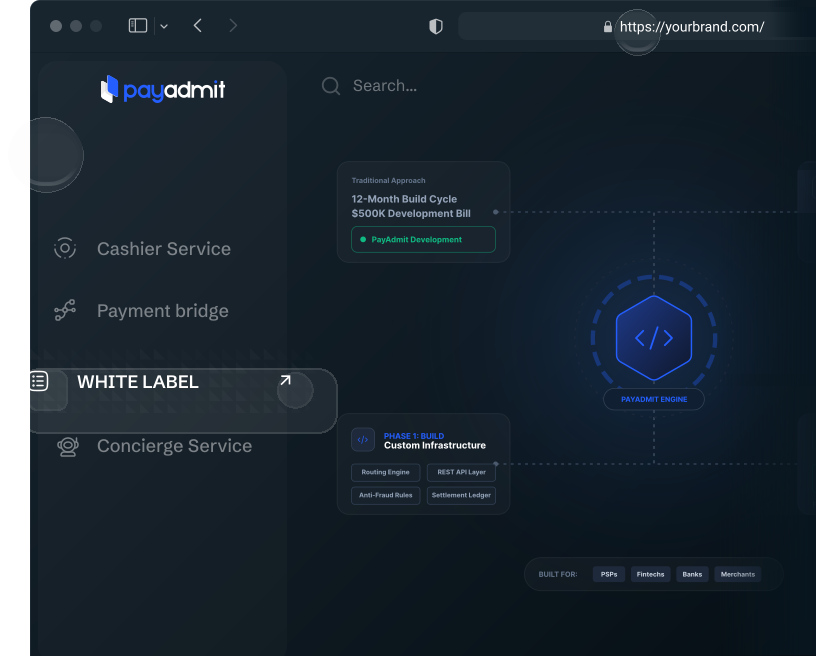
White Label vs From Scratch vs Hybrid
A summary of the three routes, and the conditions under which each one is the sensible way to build a payment system.
| Path | When It Fits |
|---|---|
| From Scratch | Orchestration logic no vendor sells, and 12 to 18 months before the first live payment. |
| White Label | Launch speed matters most, and differentiation comes from focus, not the payment stack. |
| Hybrid | A licensed core, with your own routing or merchant experience layered on top of it. |
Each route has its own reading. The from-scratch path is covered end to end in our guide to building a payment gateway; the licensed path is described under white label payment gateway software; and the hybrid route usually arrives through custom fintech software development layered on top of a certified core.
Frequently Asked Questions
How long does it take to build a payment system?
What is the highest-leverage architectural choice?
Idempotency at the API layer plus a strongly consistent payment ledger. Cascading, retries, reconciliation, and every reporting feature the system will ever need all depend on those two decisions.
Do I need PCI DSS Level 1 from day one?
Level 1 applies above six million card transactions a year, but scope discipline matters at any size. Tokenising early keeps most of the payment system out of scope and shrinks the security audit surface later.
What does a payment system cost to run once it is live?
The recurring costs of payment processing are compliance staff, screening subscriptions, annual certification, card network rule changes, and merchant support. Software is rarely the largest line once the payment system is in production.
How much does cascading actually lift approval rates?
Well-tuned cascading recovers 10 to 15% of payments that would otherwise fail. The lift is usually measurable within one quarter of switching it on, provided the system logs enough decline detail to tune against.
Native SDK or web checkout for mobile payments?
Native where Apple Pay and Google Pay carry real share, because wallet and biometric support improve both conversion and security. Embedded web ships faster and updates without a store review, which is why many payment systems start there.
How large a team does a payment system need?
Fewer engineers than most teams expect and more operations people than they plan for. Budget a compliance owner, a risk analyst, and roughly one support hire for every fifty active merchants alongside the engineering group.
Can a payment system be migrated later?
Connectors and checkout can be replaced incrementally. The ledger and the payment status model realistically cannot, which is why those two components deserve the most design time at the start of the build.
ADDITIONAL RESOURCES
How to Build a Payment Platform
The platform layer sits above the gateway, and building it well decides how far the business can scale.
How to Create an Online Payment System
Every business now competes on the smoothness of its checkout, and controlling your payment experience has never been more important.
Smart Routing and Cascading
How routing and cascading logic recover payments that a single-acquirer setup would simply lose.