

Card testing and bonus abuse show up as patterns long before they show up as losses. Velocity caps per card, per device and per player catch most of it at no cost. Any iGaming operator can list payment services; far fewer can show account-level approval by card range.
iGaming Payment Processing for Licensed Operators
Deposits in. Payouts out. Both measured.
iGaming payment processing is the full round trip of a player's money: the deposit that has to clear in seconds, the withdrawal that has to leave on time, and the risk and reporting layer that keeps both inside the rules your licence sets.

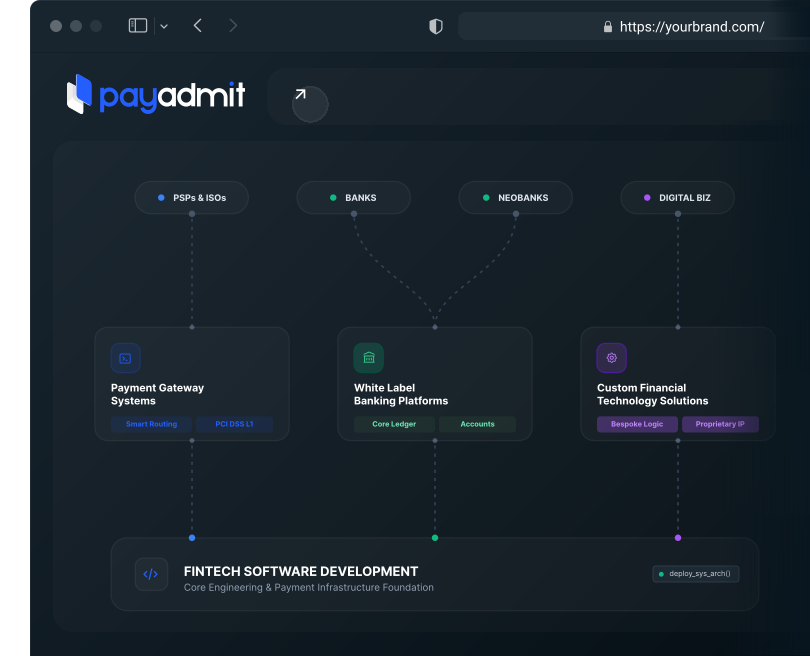
How iGaming Payment Processing Works
A deposit has four stages. The player submits a payment in the cashier. The gateway sends an authorisation to the chosen provider, which asks the issuer or the bank to hold the funds. On approval the payment is captured, and the player balance is credited from the webhook rather than from the browser. Settlement lands days later, net of fees and reserve.
The components that carry this round trip are listed on gaming payment system. A withdrawal runs the other way and is not a refund. It is a fresh payment out to an instrument the operator has verified, drawn from a funded balance, screened before it leaves and reconciled against the same ledger. Most of the operational cost in gaming payments sits on this side, not on the deposit side.
The one conclusion that matters
Deposits and payouts are two different products that happen to share a customer. Treat them as one pipeline and you will end up funding withdrawals out of settlement timing, which is where operators discover their working capital problem in the same week they discover their payout SLA problem. Card services and payout services are underwritten separately, and an iGaming business is assessed on both.
Why iGaming Processing Is Different
1
Risk appetite comes first
Under MCC 7995 most acquirers decline the category outright. The ones who do not price it, cap it and monitor it, so the commercial conversation starts from risk rather than from volume.
2
Licensing binds the flow
Acceptance has to be switched off geographically wherever the licence does not reach. That is a payment control, not a marketing preference, and it is audited as one. An account that clears card volume cleanly for two quarters usually earns better payment terms on renewal.
3
Disputes have a motive
A losing player has a reason to dispute a charge that a retail buyer does not. Friendly fraud is therefore a steady-state cost to manage rather than an incident to investigate.
4
Traffic arrives in peaks
A final or a tournament concentrates a month of deposits into a few hours. Capacity that is comfortable on an average day is the binding constraint on the day that matters. Any business that runs a single card account is one review away from a silent day.
5
Regional rules diverge
Deposit limits, cooling-off rules and payout timing are set per jurisdiction. The payment layer has to hold different rules for different players at the same moment.
6
A decline ends the session
There is no abandoned cart to retarget. The player closes the app and opens a competitor, which is why approval rate is a retention metric in this business and not a finance one. iGaming payment services differ from retail acquiring in one respect above all: the payout side is a product, not an exception.
Withdrawals and Payout Operations
Payouts are where operators lose players and lose evenings. The request arrives, and before any money moves the platform has to confirm the player is verified, the instrument belongs to them, the balance is genuinely withdrawable and the amount clears sanctions and AML screening. Card deposits, card payouts and account funding each carry their own limits, and an iGaming business plans capacity for all three.
Only then does the payout hit a rail, and rails have their own cut-off times, per-market limits and failure modes. A payout that misses a cut-off does not fail, it waits, and the player experiences waiting as failure.
What makes this survivable at scale is separation. Payout balances funded independently of deposit settlement, an approval queue your risk team can work through, and a status the player can see without asking support. A payment account with a low monthly cap will decline the overflow rather than queue it, and any peak will find that ceiling.
Payout rail: the specific network a withdrawal travels on, such as an instant domestic transfer, a card push payment or a wallet credit. It is chosen separately from the deposit route, because the provider that accepts money best in a market is often not the one that sends it back fastest.
Multi-Provider Processing and Acquiring
One provider is a single point of failure with an invoice attached. Volume caps, maintenance windows, risk reviews and market gaps all resolve the same way, by having somewhere else to send the payment. Operators past a modest size run two or three relationships as a matter of course. Online card acceptance in a regulated market is bound to the account the licence sits behind.
The cost of that is integration work, unless the providers sit behind a layer that speaks one API to your platform and each provider's dialect on the other side.
Acquiring stays with the licensed institution. PayAdmit is a technology vendor, not an acquiring bank, so the accounts you hold remain yours and new ones join the same routing order on equal terms. The business case for a second payment account is written in the hours you did not lose.
What changes is the switching cost. Adding a provider becomes configuration and a test window rather than a release, which is what makes the relationship reviewable instead of permanent. The evaluation criteria sit on igaming payment provider.
Routing, Cascading and Decline Recovery
Routing decides where a deposit goes first; cascading decides what happens when that route says no. Together they are the difference between a decline the player sees and one they never know about. In gaming the second attempt matters more than in almost any other vertical, because the customer is not coming back to a saved basket. The eligibility rules, retry budgets and duplicate-charge safeguards are set out on cascading payments.
Fraud Prevention, 3DS and Chargeback Management
Every deposit passes the same five gates before it becomes a balance. The order matters: the cheapest check runs first and the most expensive one runs last.

A probability is calculated before authorisation, with three outcomes rather than two: approve, decline, or step up to additional verification.

3D Secure is applied where the market mandates it and exemptions are claimed where the rules permit, so a returning player is not challenged on a routine top-up. Payment processing for a licensed business is judged on the payment that went through, not on the account that was opened.

A dispute that is refunded before it becomes a chargeback never touches the ratio. Alerts wired into the support desk are the cheapest ratio management available.

Session logs, KYC records and wagering history assembled per case, plus a weekly read of the ratio against scheme thresholds rather than a monthly one.
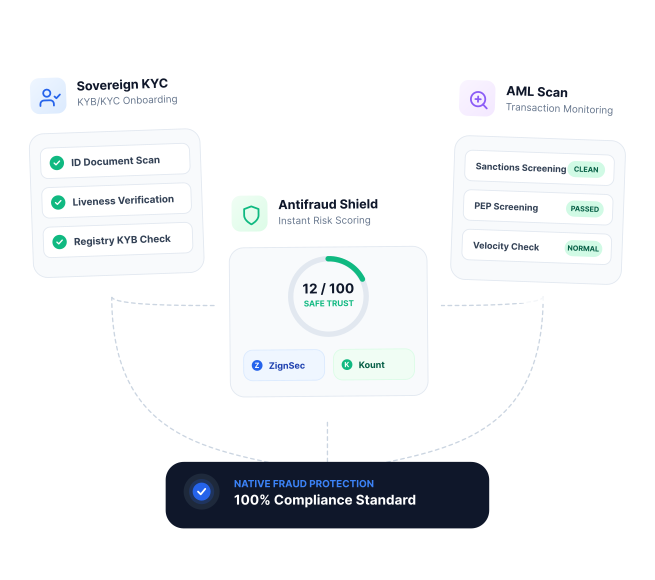
PayAdmit runs these gates through its antifraud and risk management engine, with rules configurable per merchant and a full audit trail behind every decision. An online business reading its own payment data will see which account is carrying the risk and which card segment is quietly failing.
Want your deposit and payout flow reviewed end to end?
Security and Compliance Requirements
Five obligations that sit on the payment layer specifically, and who is accountable for each once a platform is in place.
| Requirement | What it means in practice | Who carries it |
|---|---|---|
| Card data handling | Raw card numbers never reach your servers; tokens do. | Platform, in a PCI DSS Level 1 ready environment. |
| AML monitoring | Transaction rules per jurisdiction, with escalation. | Shared. Tooling is ours, the policy is yours. |
| Player KYC | Verified before the first withdrawal, not after it. | Operator, using platform verification data. |
| Responsible gaming limits | Deposit caps and cooling-off enforced at payment level. | Operator, configured in the platform. |
| Audit trail | Every decision reconstructable months later. | Platform, retained per merchant. |
Checkout Conversion and Player Experience
Conversion in a gaming cashier is decided in about eight seconds. Five things move it, and none of them require a redesign. Payment terms, account limits and payout capacity form one picture, and an iGaming business that reads them separately will misprice all three.
- Show the methods that work in that market and hide the rest entirely.
- Put the player's last successful method at the top of the list.
- Price in the player's currency, and say what will actually be charged.
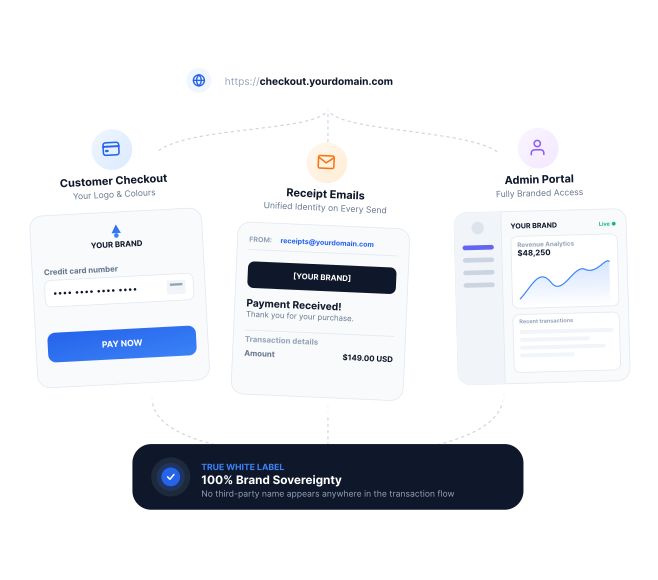
- Keep the deposit inside your brand, with no third-party page in the middle.
- Return a clear result, and where a retry is possible, run it without asking again.
The cashier itself is a product surface players come back to daily, not a one-off checkout. It is covered as a component on cashier service.
Reconciliation, Reporting and Payment Analytics
Six views an operator needs daily. Anything a provider will not give you per segment is a number you cannot act on. Every underwriting review starts with the same question: has this business processed what it said it would process?
Approval rate by market, method and provider, compared against each route's own recent baseline.
Decline reasons in one taxonomy, so an issuer refusal reads the same whichever provider returned it. The payment account, the payment services around it and the online cashier in front of it are three purchases that behave as one product.
Payout timing against your published SLA, broken out by rail rather than averaged.
Chargeback and refund ratios tracked weekly against scheme thresholds, not monthly. Operators that treat payment as infrastructure rather than as a vendor line item renegotiate from a stronger position.
Cost per approved payment, including the failed attempts that preceded it.
Settlement files matched line by line to captured payments, with only the exceptions surfaced. An operator that can show clean card data across an online business earns headroom that no pitch deck will buy.
All six sit in the payment analytics dashboard, per merchant rather than pooled.
Integration with Gaming Platforms
Three integration surfaces, and the discipline each one needs to survive a busy weekend.

Two endpoints with separate lifecycles. Deposits are synchronous with an asynchronous confirmation; payouts are queued, approved and then executed. Modelling them as one call is the mistake that costs a rebuild once payout volume grows, because the approval step has nowhere to live. Payment services for iGaming are priced on expected loss, so the business that documents its controls pays less for the same payment volume.

Signed callbacks decide the final state of any payment. A player balance is credited when the notification confirms it, never when the browser comes back. That single rule removes most double-credit incidents new gaming operators run into during their first peak.

One adapter per acquirer, wallet or local method, translating your normalised request into that provider's dialect and its answer back again. New markets arrive as connectors plus configuration, so the platform grows sideways instead of accumulating branches in your own codebase. A payment account is only as useful as the reporting behind it, and an iGaming business needs that reporting per payment segment.
Use Cases by Gaming Model
Casinos deposit little and often, so cashier friction and approval rate dominate everything else. Sportsbooks live and die on peaks around fixtures, which makes provider redundancy the binding requirement rather than a nice-to-have.
Poker rooms move money in both directions constantly, so payout operations carry more weight than deposit conversion. Fantasy and skill gaming look like retail commerce until a market reclassifies them, which is why eligibility is checked per jurisdiction rather than per product, and why social gaming merchant account is underwritten as its own category. Payment processing is the part of the business a player never sees and always feels.
What all four have in common
None of them can afford a payment stack that only works on an average day. The requirement they share is not a feature, it is headroom: a second provider that is already live, a cascade that is already configured, and payout capacity that does not depend on this week's settlement arriving on time. The architectural version of that is described on igaming payments platform.
Frequently Asked Questions
Does PayAdmit process the payments itself?
No. We are a payment technology vendor. The gateway, cashier, routing, risk tooling and reporting are ours; the acquiring, the licence and the settlement of funds stay with the institutions you contract with. An online card stack that reports per market lets a business defend its card costs line by line.
How long does a deployment take?
One to two months from signature to live payments in a typical case. The variable is rarely the integration; it is how quickly the provider agreements and underwriting on your side complete.
Can we keep our current providers?
Yes, and most operators do. Existing acquirers, PSPs and local methods connect as routes and are ranked alongside anything added later on the same evidence.
What does an iGaming payment account actually consist of?
Three things that are often sold as one. An acquiring account that settles the money, a gateway account that carries the card traffic, and the platform account your business logs into. Any iGaming business should know which company holds each of them, because the party that owns the acquiring account is the only one that can close your card processing. The payment layer, the payment data and the payment people are one function, not three, in any business at this scale.
What are the best practices for gaming payment processing at launch?
Two providers from day one, three method families per market, webhooks as the authoritative state, KYC before the first withdrawal, and a weekly read of approval and chargeback ratios per segment rather than a monthly summary.
How are player balances kept in sync?
Through signed webhooks with idempotency keys, so a duplicated or delayed notification cannot credit a balance twice. Every attempt is logged with its route and response for later reconciliation. Payment volume alone does not win better terms; the payment mix behind it does.
Do you support crypto deposits and payouts?
Yes, subject to what the operator's licence allows in each market. Crypto deposits and payouts appear in the same cashier and the same reconciliation as card and bank methods, rather than living in a parallel flow with its own reporting.
How many payment accounts should an iGaming business run?
Two as a minimum in every major market. A single account is a single point of failure: a cap, a review or a maintenance window takes the whole card flow down at once. With a second account live, the same event becomes a routing decision, and any online business that has survived one outage will tell you the second account paid for itself.