

One key per customer intent, carried across every attempt in the cascade. If a response is lost in transit and the same request arrives twice, the provider returns the original result instead of creating a second payment. Without this, a network blip becomes a double charge and a chargeback. The routing layer normalises every provider response automatically, so cascade logic reads one taxonomy rather than five.
Cascading Payments: Recover Declined Transactions
A declined payment is not always a lost one. Cascading retries an eligible failure through the next provider in the routing order, automatically and inside the same session, so the customer never sees the first attempt.

What Is Payment Cascading?
Payment cascading is a controlled reattempt. When a transaction fails for a reason that another provider could plausibly approve, the routing logic sends it down the ordered list of eligible routes until one succeeds or the retry budget runs out. Controlled is the operative word: an uncontrolled retry is not a cascade, it is a duplicate charge waiting to happen. Smart routing chooses the route; the cascade decides what happens automatically after that route says no.
How a Payment Cascade Works
1
Initial attempt
The routing engine picks the best first route for the transaction profile and sends the authorisation there.
2
Classify the response
The decline is normalised into one taxonomy, because every provider reports the same refusal with a different code. Cascade management is therefore a routing exercise with a memory of what already failed.
3
Check eligibility
Is this failure retryable at all, is a retry budget left, and does the currency, amount and geography allow another route? The routing engine holds the conversion rules, so a retry never converts a payment the customer did not agree to.
4
Next route
The transaction is re-presented to the next provider with its context intact, automatically and without a new customer action. Each attempt is logged automatically, which is what makes cascade management auditable rather than anecdotal.
5
Final result
One outcome is returned to your platform, with the full attempt history behind it. In gaming this recovery is worth the most, as igaming payment processing explains.
Which Failures Should and Should Not Be Cascaded
Retrying the wrong decline wastes money and annoys issuers. This is the split that matters. Smart routing and cascading share one configuration, so a change to routing priorities updates the retry logic with it.
| Failure | Cascade? | Why |
|---|---|---|
| Provider timeout or outage | Yes, immediately | Nothing about the payment was refused. |
| Generic issuer decline | Yes, once or twice | Soft decline, often route-specific. |
| Risk rule at the provider | Yes, another provider may differ | Risk appetite is set per provider. |
| Insufficient funds | No, not in-session | The balance will not change in seconds. |
| Stolen or closed card | Never | A hard decline. Retrying invites a block. |
| Invalid card data | Never | The data is wrong. Ask the customer. |
Not sure which of your declines are worth retrying?
Cascading Rules and Priorities
A cascade is defined by seven settings. Write them all down before switching it on, because the defaults are rarely right for a specific business.
- Provider order, either fixed or ranked by live approval performance for that profile.
- The decline codes that qualify, mapped from every provider into your own taxonomy.
- Retry depth, meaning how many further routes a single transaction may visit.
- Geography rules, so a payment is not re-presented through a route not licensed for that market.
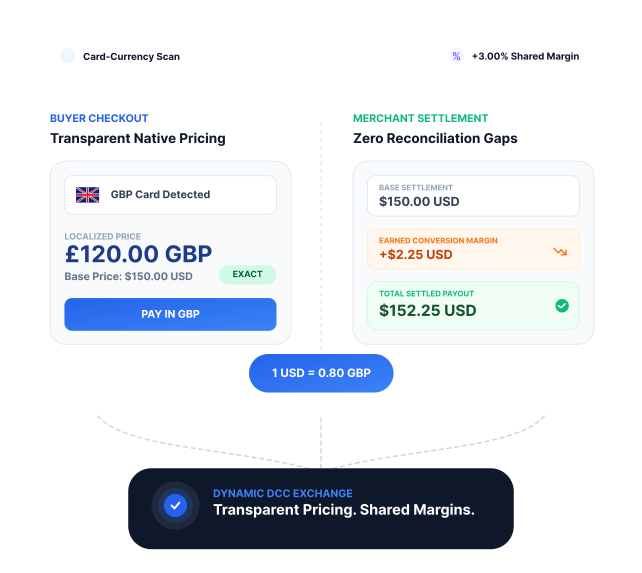
- Currency rules, so a retry does not silently introduce a conversion the customer did not agree to.
- Amount thresholds, because a large payment deserves a different retry budget than a small one.
- Timeouts, so the whole cascade completes inside a window the customer will wait through.
A currency mismatch is a routing condition, not a decline, and the logic treats it that way.
Cascading vs Payment Routing
They are two halves of the same routing configuration, and they fail in different ways when treated as one.
- Routing runs before the first attempt. Cascading runs after a failure.
- Routing optimises expected outcome. Cascading recovers an actual loss.
- Good routing reduces how often the cascade is needed at all.
Retry management is where routing stops being a plan and starts being an operation.
The practical consequence is that they are tuned separately and measured separately.
- Routing is judged on first-attempt approval. See intelligent payment routing.
- Cascading is judged on recovery rate and on added latency and cost.
- Both share the same provider ranking, described on smart payment routing.
Preventing Duplicate Charges and Retry Loops
The failure mode of a badly built cascade is charging one customer twice. Three safeguards prevent it, and all three have to be present.

A timeout is not a decline. When a provider fails to answer, the engine queries the transaction status before it does anything else, and only cascades once the first attempt is confirmed as unsuccessful. Silence is treated as unknown rather than as permission to try again. Smart cascade management pays off most where approval rates differ sharply between routing candidates.

Hard caps per transaction, per card and per customer over a rolling window, so a retry loop cannot form between two providers or across sessions. Issuers notice repeated presentment of the same card, and excessive retries damage approval rates well beyond the transaction that caused them. Retry rules and cascade order are edited in the same console, which keeps operational overhead low.
Preserving Transaction Context
A retry only helps if the second provider receives the same payment, not a rough approximation of it. Tokenisation keeps the card usable across routes without your platform ever holding the raw number. A transaction re-presented through the routing order carries its original currency and its original token.
Authentication state travels with it: where 3D Secure has already completed, the liability shift and the authentication data are carried forward rather than the customer being challenged twice for one purchase.
The takeaway
Normalise everything at the platform edge. One token format, one status model, one decline taxonomy, one idempotency scheme. Every provider-specific quirk that leaks past that boundary becomes a special case in your cascade logic, and special cases are where duplicate charges live.
Monitoring Cascade Performance
Five numbers tell you whether the cascade is earning its place. Watch them together, because improving one at the expense of the others is easy.

The share of cascaded attempts that end in an approval. Track it by decline reason, not as one figure.

Overall approval with the cascade on, against a holdback with it off. This is the only honest measure of value. Where routing candidates are equal, the cascade falls back automatically to the cheaper of the two.

Time from first attempt to final answer. A recovery the customer waited too long for is not a recovery.

Fees on failed attempts plus the more expensive route that finally approved, set against the payment recovered. Smart routing reduces how often the cascade runs at all, and that is the cheapest form of cascade management.

How far down the order recoveries actually happen. If nothing succeeds past route two, route four is pure cost.
How PayAdmit Supports Resilient Multi-Provider Flows
Cascading in the PayAdmit platform is configuration, not development. Providers are connected once, ranked per market and currency, and the retry rules are edited from the back office by the people who own payment performance.
Every attempt is logged with its route, response and timing, so a support question about one customer has a factual answer, and a monthly review has data rather than impressions. Existing acquirers and PSPs join the same order as new ones. Currency, amount and geography are all cascade inputs, and the retry logic re-checks each one before it moves.
Soft decline: a refusal that another route or a later attempt might approve, such as a generic issuer rejection or a provider-side risk rule. The opposite is a hard decline, which states the payment instrument itself is unusable. Only soft declines belong in a cascade. Connectivity to the providers behind them runs through payment bridge.
Frequently Asked Questions
Does the customer see the failed attempt?
No. The cascade completes inside the same session and one result is returned. The only visible difference is a slightly longer wait when a retry occurs.
Can cascading trigger a double charge?
Not when idempotency keys and status checks are in place. An ambiguous response is resolved by querying the provider before any retry is allowed, which is the safeguard that separates a cascade from a blind retry.
How deep should a cascade go?
Two or three routes for most businesses. Beyond that the recovery rate falls sharply while cost and latency keep rising. Let your own retry-depth data set the limit rather than a default.
Can cascading run without smart routing in place?
Not usefully. The cascade reuses the ranking that routing already produced, so the retry logic inherits the same currency rules, the same market restrictions and the same provider order. Without a routing layer underneath, a retry is just a second guess.
Does a retry keep the 3D Secure result?
Where the receiving provider accepts externally authenticated data, yes, and the liability shift travels with it. Where it does not, the rule set can either skip that route or re-authenticate, and that choice is yours to configure.
Is cascading useful with only one provider?
Barely. A cascade needs somewhere to go. With a single provider the only option is a delayed retry on the same route, which helps with technical failures and not with declines.
Does it work for non-card methods?
Partially. Bank transfers and wallets can be cascaded between providers offering the same method, but a customer who abandoned an off-site flow cannot be retried automatically without asking them again.
Who manages the cascade day to day?
Your own team, from the back office. Provider order, retry limits and the currency and amount thresholds are management settings rather than code, so routing logic can be adjusted automatically by rule or manually by an operator without a release.