

Free entry with optional purchases. The cleanest profile to underwrite, provided the purchase flow and refund policy are clearly documented.
Social Gaming Merchant Account and Payment Setup
A social gaming merchant account covers in-app purchases, virtual currency and subscriptions for games where nothing pays out in money. The model is not gambling, but the payment profile looks close enough that underwriting treats it carefully.

What Is a Social Gaming Merchant Account?
It is the acquiring relationship that lets a social gaming business charge a player's card for coins, gems, energy, a battle pass or a subscription. The goods are virtual and consumed inside the game, and nothing is redeemable for money.
What makes it its own category is the payment shape rather than the product: very small amounts, very high frequency, a young audience, and a purchase the buyer cannot show anyone afterwards. Underwriters price all four.
Virtual goods: items that exist only inside the game and carry no cash value outside it. The distinction matters at underwriting because a virtual item that can be exchanged for money changes the model from social gaming into something a gambling licence may cover, and that reclassification is decided by the regulator and your counsel rather than by your payment provider.
Social Gaming vs Real-Money Gambling
The commercial difference is what leaves the game. In social gaming a player buys currency, spends it inside the product and receives nothing convertible back. In real-money gambling a player stakes money and can withdraw winnings, which is what a gambling licence regulates.
That single line decides the licence, the MCC, the acquirer and often the country list, and it is why the underwriting on online gaming merchant account reads differently from this one. Sweepstakes and social casino models sit near it deliberately, and their treatment varies by market and sometimes by state.
In payment terms the practical differences are these: social gaming has no payout rail to build, no player withdrawal to screen and no wagering data to report, but far higher transaction counts and far more disputes per unit of revenue.
Nothing here is legal advice. Where a model sits near the line, get an opinion for your specific product and jurisdictions before an acquirer asks for one, because they will.
Why Social Gaming Can Be Treated as High Risk
Nothing about virtual goods is inherently risky. What acquirers price is the pattern: hundreds of tiny charges from one card in a week, a buyer who cannot produce a delivery receipt, a meaningful share of purchases made on a family member's card, and a dispute reason that is genuinely hard to contest. Add recurring billing and a young audience, and a business with excellent margins can still carry a chargeback ratio that looks like a problem long before it becomes one.
Supported Social Gaming Business Models
Four models underwriters see regularly, and one that needs a jurisdiction check before anything else.

Players buy a balance and spend it inside the game. Fine while it is one-directional; convertibility changes the category entirely.

Battle passes and memberships on recurring billing. Predictable revenue, and the model most exposed to involuntary churn from card declines.

One-off items and bundles. High frequency, low value, and the profile that makes velocity rules essential rather than optional.

Casino mechanics with no cash payout. Eligibility varies by market and sometimes by state, so it is checked per jurisdiction first.
Payment Methods and In-App or Web Checkout
Where the purchase happens changes the economics more than which card is used.
| Factor | App store billing | Your own web checkout |
|---|---|---|
| Fee on each purchase | A fixed platform share | Acquiring cost you negotiate |
| Player data | Held by the store | Yours, with the merchant account |
| Method choice | Whatever the store offers | Cards, wallets and local methods |
| Dispute handling | Store decides, you are told | Yours to contest with evidence |
| Friction | Lowest, already signed in | Higher, so the flow has to be good |
Most studios run both: store billing inside the app, and a branded web shop where the margin is materially better. The merchant account is what makes the second one possible.
Merchant Onboarding and Underwriting
Five things an underwriter will ask for. Prepare all of them together, because a partial answer restarts the review.
- Corporate documents and ownership down to every ultimate beneficial owner.
- A plain description of the model, stating explicitly that nothing converts to cash.
- Processing history with volume, average value, refund and chargeback ratios by month.
- Refund policy, age-gating approach and the terms a player accepts at purchase.
- The countries you sell into, and confirmation that the model is permitted in each.
The same discipline applies as in any regulated gaming vertical; the comparison is on online gaming merchant account.
Fraud, Chargebacks and Account Security
Six controls that keep a microtransaction business inside scheme thresholds.
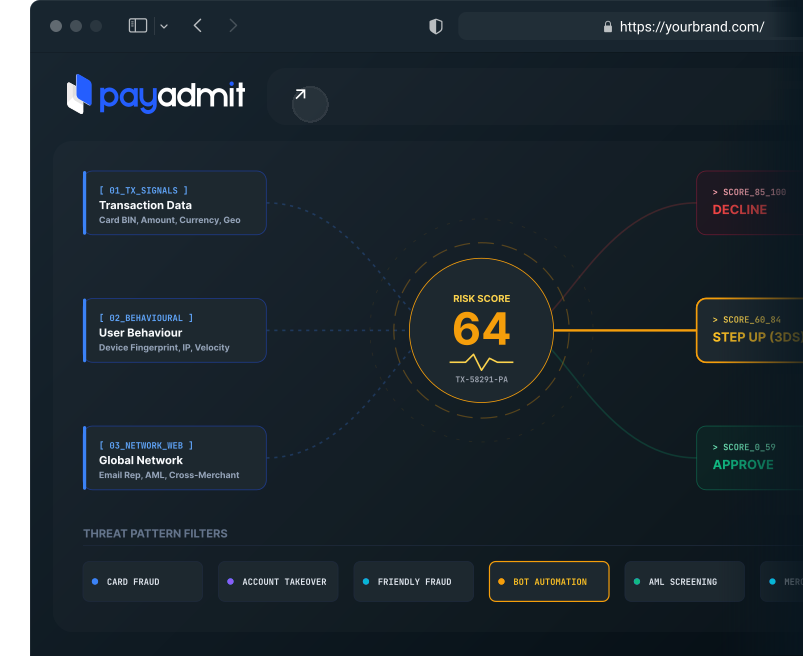
Velocity limits per card, per device and per player account over a rolling window.
A billing descriptor that names your game, because an unrecognised line is a dispute.
A visible purchase history in-game, so a parent can be shown what was bought and when.
A refund path that is easier than a chargeback, and support staffed to use it.
Dispute alerts wired to support, so a refund can pre-empt the case reaching your ratio.
Account takeover protection, since a compromised account is a purchasing instrument.
These run through the platform's antifraud and risk management engine, configurable per merchant.
Recurring Billing and Microtransaction Considerations
Three payment problems specific to selling small amounts very often.

Fixed per-transaction fees dominate when the average purchase is small, so the same rate card behaves completely differently at one dollar and at fifty. Bundling, top-up balances and larger currency packs are payment design decisions as much as monetisation ones.

A subscription lost to an expired card is a cancelled customer with extra steps. Network tokens, account updater services and a retry schedule tuned to the billing cycle recover a meaningful share of it without any change to the product itself.

Chargeback ratios are counted per transaction, not per dollar, so a business selling many tiny items reaches a threshold on a small amount of money. Watch the count weekly rather than the value monthly, because the count is what triggers a monitoring programme.
Not sure how your model will be underwritten?
Multi-Currency and Cross-Border Payments
Social games sell globally from day one, which means a large share of card payments are cross-border. Those approve at lower rates and cost more, and at a one-dollar purchase the difference is proportionally severe.
Two levers help. Price in the player's own currency so the amount is not a surprise, and acquire locally where a domestic route exists so the issuer sees a domestic transaction rather than a foreign one.
The conclusion for a microtransaction business
Local acquiring matters more here than almost anywhere else, because both effects land at once: approval goes up and cost per charge goes down, on a payment where the fixed fee was already the dominant component. It is usually the single highest-return change available to a social gaming payment stack.
Payment Routing and Provider Resilience
1
Route on evidence
Each purchase goes to the account with the best live approval for that country and card range, rather than to whichever contract is oldest.
2
Recover the decline
Soft declines are retried on the next eligible account inside the same session, which matters most on a purchase the player made on impulse.
3
Keep a second account
A cap or a review on one account becomes a routing decision instead of a day with no revenue. Two accounts is the practical minimum at scale.
4
Time the retries
Subscription renewals retry on a schedule tuned to billing cycles, not immediately, because an insufficient-funds decline needs days rather than seconds.
Gateway and API Integration
Hosted checkout is the fastest route and keeps PCI scope light, which suits a web shop sitting beside app store billing. Server-to-server keeps the purchase inside your own product, with saved instruments and one-tap repeats.
Either way, the entitlement is granted from the signed webhook and never from the browser returning to a success page, and every request carries an idempotency key so a repeated notification cannot grant the same purchase twice.
Entitlement: the moment your game credits the coins, unlocks the item or starts the subscription. Tying it to a signed callback rather than to a browser redirect is what prevents both double grants and the far worse case: a player charged for something the game never gave them.
Setup Process
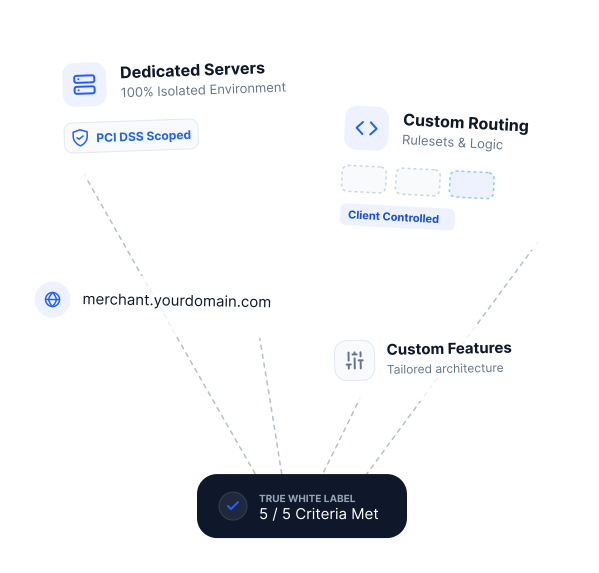
Underwriting first, because everything else depends on it. In parallel the environment is provisioned, branding is applied to the web shop and the provider connections you already hold are wired in alongside any new ones.
Then testing against declines, retries, duplicate notifications and refunds, and a launch to a cohort before a launch to everyone. One to two months is typical once the account side is agreed. Method coverage per market is on gaming alternative payment solution.
Frequently Asked Questions
Do we need a gambling licence for social gaming?
Not where nothing converts back to money, but the line varies by market and by mechanic, and sweepstakes models sit close to it. Take an opinion for your specific product and country list; an acquirer will ask for that position in writing.
Why is a social gaming merchant account harder to open than a retail one?
Because of the payment pattern rather than the product: very high transaction counts, very low values, digital goods with no delivery evidence and a dispute reason that is difficult to contest. Underwriters price that combination carefully.
Can we run a web shop alongside app store billing?
Yes, and most studios do. The web shop is where the margin is materially better and where you own the player relationship, the payment data and the dispute process. The gateway side of that setup is covered on payment gateway for gaming site.
How do we keep the chargeback ratio down?
A recognisable billing descriptor, a visible purchase history, velocity limits, and a refund that is easier to obtain than a chargeback. Ratios are counted per transaction, so the count is what to watch weekly.
Is PayAdmit an acquiring bank?
No. PayAdmit is a payment software vendor supplying the gateway, checkout, routing and reporting around your account. Acquiring and settlement stay with the licensed institutions you contract with.
How long does setup take?
One to two months once underwriting is agreed. A complete application file is the single biggest factor, because every follow-up question restarts the reviewer's queue position.