


The acquirer holds the licence and settles the money. A PSP resells that acquiring under its own contract, which is faster to sign and easier to lose. Ask which of the two you are contracting with, because it determines who can switch your traffic off and how much notice you get. A provider that has processed gaming volume for years reads a decline pattern faster than one learning your vertical on your traffic.
iGaming Payment Provider for Licensed Operators
Compare on coverage, not on brochures.
Every igaming payment provider will tell you it supports gaming. The differences that matter are which markets it can actually reach, which methods players there will use, how fast a withdrawal leaves the platform and how quickly a second provider can be added when the first one stumbles. That experience shows up in the payment data long before it shows up in a quarterly review.
What an iGaming Payment Provider Does
The word provider covers five different jobs. Knowing which one a vendor is selling you is the first filter in any comparison. Each role is priced differently and each one fails differently, so knowing which payment service you are buying matters more than the logo on the contract.

The gateway carries the authorisation. The orchestration layer decides which gateway or acquirer receives it. An operator that owns the orchestration layer can add and drop providers without touching the cashier, which is what makes multi-provider work sustainable rather than painful.

Withdrawals often run on entirely separate rails from deposits, with their own limits, cut-off times and fees. A provider strong on deposits can be weak on payouts, so the two capabilities are worth evaluating separately even when they come from the same contract.
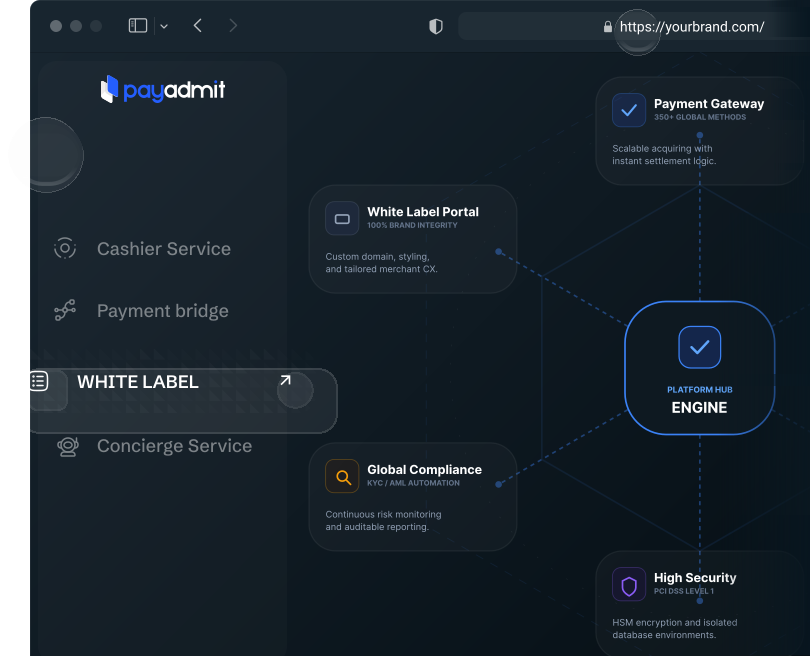
PayAdmit is the gateway and orchestration layer. Acquiring stays with the bank or PSP, and the same technology sits behind our igaming payment gateway deployments.
Payment Coverage for iGaming Operators
Coverage is not a count of logos. It is whether a player in your third-largest market can deposit with the method they already trust, and whether the payout goes back out on the same rail. Four things define it, and they are the key conclusion for any provider comparison.
Cards are the baseline, not the answer. Visa and Mastercard reach everywhere and convert badly in several gaming markets.
Local methods carry the volume. Open banking, instant transfers, wallets and vouchers are what regional players actually use. Local processing through a domestic bank turns a foreign payment into a familiar one for the issuer.
Withdrawals need parity. A market with five deposit methods and one slow payout rail will generate support tickets, not loyalty. Online players judge a payment service in seconds, and the experience they remember is the one that failed.
Multi-currency has to be real. Pricing in the player's currency and settling in yours are two separate capabilities.
Multi-Provider Connectivity
No single provider covers every gaming market, and none stays available every hour of the year. Operators therefore run several. The cost of doing that is integration work, unless a unified layer absorbs it.

Your platform speaks to one API. Providers sit behind it as connectors rather than as separate builds in your codebase.

Statuses, decline reasons and refund semantics are normalised, so your risk rules do not need a translation table per partner.

Traffic is split by market, currency or card range from configuration. See intelligent payment routing for the decision model.

A new provider goes live as a configuration change and a test window, not as a release cycle in your product backlog. Any online operator processing across several regions will see the same payment split repeat: cards convert, local rails carry the volume. The layer that makes this possible is described on igaming payments platform.
Player Checkout and Cashier Experience
The cashier is where a provider stops being an integration and starts being a product decision. Players judge it in seconds: is my method here, is it in my language and currency, and did the deposit land before I lost interest. The payment experience is the product here; every online deposit that stalls is a session your acquisition spend already paid for.
A good cashier remembers the last successful method, hides what is unavailable in that market instead of showing it greyed out, and keeps the player inside your brand throughout. Withdrawal requests belong in the same place, with a visible status rather than an email promise. Any provider can list payment methods; far fewer can show you approval by method for online gaming traffic in your own markets.
Cashier: in igaming, the deposit and withdrawal interface inside the player account, as distinct from a one-off e-commerce checkout. It is a persistent surface a player returns to, so method ordering, saved instruments and payout status all live there.
Fraud, 3DS, Chargebacks and Compliance
Strong customer authentication is mandatory in some markets and optional in others, and a provider that applies 3DS uniformly will cost you good deposits. What you want is exemption handling: challenge where the rules require it or the risk score justifies it, and let the routine top-up through.
Chargeback exposure sits with whoever holds the acquiring, but the operational burden sits with you. Dispute alerts, evidence templates and a ratio you can watch daily are the difference between a manageable month and a monitoring programme.
On the compliance side, ask three questions of any provider: is the card environment PCI DSS Level 1, is AML transaction monitoring configurable per jurisdiction, and can player limits and self-exclusion signals reach the payment layer rather than stopping at the game client.
PayAdmit answers those from a single platform, with risk scoring applied before authorisation and full decision logs retained per merchant. Nothing here removes your regulatory obligations, but it does put the controls in one place. A payment service that reports well but processes poorly is easy to spot once the data is split by market.
Payout and Settlement Operations
Deposits are a conversion problem. Payouts are an operations problem. They involve balance funding, cut-off windows, per-market limits, sanctions screening and a support desk that has to answer for anything delayed. Providers vary far more here than in their deposit coverage.
Settlement is the other half. Ask when funds arrive, in which currency, with which reserve held back, and whether the report reconciles line by line against your own ledger. A provider that settles weekly with a summary file will cost your finance team more than it saves you in fees. Payout experience deserves the same scrutiny as deposit experience, because a slow payment out costs more goodwill than a declined payment in.
Players remember the withdrawal, not the deposit. Payout speed is the only part of a payment stack that shows up in retention numbers, and it is the first thing a competitor will advertise against you.
Analytics, Reconciliation and Provider Monitoring
1
Capture
Every attempt is logged with its provider, market, method, amount, response code and latency, including the ones that never became a payment.
2
Normalise
Provider-specific codes are mapped to one taxonomy, so an issuer decline reads the same whichever partner returned it. Processing is only half the job; the online reporting that follows it is what turns a payment decision into an informed one.
3
Compare
Approval, cost and speed are ranked per provider per segment, which is what turns a monitoring screen into a routing change. An online gaming operator that processes its own payment data will spot a weak payment route weeks before a provider volunteers it.
4
Reconcile
Settlement files from each provider are matched against captured payments, and the exceptions are what your finance team reviews.
Developer Integration
What your engineering team will actually be asked to build, and roughly how much of it is one-off work.
| Work item | What it involves |
|---|---|
| Deposit API | One server-to-server call plus a hosted fallback for regulated markets. |
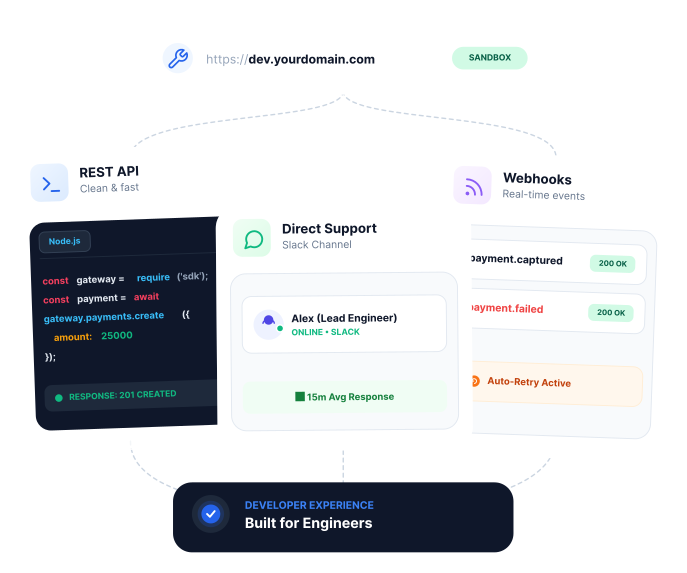
| Webhooks | Signed callbacks are authoritative. Never credit a balance on browser return. |
| Payout API | Separate endpoint with its own limits, approvals and status lifecycle. |
| Adding a provider | Configuration and a test window. No change to your codebase. |
| Migration | Run old and new side by side, shift traffic by percentage, keep tokens. |
How to Evaluate an iGaming Payment Provider
Run every candidate through the same nine questions and score them side by side. The best igaming payment providers answer all nine without a follow-up call.

Is our licence and product model inside your stated risk appetite? Ask for it in writing. A verbal yes from a sales team is not an underwriting decision.

Which of our target markets are processing today, and which are roadmap? Roadmap is a plan, not coverage, and plans slip past the launch you are planning around.

What is your live approval rate for our card mix in our top three markets? A portfolio average from another vertical tells you nothing about your own traffic.

Which local deposit methods and which payout rails do you support per market? Deposits and withdrawals are separate capabilities and often differ sharply.
What are the cut-offs, the per-market limits and the typical time to the player's account? This is what your support desk will be answering for every day.

What reserve, settlement cycle and settlement currency apply to our profile? A weekly cycle with a summary file costs your finance team more than it saves.

Who owns the funds in transit, and what happens to them if the agreement ends? The answer changes how much of your float you can safely leave in the flow.

What notice do we get before suspension, and who do we reach out of hours? Every provider is fine until the first incident, which is when this clause matters.
Can we run you alongside another provider without rebuilding the cashier? A no here means the provider decision is one you will not be able to reverse cheaply.
Score the answers rather than collecting them. Nine yeses from one provider and six from another is a decision you can defend to a board. Gaming operators comparing payment providers should weigh online coverage, payout speed and support response as one score rather than three.
Why PayAdmit Fits Multi-Provider iGaming Payments
We are not the acquirer, and that is the point. Our job is the layer that makes several providers behave like one, so the provider decision stays reversible.
- Provider-neutral. Keep the contracts you have and add ours only where they help.
- One cashier across every connected provider, in your brand and your currencies.
- Routing and cascading as configuration, changeable without a release.
What that means in practice for an operator running more than one relationship:
- Per-provider approval, cost and payout reporting in one dashboard.
- PCI DSS Level 1 ready environment, with card data tokenised at the platform.
- Typical deployment in one to two months, including the online gaming merchant account connections you already hold.
Frequently Asked Questions
Do we need more than one igaming payment provider?
Above modest volume, yes. A second provider covers outages, volume caps and market gaps, and it gives you a comparison your first provider can see you making.
Is PayAdmit a payment provider or a technology vendor?
A technology vendor. We supply the gateway, cashier, routing engine and reporting. Acquiring and settlement remain with the licensed institutions an operator contracts with.
How long does it take to add a new provider?
Once the platform is live, a connected provider is a configuration change plus a test window. The long pole is the commercial agreement and underwriting on the provider's side, not the integration.
How much does an iGaming payment provider cost to run?
Nobody quotes a gaming rate from a web page, but the cost categories are the same everywhere: a discount rate on each payment, a per-transaction fee, scheme pass-through, a monthly platform fee and the cost of any currency conversion. Ask how payouts are priced separately, because payout fees are where a cheap deposit rate is often recovered.
Can players keep their saved cards during a migration?
In most cases yes, through a token migration agreed with the outgoing provider. Where that is refused, the platform re-tokenises on the next successful deposit so the disruption lasts one transaction per player.
Which payment services matter most for retention?
Payout speed and local deposit methods. Both are visible to the player. Approval rate matters just as much but is felt rather than seen, which is why it is often measured too late.
Do you support crypto alongside cards?
Yes, where the operator's licence permits it. Crypto sits in the same cashier and the same reporting as card and bank methods rather than in a separate flow.
Can one provider serve every market we operate in?
Rarely. Coverage is regional, so a payment partner that is strong in one bank network can be weak two borders away. The practical answer is to run more than one and let live approval data decide which payment takes which route, rather than committing every online market to a single relationship.