

Bonus abuse, stolen card testing and account takeover all target the deposit flow rather than the game itself. The acquirer reads your fraud tooling as part of the account file, not as something you will add later once volume justifies it.
Online Gaming Merchant Account for Licensed Operators
An online gaming merchant account is the acquiring relationship that lets a licensed operator charge a player's card and keep the money. Approval is an underwriting exercise, not a purchase. This page covers what an acquirer asks for, how the account is assessed and how the technology around it is put together.

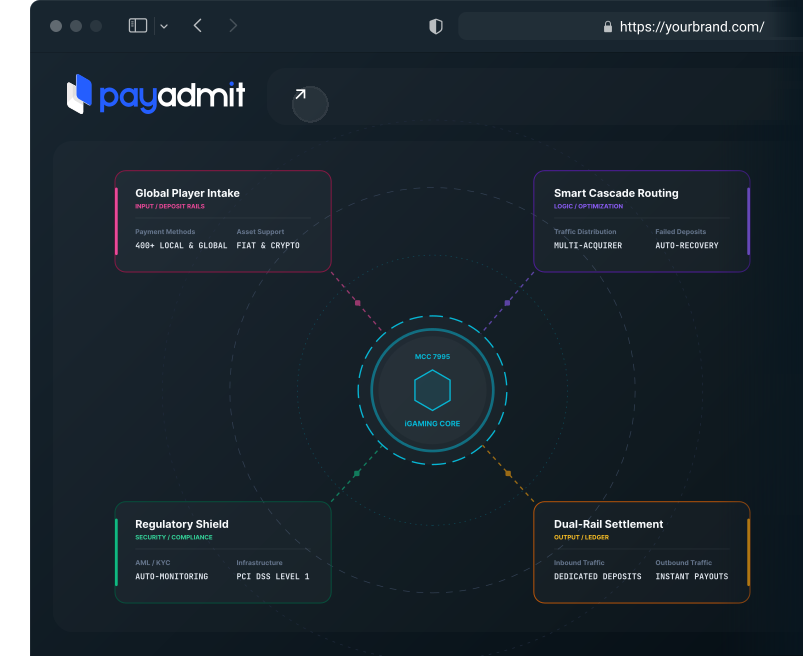
What Is an Online Gaming Merchant Account?
Operators use the words merchant account, gateway and PSP as if they were one thing. They are four separate layers with four separate contracts, and only one of them holds your money. Read the table before you sign anything. The distinction decides who can halt your processing, who absorbs a chargeback and who reviews the business when volume moves.
| Layer | What it actually does | Who holds the risk |
|---|---|---|
| Merchant account | Holds the acquiring licence and settles funds to your business. | The acquiring bank, which is why underwriting is strict. |
| Payment gateway | Moves the authorisation request between checkout and the acquirer. | Nobody. A gateway carries no chargeback exposure. |
| PSP / aggregator | Sells you access to somebody else's acquiring under one contract. | The aggregator, which is why it can close you fast. |
| Orchestration layer | Chooses which account or provider each charge is sent to. | Nobody. It optimises the routing decision only. |
A gaming merchant account is therefore the one layer you cannot replace with software. Everything else in this article sits around it, and the deposit-to-settlement cycle those layers carry is covered on igaming payment processing.
Why Online Gaming Requires Specialized Payment Acceptance
Card schemes place online gaming under MCC 7995 and treat it as high risk by default. That classification is not a judgement about your business. It is a statement about the loss curve an acquiring bank has seen across the category. Work through the four items below, and the four operating constraints that follow them, before you approach anyone for a gaming merchant account.
- High risk classification. MCC 7995 raises the scheme fees, the reserve requirement and the level of monitoring applied to the account from the first month.
- Chargeback exposure. Friendly fraud is common in gaming because a losing player has a motive to dispute the charge. Every chargeback counts twice, once against the ratio and once against the balance.
- Underwriting depth. An acquirer reads your licence, your ownership chart, your processing history and your marketing before it reads your volume forecast.
- Jurisdictional restrictions. A licence in one market does not authorise acceptance in another. Card acceptance has to be switched off geographically, not just discouraged.
Most operators who are declined were not declined on the business model. They were declined because the file was incomplete. The same discipline applies to any high risk merchant account, and gaming is simply the strictest version of it. Online deposits and online payouts are processed on separate rails, and a payment team that treats them as one flow finds the high-water mark on a Friday night.
Four Constraints That Shape the Terms
The four points above decide whether an account is opened at all. These four decide what it costs to run and how much headroom it gives you once it is live. The highest-volume operators run the same payment stack as the smallest ones; what differs is how many accounts process the traffic and how high the caps are set.

A tournament or a sports final can multiply the hourly charge count several times over. A single account with a fixed monthly cap will simply decline the overflow, and the players who hit that wall are the ones you spent the most to acquire.

Withdrawals move money back out to players, so the acquirer looks at both directions of the flow rather than at the incoming charge alone. Payout rails, limits and cut-off times belong in the application, not in a later conversation.

Rolling reserves and delayed settlement are normal in this category. Both have to be modelled into working capital before launch, because a reserve is your money held on a schedule rather than a fee you can price into the margin.
Who This Solution Is For
Eligibility is decided by licence and by product, not by size. It also depends on how much money the online business has already processed and how cleanly. These operator types are routinely underwritten for online gaming merchant services:
- Licensed online casinos operating under a recognised gaming authority.
- Sportsbooks and betting exchanges with a live regulatory permission.
- Online poker rooms and tournament platforms.
- Fantasy sports and skill gaming businesses in markets where that model is lawful.
These profiles are usually referred to specialist underwriting or declined outright, so raise them early rather than late:
- Unlicensed operators, or operators trading ahead of a licence being issued.
- Sweepstakes and social casino models where the legal position varies by state.
- Businesses with an existing chargeback ratio above scheme thresholds.
- Applicants whose ownership or settlement account sits in a restricted jurisdiction.
If your model sits near one of these lines, raise it in the first conversation with an igaming payment provider rather than at underwriting.
Merchant Onboarding and Underwriting
Underwriting for a gaming merchant account runs in three passes. Each one has its own document set, and a gap in the first pass stops the other two. Prepare all three at once and the account opens in weeks rather than quarters. Every online merchant is underwritten on the same three questions: who owns the business, what has it processed, and how much risk the payment flow carries.

Certificate of incorporation, ownership chart down to every ultimate beneficial owner, director identification, proof of the registered address and the gaming licence itself with its market scope. If the licence has conditions attached, submit those too. An acquirer that finds a condition later treats it as a disclosure failure rather than an oversight.

Six to twelve months of statements from the previous account, showing monthly volume, average charge value, approval rate, refund rate and chargeback ratio month by month. A new business with no history is not disqualified, but it will be underwritten on a lower cap with a higher reserve until a track record exists.

AML and KYC procedures, responsible gaming controls, the refund and payout policy, geo-blocking rules and the terms shown to players at deposit. The underwriter is checking whether your written policy matches what the account will actually process. This is the single most common online gaming merchant account requirements gap.
Expect one round of follow-up questions. Answer them in a single reply rather than in fragments, because each partial response restarts the review clock. A payment business that processes high volume across several accounts needs the highest available processing headroom before the peak, not after it, and it sizes that headroom on what it actually processed last quarter.
Payment Acceptance Architecture
An account on its own does not process anything. It has to be wired to a checkout, to a set of payment methods and to the risk tooling that keeps the ratio inside scheme limits. In practice a working gaming stack has four moving parts and one control plane above them. In a high-risk category the architecture is what keeps processing available on the day one route stops answering.
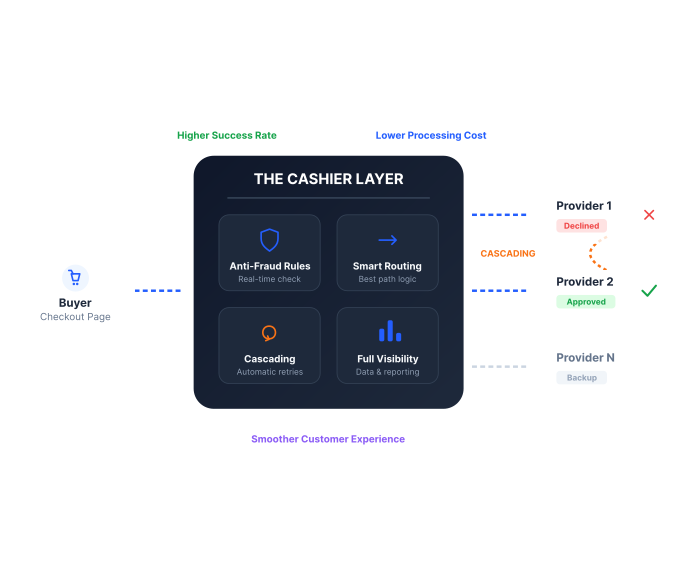
PayAdmit supplies the technology around the acquiring relationship: the gateway, the cashier, the reporting and the intelligent payment routing that decides which account each charge is sent to. The acquiring itself stays with the bank or PSP that underwrote you, and operators can keep the accounts they already hold.
The one thing worth remembering
Never run online gaming on a single merchant account. One account is a single point of failure for the whole business: a volume cap, a maintenance window or a risk review takes the entire deposit flow offline at once. Two accounts on the same technology layer turn that outage into a routing decision instead of a revenue event.
Gaming Payment Optimization
1
Select the route
Each deposit is scored against the accounts available for that country, currency and card range. The account with the best live approval rate for that profile takes the charge first.
2
Authenticate proportionately
3D Secure is applied where the market requires it and exemptions are claimed where the rules allow, so a returning player is not challenged on every routine top-up.
3
Recover the decline
A soft decline is retried on the next eligible account inside the same session. The mechanics are covered in detail on cascading payments.
4
Offer the local method
Where cards convert badly, the cashier presents the bank transfer, wallet or instant rail that players in that market actually use, and the deposit completes off the card network.
Settlements, Reconciliation and Reporting
Once the account is live, the numbers that matter are operational rather than commercial. Approval rate by country and by account tells you where to move traffic. Decline reason codes tell you whether a drop is your fraud rules or the issuer's. Refund and chargeback ratios tell you how much runway you have before a review.
On the money side you need the settlement report to reconcile against your own ledger: gross charge volume, scheme and interchange fees, reserve withheld, reserve released and the net amount paid. Where an operator holds more than one account, those files arrive in different formats, which is exactly the work a single reporting layer removes. Finance teams read this data weekly, because in a high-risk business a processing anomaly shows up in the settlement file before anyone raises it as an incident.
Rolling reserve: a share of each settlement, commonly held for six months, that the acquirer keeps against future disputes. It is your money, released on a schedule, but it is not available working capital. Model it as deferred revenue rather than as a fee, and confirm the release schedule in writing before the first charge is processed.
Integration Options
Hosted checkout is the fastest path and the lightest compliance burden. The player is handed to a payment page served from the platform, card data never reaches your application, and your PCI scope stays at SAQ A. Most operators launch this way and keep it for mobile web.
Server-to-server API integration gives full control of the deposit experience. The cashier stays inside your product, tokens are stored against the player account, and repeat deposits complete in one tap. It requires a higher PCI level and a development team that owns the flow.
Connectors sit between the two. Existing acquirers, wallets and local providers are added as configuration rather than as new code, so a new market is a settings change and not a release. Reporting from every connected provider lands in the same payment analytics dashboard.
Whichever route you take, keep webhooks authoritative. A deposit is credited to a player balance when the notification confirms it, never when the browser returns. That single rule removes most of the double-credit incidents new gaming operators run into. Whichever option you pick, the payment path stays the same and the online cashier is what your players actually judge.
Costs and Commercial Terms to Evaluate
Nobody can quote a gaming rate from a web page, and any provider who does is quoting a headline that will change at underwriting. What you can do is compare the categories of cost, because those are the same everywhere: the discount rate on each charge, the per-transaction fee, scheme and interchange pass-through, the monthly account fee, chargeback and retrieval fees, and the cost of settling in a currency you do not hold. Pricing on a high-risk merchant account is quoted per charge, so model the cost of a declined charge and a refunded charge alongside the approved one.
Alongside price, three terms decide how the account behaves under stress: the reserve percentage and its release schedule, the monthly volume cap and how quickly it can be raised, and the notice period the acquirer must give before suspending processing. Negotiate those with the same attention you give the rate. High-risk pricing reflects what an acquirer expects to lose, so an online business that processes cleanly for two quarters can usually reopen the rate conversation.
The cheapest gaming merchant account is rarely the one with the lowest rate. It is the one that stays open through a volume spike, a dispute cluster and a bad month, because a suspended account costs more in a week than a basis point costs in a year.
Frequently Asked Questions
What are the core online gaming merchant account requirements?
A valid gaming licence for every market you accept from, full corporate and ownership documentation, a written AML and responsible gaming policy, and processing history where it exists. Acquirers also expect a settlement bank account in an acceptable jurisdiction.
How long does approval take?
With a complete file, two to six weeks is normal for a gaming merchant account. Incomplete submissions are the main cause of longer timelines, because every follow-up question resets the underwriter's queue position.
Can a start-up operator get an account with no history?
Yes, provided the licence is issued and the policy documents are in order. Expect a lower monthly cap, a higher reserve and a review after the first three months of live processing.
How do chargebacks affect an online gaming merchant account?
Every chargeback is counted twice, once against your ratio and once against your balance. Card schemes watch the share of disputes against processed volume, and a high-risk business that drifts above the published ceiling enters a monitoring programme with higher fees attached. Clear billing descriptors, dispute alerts and a prompt refund policy keep the chargeback count down before it becomes a processing problem rather than a reporting one.
Is PayAdmit an acquiring bank?
No. PayAdmit is a payment technology vendor. We provide the gateway, cashier, routing and reporting layer around your merchant account, and we work with the acquiring relationships an operator holds or is introduced to.
Can we keep our existing online gaming merchant account providers?
Yes. Existing accounts and providers connect to the platform as configured routes, and traffic can be split between them by market, currency or card range without changing the checkout.
What happens if an account is suspended?
If more than one account is connected, traffic moves to the remaining route automatically and deposits keep completing. That is the practical argument for running a second account before you need it.
What do online gaming merchant services usually exclude?
Payouts, in most cases. Card acquiring covers the incoming charge; sending money back to a player is a separate payout arrangement on separate rails, underwritten and priced on its own terms. Ask each provider to quote both sides of the flow, because a high approval rate on deposits tells you nothing about how quickly a withdrawal is processed.