
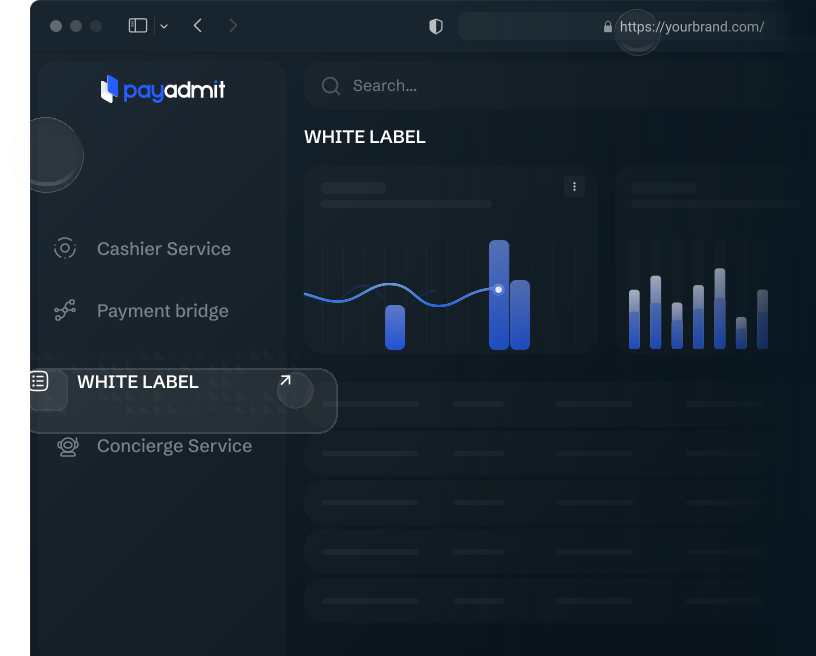
The cashier, so deposit and withdrawal surfaces stay consistent across every connected provider.
iGaming Payments Platform for Operators
An iGaming payments platform is the layer that turns several providers, dozens of methods and two directions of money into one integration your product talks to. This page is about the architecture: what sits where, and why it matters at the fourth market rather than the first.

What an iGaming Payments Platform Should Centralize
Six things. If any of them lives outside the platform, it becomes the thing you reconcile by hand at the end of every month. The operational view of the same six is on gaming payment system.
Provider connectivity, so adding an acquirer is configuration rather than a release.
Payment methods, with per-market availability held in one place instead of in the front end. A payment platform is a solution to an integration problem before it is a solution to an approval problem, and crypto belongs in it too, as white label cryptocurrency payment processor sets out.
Routing and retry logic, expressed as rules your own team can read and change.
Payouts, with their own approval workflow rather than as an afterthought on the deposit path.
Risk and reporting, applied once at the platform rather than separately per provider. Every provider connection the platform absorbs is one your own team does not process, maintain or debug.
Platform Architecture
Three layers and a back office. Each one can change without the others being rewritten, which is the entire point of building it this way.

The cashier and the payment surfaces inside your product, on your domain and in your brand. It knows which methods are available for this player in this market, and nothing at all about which provider will end up receiving the payment. That ignorance is what lets routing change underneath it in real time.

Where rules, weights, provider health and performance history live, and where each payment is scored and assigned a route. It also normalises everything coming back, so one taxonomy of statuses and decline reasons reaches your platform regardless of which connector produced it.

One adapter per acquirer, wallet or local rail, plus the operator console where payouts are approved, rules are edited and settlement data is reconciled. Connectors are added over time; the console is where your team spends its day and where every change is versioned. Online gaming traffic changes faster than a payment roadmap, which is why configuration beats code here.
Payment Provider and Method Connectivity
Connectivity is the part operators underestimate. Each provider has its own request format, its own status vocabulary, its own idea of what a refund means and its own settlement file. Integrating three of them directly is three integrations plus three maintenance commitments.
Behind a platform it is one integration and a growing list of connectors. Your product never learns a provider's dialect, and a provider can be added, weighted, demoted or dropped without your engineering team being involved at all.
The conclusion to hold on to
The value of a payments platform is not the connectors it ships with. It is that adding the next one costs a configuration change instead of a sprint, which is what keeps a provider relationship reviewable rather than permanent. Over 550 methods are already connected, and that number matters far less than the cost of connecting the 401st.
Smart Routing and Cascading
1
Score the payment
Country, currency, amount, card range, provider health, cost and recent performance for that exact profile.
2
Produce an ordered list
Not one route but a ranking. The first entry is the routing decision; everything below it is the cascade. Payment data is only actionable if the payment platform normalises it as it arrives.
3
Attempt and classify
The response is normalised, and only a genuinely recoverable failure qualifies for another attempt.
4
Retry safely
Same idempotency key, same token, ambiguous responses resolved before anything is re-presented.
5
Return one result
Your product sees a single outcome with the full attempt history behind it. The decision model is on intelligent payment routing.
Risk, Fraud and Security Controls
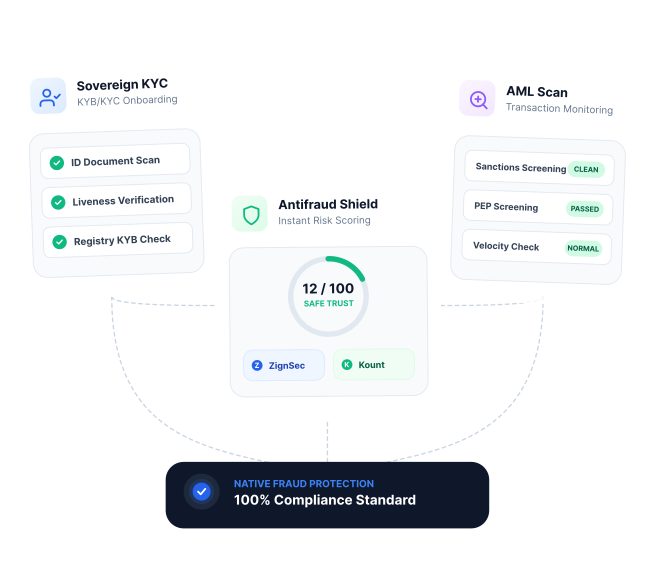
Risk belongs in the orchestration layer, not in each connector. Scoring runs before authorisation, with three outcomes rather than two, and the same rules apply whichever provider is about to receive the payment.
Card data is tokenised at the platform edge, so raw numbers never reach your servers and PCI scope stays where it belongs. Authentication is applied proportionately, and every decision keeps an audit trail per merchant that can be reconstructed months later. The payment layer records what it did and when, so an online support question has a timestamped answer backed by payment data.
Orchestration layer: the part of a payments platform that decides and normalises rather than transacts. It holds the rules, the routing, the risk checks and the shared data model, which is why putting risk anywhere else means maintaining the same policy in as many places as you have providers. The engine behind it is antifraud and risk management.
Planning a platform layer over providers you already hold?
Merchant and Operator Back Office
The console is where the platform stops being architecture and starts being a job. Payout approvals are worked here, routing rules are edited here, methods are opened and closed per market here, and a single player's payment history is looked up here when support asks.
Access is role-based and every change is versioned with an author and a timestamp. An operator running a portfolio can hold a house default and override it per merchant, and each merchant sees its own numbers rather than the pool.
Analytics and Reconciliation
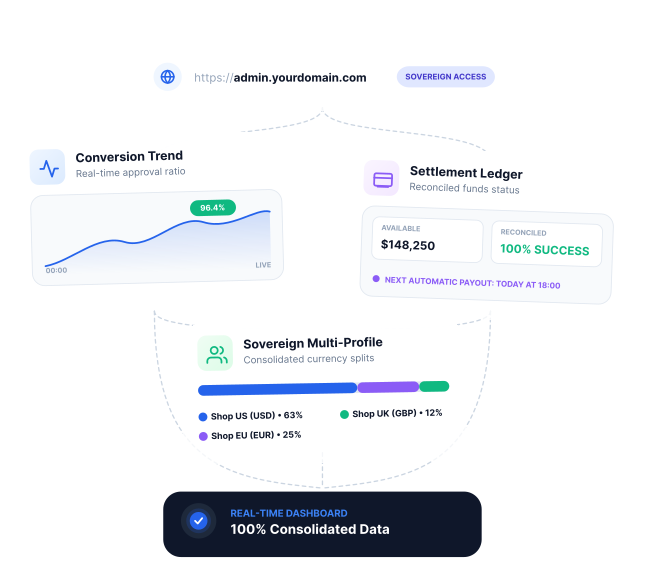
Real-time data is only useful at the granularity you can act on. Approval, cost, latency and payout timing per market, per method and per provider are decisions; the same four numbers averaged across a portfolio are a report. Settlement files matched line by line against captured payments turn month-end into a review of exceptions rather than a re-count of the ledger.
Developer APIs and Integrations
What your engineers actually build against, and the contract each part carries.

One server-to-server call, with a hosted fallback for markets where a redirect is required.

A separate endpoint with its own lifecycle: requested, approved, executed, settled. Not a reversed deposit. Payment rules for each online gaming market live in the platform, not in the product team's backlog, and the platform processes them the same way every time.

Signed callbacks are the only authority on final state, carried with idempotency keys so a repeat cannot pay twice.

Providers join behind the same interface, so a new market is a configuration change and a test window.
Scaling Across Markets and Currencies
What entering a fifth market costs, depending on how the payment layer was built.
| Task | Direct integrations | Platform layer |
|---|---|---|
| Adding a provider | A new build and a new maintenance commitment | A connector plus configuration |
| Adding a local method | Front-end and back-end changes together | A setting, with availability held centrally |
| New currency | Handled per provider, differently each time | Priced to the player, settled to your treasury |
| Market-specific rules | Conditions spread through product code | Rules held per jurisdiction in one place |
| Reporting | One export per provider, merged by hand | One consolidated view, split by segment |
Platform Reliability and Provider Redundancy
Five conditions that have to hold before a platform is genuinely redundant rather than nominally so.
- At least two providers live per major market, both carrying real traffic.
- Health measured against each route's own baseline, not against an uptime check.
- Automatic demotion of a degrading route, with a probe share that keeps testing it.
- Payout capacity funded independently of deposit settlement timing.
- A rehearsed failover, because a redundancy no one has exercised is a hypothesis.
How to Evaluate an iGaming Payments Platform
Questions about what the platform does today:
- How many providers can run concurrently, and who ranks them?
- Do payouts have their own approval workflow and limits?
- Is reporting available per market and per provider, or only in total?
Questions about what happens later, which matter more:
- What can our team change without raising a support ticket?
- Who holds the card tokens, and are they portable if we leave?
- What does adding the next provider or market actually cost us?
PayAdmit Platform Capabilities Relevant to iGaming
What we supply, stated plainly. PayAdmit is a payment software vendor: we do not act as a PSP, hold merchant accounts or settle funds.

Cashier, gateway, orchestration engine and connectors, deployed on dedicated infrastructure in a PCI DSS Level 1 ready environment. Over 550 payment methods are already connected, and providers an operator already holds join the same routing order on equal terms rather than being ranked behind ours.

Routing rules, cascade priorities, risk thresholds, method availability and payout approvals are all edited by your own team from the back office, versioned with an author and a timestamp. Portfolio operators can hold a house default and override it per merchant without duplicating configuration.

Platform maintenance, PCI upkeep, connector updates and 24/7 technical support, so an operator does not carry an internal payments engineering team. A typical deployment reaches live payments in one to two months once provider agreements are in place.
Where the question is whether to license this layer or build it, the trade-offs are set out on payment gateway infrastructure.
Frequently Asked Questions
Is a platform worth it with only one provider?
Partly. You get the cashier, the reporting and the risk layer, but the routing and cascade capabilities need somewhere to route to. Most operators see the real return once the second provider is live.
Does the platform hold our funds?
No. Money moves between the player, the provider and your settlement account. PayAdmit supplies the software layer and does not take custody of funds at any point.
How long does a platform integration take end to end?
One integration against the payment API, then configuration per provider. Most of the elapsed time sits with commercial agreements rather than with code, so an online operator that starts the provider conversations early usually goes live sooner than one that starts with the build.
What reporting should an online operator expect from the platform?
Approval, cost, latency and payout timing per market, per method and per provider, in real time rather than a monthly export. A solution that reports only at portfolio level hides the online market that is failing, and the platform should process that split for you.
Can we migrate without asking players to re-enter cards?
Usually yes, through a token migration agreed with the outgoing provider. Where that is refused, the platform re-tokenises on the next successful deposit, so the disruption lasts one transaction per player.
How is this different from a gateway?
A gateway carries a transaction to one destination. A platform decides which destination, handles the retry, owns the payout workflow and consolidates the reporting across all of them.
Is a payments platform the same as a payment product from one provider?
No. A single-provider solution processes your traffic and reports on itself. A platform sits above several providers, holds the payment record in one model and lets you compare them, which is the difference between a product you use and a payment layer you own.
Can the platform run alongside our current payment solution?
Yes, and that is the usual migration. The platform processes a small share of gaming traffic first, the numbers are compared against the incumbent solution over a full weekly cycle, and the payment mix moves only once the data supports it.