

Find what players there already pay with. It is rarely a card, and it is never the method that is easiest for you to add. A payment system is bought once and used daily, so the back office matters more than the pitch, and the payment team processes more of its work there than anywhere else.
Gaming Payment System for Online Operators
A gaming payment system is everything between the player pressing deposit and your finance team closing the month: cashier, gateway, provider connections, payouts, risk and reporting, running as one operation instead of six contracts.

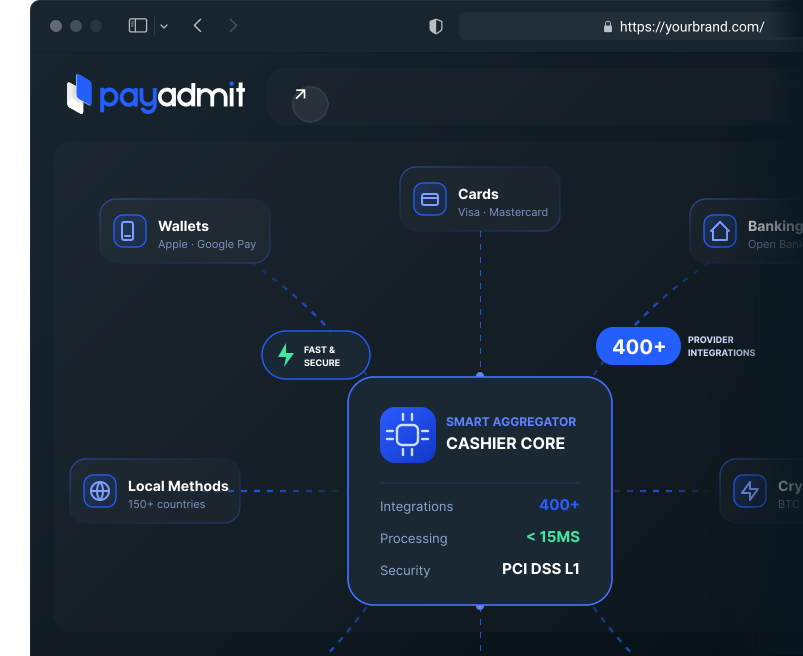
What a Gaming Payment System Includes
Seven components, and an operator ends up owning all of them whether or not they were bought together. The cashier the player uses. The gateway that carries the authorisation. The PSP and acquirer connections behind it. The payment methods offered per market. The payout side, which runs on its own rails. The risk layer that screens both directions. And the back office where the data lands.
Buying them separately is normal and workable. What is not workable is having them reconciled by hand, because the seams between components are where money and evenings disappear.Any online gaming business will use the same seven components; what differs is how many of them it processes itself. The architectural view of the same seven parts is on igaming payments platform.
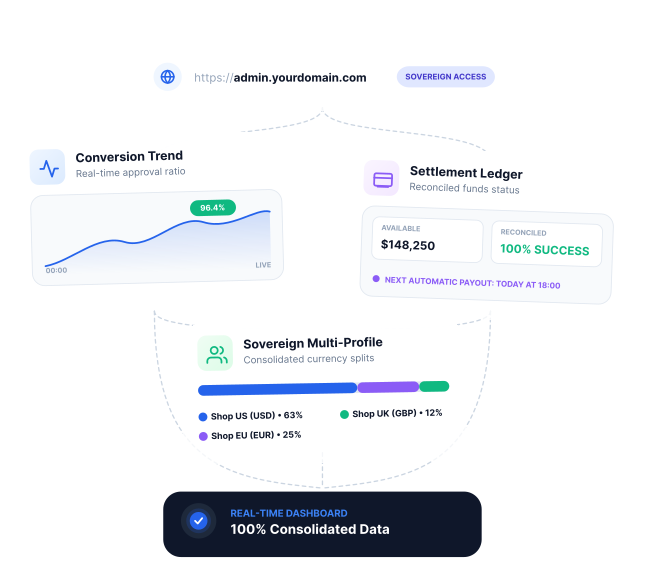
Back office: the operator-facing side of a gaming payment system, where transactions, payout approvals, risk rules, merchant settings and settlement data are worked on. It is not the same thing as reporting; reporting shows you the numbers, the back office is where you change them.
Player Deposit Flow
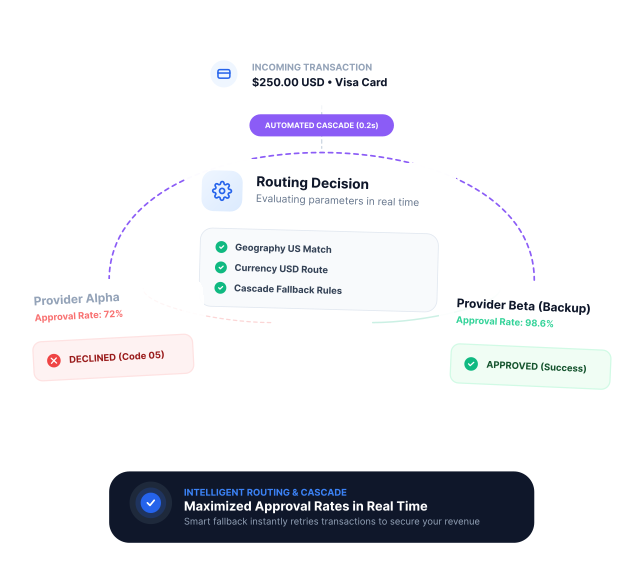
The player picks a method in the cashier and the system scores the available routes for that market, currency and instrument before it sends anything. Authorisation goes to the best-placed provider, the bank answers, and a signed callback confirms the result.
Only that callback credits the balance. If the first route declines for a recoverable reason, the payment is re-presented elsewhere inside the same session, so what the player experiences is a short wait rather than a refusal. Every attempt is logged, including the ones that never became payments.
Withdrawal and Payout Flow
A withdrawal is not a reversed deposit. It is a new payment out to a verified instrument, drawn from a funded balance, screened before it moves and settled on a rail with its own cut-off times. Operators who model payouts as refunds discover the difference on the first busy Friday, when the queue is full and the settlement they were counting on has not arrived.
Payment Method and Currency Coverage
How a market goes from unsupported to live, in four steps that repeat for every country you enter.

The method joins as a connector with its own limits and settlement behaviour, not as a branch in your platform code.

Show players the amount they will actually be charged, then settle into whichever currency your treasury holds.

A market with five deposit methods and one slow payout rail generates support tickets rather than loyalty.
Gaming Cashier and Checkout Experience
What a player notices, and what it costs when it is missing. Online deposits and online payouts are processed on different rails, and any business that models them as one will discover the difference on a busy weekend.
| In the cashier | Why it moves the number |
|---|---|
| Saved method first | Repeat deposits complete in one tap instead of four. |
| Local currency shown | No surprise at the bank statement, so fewer disputes. |
| Unavailable methods hidden | A greyed-out option reads as a broken platform. |
| Stays on your domain | A third-party page mid-deposit is where sessions end. |
| Withdrawal status visible | Removes the single most common support contact. |
Want to see the cashier and back office on your own markets?
Routing and Provider Redundancy
Five settings decide how the system behaves when a provider has a bad afternoon.
- Provider order per market, ranked on live approval rather than on contract age.
- Which decline codes are eligible for a second attempt and which are final.
- Retry depth, because past the second or third route the cost outruns the recovery.
- Health thresholds that demote a slow provider before anyone files a ticket. The payment record a system produces is the only honest report card on the payment decisions it made.
- Traffic weights, so a new connection proves itself on a small share first.
The rule set behind these is described on smart payment routing.
Fraud, KYC/AML, 3DS and Chargeback Controls
Six controls that belong to the payment layer rather than to the game client.
Velocity and device rules at deposit, catching card testing and bonus abuse before authorisation.
Risk scoring with three outcomes: approve, decline, or step up to further verification.
KYC completed before the first withdrawal, with the result available to the payout queue. Every operator can process a payment; far fewer can show the data behind every payment they declined.
3D Secure applied where mandated, with exemptions claimed where the rules permit.
AML transaction monitoring configured per jurisdiction, with escalation paths recorded.
Dispute alerts routed to support, so a refund can pre-empt a chargeback against the ratio.
Back Office, Reporting and Reconciliation
Three jobs the operator's own team does daily, without raising a ticket with anyone.

Work the payout approval queue, adjust risk thresholds, change provider priorities, open or close a method in a market, and look up a single player's payment history when support asks. Every change is versioned with an author and a timestamp so a decision can be explained a quarter later.

Approval rate, decline reasons, payout timing, refund and chargeback ratios and cost per approved payment, all sliced by market, method and provider rather than pooled. A portfolio average will stay flat while a single market quietly falls apart underneath it. An online business that reads its own payment data weekly will spot a failing market before its provider does.

Settlement files from every connected provider matched line by line against captured payments and payouts, with only the exceptions surfaced for a human. Finance closes on the exceptions rather than on the full ledger, which is what makes month-end a morning instead of a week.
Gaming Platform Integration
Integration is two APIs and a contract about state. Deposits are a call with an asynchronous confirmation; payouts are queued, approved and then executed. Transaction states are normalised across providers so your platform never learns anyone's private vocabulary.
Connectors carry the rest. A new acquirer, wallet or local method is added behind the same interface, which is what keeps a market launch inside a configuration window instead of a release cycle.
The rule worth hard-coding
Signed webhooks are the only authority on whether a payment succeeded. Never credit a player balance on a browser redirect, and always carry an idempotency key so a repeated notification cannot pay twice. Nearly every double-credit incident a new gaming operator reports traces back to one of those two rules being treated as optional.
Scalability and High Availability
1
Size for the peak
A final concentrates a month of deposits into hours. Capacity is planned against that hour, not against the monthly average.
2
Spread the traffic
Two live providers per major market means a cap or an outage becomes a routing decision instead of a revenue event. Payment processing, payout processing and reconciliation are three jobs a system has to do without a spreadsheet in between, and the team that uses it daily will tell you which one is missing.
3
Degrade deliberately
A slow provider is demoted automatically and probed with a small share until its own numbers recover.
4
Keep payouts independent
Withdrawal capacity funded separately from deposit settlement, so a busy weekend never becomes a payout backlog.
How to Evaluate a Gaming Payment System
Ask what your own team can change without a support ticket, how many providers can run at once, whether payouts have a real approval workflow, and what the reporting looks like per market rather than in total.
Then ask the uncomfortable one: what happens if we leave. Who holds the tokens, who owns the transaction history, and how much of the cashier would have to be rebuilt. The answer tells you how reversible the decision is.
Vendor lock-in, measured properly: not whether a contract has an exit clause, but how many weeks of engineering it would take to move. A system where providers are configuration and tokens are portable is one you can leave; one where each provider is wired into your codebase is one you cannot. The gateway component of that decision is covered on payment gateway for gaming site.
Frequently Asked Questions
Do we have to replace our whole stack at once?
No. The usual path is to run the new system alongside the existing one, move a percentage of traffic, compare the numbers and then shift the rest. Tokens migrate where the outgoing provider permits it.
Is the cashier really under our brand?
Yes. It runs on your domain with your styling, and players do not encounter a third-party payment brand during a deposit or a withdrawal.
Is a gaming payment system the same as a gaming payment gateway?
No, and the difference matters commercially. The gateway carries one payment to one destination. The system around it holds the cashier, the payouts, the risk rules and the reporting, and any online business that buys only the gateway will build the rest itself.
Who holds the funds?
The licensed institutions you contract with. PayAdmit is a software vendor and does not act as a PSP, hold merchant accounts or settle money.
How long until the first live payment?
One to two months in a typical deployment. Provider agreements and underwriting usually set the pace rather than the technical work.
What data should the system give our finance team?
Approval and cost per market, payout timing per rail, and settlement files matched line by line to processed payments. Any business closing its month on summary data is reconciling twice.