

Building their own acquiring infrastructure need a technology layer that handles routing, cascading, and merchant management under their brand.
Fintech Solutions Software Development Company
Build, brand, and launch payment-ready fintech software in weeks, not years. PayAdmit is a fintech solutions software development company that gives payment teams a production grade gateway to deploy under their own brand, or a custom fintech software build engineered to their exact specification.

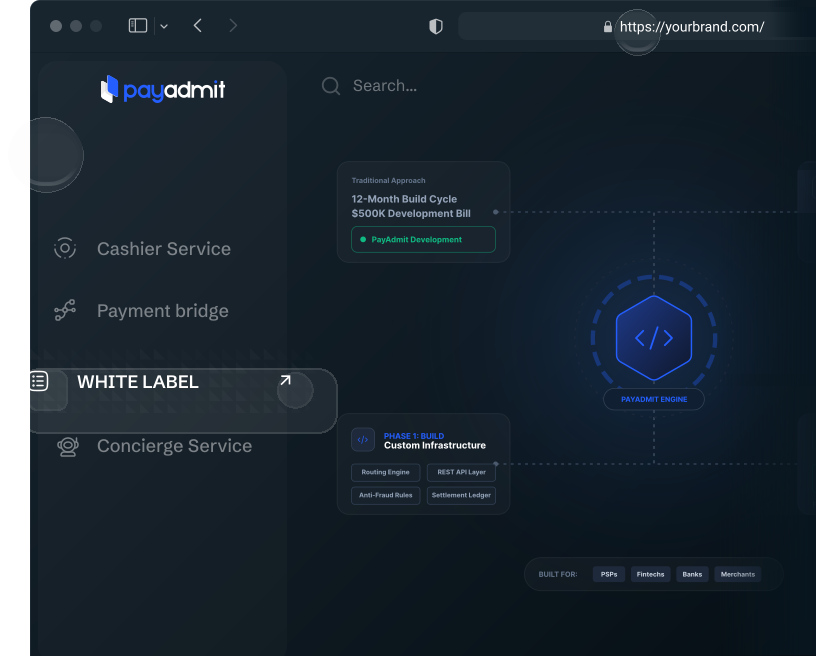
What Is a Fintech Solutions Software Development Company
A fintech solutions software development company builds the system that moves, manages, and measures money. That covers the payment gateway, the routing engine, the merchant portal, the compliance layer, and the APIs that connect them. A real fintech solution is not a screen with a logo. It is the payment technology underneath that processes every transaction securely and at scale.
Most solution development stalls on the same component: the payment core. A team can design a clean app, but the gateway, the PSP integrations, the cascading logic, and the PCI DSS environment sit far below the surface, and that is where the build cost and the timeline explode. A platform project that treats payments as a late detail rebuilds the core later, every time.
Why PayAdmit is different
A generalist software team can write application code. A payment technology vendor has already solved card processing, provider cascading, fraud screening, and certification. Fintech solution development succeeds when both come together, and PayAdmit supplies the half that takes years to build. Complementary reading: custom fintech software development.
Who Needs Fintech Software Development
Fintech software development is for any business that puts money movement at the centre of its product. The profile is consistent across verticals.

Serving business clients need to offer a complete payment solution, not just an account. White label technology lets the institution provide card acceptance, routing, and portal access entirely under its own name.

Want to embed payment processing natively rather than redirect users to a third-party page. Need a partner with a developer-ready API and branded checkout on their own domain.

Processing high card volumes across multiple jurisdictions need multi-currency routing, PSP cascading per market, and anti-fraud tooling a standard solution cannot provide.

Adding embedded finance need split payments, payouts, and recurring billing as part of the product, not as a bolted-on redirect.
The Real Problem With Solution Development
Four reasons fintech solution development is hard, and why so many in-house builds fail. PayAdmit solves all four by shipping the hardest parts already finished.

Building a gateway from scratch costs $500K to $1M and takes 12 to 24 months before a single live transaction. Ongoing maintenance runs 30 to 40 percent of the initial spend every year.

A solution that handles cardholder data must meet PCI DSS from the first commit. Teams that treat certification as a final checklist pay for it in rework, delay, and exposure.

A single PSP rarely covers every market. A solution that routes every payment down one path leaks revenue on every decline. Intelligent routing and automatic cascading are the difference between a platform that approves payments and one that does not.

New markets, methods, verticals, BIN updates, and security patches arrive continuously. A payment integration project is not a launch; it is an ongoing programme that pulls engineering away from the product that differentiates the business.
PayAdmit Fintech Software Development: Solutions and Services
Three ready-to-deploy paths plus a fully custom option. Each is a complete solution your business owns and operates under its own brand.
A complete gateway deployed on dedicated servers under your domain, with your own PCI DSS Level 1 certification. Routing, cascading, merchant tooling, and 400+ integrations come configured and branded. See the white label payment gateway software.

A hosted checkout on PayAdmit's PCI DSS environment for teams that want a faster, lower-overhead route to live payments. The cashier page deploys quickly and carries your brand.
A middleware connector that sits between your existing systems and payment providers. Unifies routing, reporting, and transaction management through a single integration. See the payment bridge.
For businesses with specific technical requirements, unique workflow logic, or proprietary card processing needs, our engineering team builds a bespoke fintech solution on the same certified foundation. White label is the fast path; custom is the precise one.
You licence the system and operate it as your own product, or commission a custom build. PayAdmit maintains the infrastructure, the PCI DSS certification, and the provider network. Your company owns the merchants, sets the pricing, and grows the business.
How Fintech Software Development Works With PayAdmit
Four phases from brief to live gateway. The path is short because most of the development is already done.

Map your markets, payment methods, merchant model, and compliance scope. Defines the routing rules, cascading chains, and provider mix your gateway needs from launch.
PayAdmit sets up your branded gateway on dedicated servers with your domain, PCI DSS certification, and initial PSP connections. Payment pages, admin panel, and every URL reflect your brand.

Your developers connect through a clean REST API with documentation, sandbox, and a dedicated onboarding engineer. Supports pay-ins, pay-outs, refunds, and recurring payments. Webhooks deliver real-time updates.

Most deployments go live in 2 to 3 weeks. New markets or methods are integrated by PayAdmit within one to two weeks and become available across the merchant network immediately.
Fintech Software Development Capabilities
A complete solution needs more than a checkout. The software ships with the full payment operation built in.
The engine evaluates every transaction in real time and sends each payment to the provider most likely to approve it. When one declines, the system cascades to the next configured PSP within the same session. See payment routing infrastructure.
Manage every merchant from a single admin panel with onboarding, settlement data, fee configuration, and advanced analytics. One integration covers the entire sub-merchant network.

Visa, Mastercard, Amex, JCB, UnionPay, plus 300+ alternative methods, digital wallets, bank transfers, and crypto. Merchants gain full coverage through a single integration.

Configurable risk rules per merchant, velocity limits, spending thresholds, and behaviour scoring inside the gateway. Third-party providers such as ZignSec, Kount, and Paydetect connect through the same scoring pipeline. Pairs with antifraud and risk management.
Real-time reporting, settlement tools, and a full back office give your team control over the entire transaction lifecycle. Multi-currency conversion applies before routing so each PSP receives the correct settlement amount.
Developer Infrastructure & Security
Built for the teams that integrate it. The software exposes a full REST API for every gateway operation, with documentation inside the admin panel. Developers get a testing sandbox, real example payloads, and webhook resend support for any transaction state.
A single API gives access to the entire 400+ provider network. Adding a new provider later requires no new development on your side. PayAdmit handles the integration work, so your developers complete the connection once and gain the full library.
Security is the foundation. The software runs at PCI DSS Level 1 on dedicated servers per client. The cardholder data environment sits inside a certified perimeter, isolated from other operators. Card data, transaction logs, and merchant records stay within your own certified boundary.
Technological efficiency comes from a lean, well-documented architecture. PayAdmit carries the maintenance, security updates, BIN database refresh, and new feature development, so your developers stay on the roadmap rather than on upkeep.
Build Versus Buy: Clear Comparison
Every fintech engineering team faces the same decision. Build the gateway in-house or deploy a white label solution and brand it as your own. The outcome is identical: a payment platform your business owns and operates. The difference is the two-year build burden.
| Factor | Build from Scratch | Deploy PayAdmit |
|---|---|---|
| Cost (year 1) | $500K to $1M in development plus 30 to 40% annual maintenance | Fixed licence and integration fee |
| Time to first live transaction | 12 to 24 months | 2 to 3 weeks |
| PCI DSS certification | Your team carries the full audit programme | Level 1 certified environment on dedicated servers under your brand |
| Provider integrations | Each provider is its own engineering project | 400+ providers through a single integration |
| Ongoing engineering | Your team on BIN updates, patches, new markets | PayAdmit handles ongoing engineering |
Why a Fintech Solutions and Software Development Company Beats a Generalist Vendor
Any competent shop can build software. Very few can build a fintech solution that passes an acquirer review, holds up under real transaction volume, and gives your compliance team the audit access they need on day one. That gap is exactly why an operator picks a fintech software development company rather than a generalist studio. The specialisation shows up in every corner of the platform, from the ledger design, to the routing engine, to the way KYC data is handed to a regulator when the request lands. Our development team has shipped this shape of fintech software for a decade, and that muscle memory compresses months of trial-and-error into a discovery week.
A fintech-first development company also brings pattern recognition. When your product manager asks whether a specific solution belongs in the platform core or in a merchant-facing app, we can answer from experience rather than from theory. When a compliance officer asks whether a KYB data field should be captured at onboarding or at first payment, we can answer with the same confidence. Every decision that a generalist software vendor would file as "we'll figure it out during development" is one we can resolve inside the first week, a hidden but very real acceleration for any fintech project.
The engagement model is intentionally different too. A fintech solutions and software development company treats each platform as a long-running relationship, not a fixed-price project. Access to the same development lead over multiple quarters, a shared roadmap, and continuous small releases beat a big-bang handover every time. Our fintech development team stays with the operator through go-live, through scale, through market expansion and through regulatory refresh cycles. The result is a software platform that keeps compounding value rather than one that ossifies the day the vendor invoice is paid.
Where the PayAdmit Fintech Platform Connects to the Rest of Our Work
The fintech development work described on this page does not sit in a silo. It plugs into the wider PayAdmit stack of fintech solutions: the payment platform, the compliance tech, the merchant app, the reporting layer. If you are shaping a scope right now, the following related pages will give you the surrounding context in the time it takes to make a coffee.
For the broader engineering service, our fintech software development page covers the day-to-day development capability our team runs across every fintech project. For custom, from-scratch work, see custom fintech software development. If the shape you actually want is an embedded development pod, the fintech development outsourcing page describes exactly how we structure it. And if you are still shaping the team side, our page on how to hire fintech software developers covers regions, seniority and cost.
On the blog side, three companion posts round out the picture: fintech software developers covers the people who build the platform, fintech software development services maps the service catalogue against real scope decisions, and fintech product development covers the product-management view of any fintech platform. Read together they explain exactly how a fintech solutions and software development company like ours turns an idea into a working, compliant platform your users can trust.
Use Cases
A founder building a payment service provider deploys PayAdmit's white label software, brands it, and onboards merchants in weeks. Keeps the licence and merchant relationships while PayAdmit runs the technology.
A fintech business with an established user base adds card acceptance for its business clients through a fintech platform engagement, without building backend payment infrastructure in-house.
A bank offers branded card processing to its fintech and merchant clients, retaining the client relationship and the revenue that a third-party processor would otherwise take.
An iGaming or marketplace operator routes high volume across multiple PSPs and markets with cascading per region, lifting approval rates and recovering revenue lost to single-provider declines.
Frequently Asked Questions
What is fintech solution development?
The work of building the system that processes, routes, and secures money movement, including the gateway, provider integrations, compliance layer, and APIs. PayAdmit delivers this as a branded white label product or as a fully custom build.
How much does fintech solution development cost?
Building from scratch runs $500K to $1M in the first year plus ongoing maintenance. Deploying PayAdmit's white label software removes most of that cost, because the routing, certification, and integrations already exist.
How long does fintech platform development take?
In-house typically takes 12 to 24 months before live transactions. A company that deploys PayAdmit launches a branded platform in 2 to 3 weeks, since the software and PCI DSS certification come configured.
Does PayAdmit offer custom development?
Yes. Alongside ready-to-deploy software, our team builds fully custom fintech solutions for businesses with unique workflows or proprietary processing needs, on the same PCI DSS Level 1 foundation.
Is PayAdmit a payment service provider?
No. PayAdmit is a software vendor. We develop and maintain the payment software, the routing technology, and the PCI DSS Level 1 infrastructure. Your company holds the licence, the merchant accounts, and the commercial relationships.
What payment methods does the software support?
Visa, Mastercard, Amex, JCB, and UnionPay, plus 300+ alternative payment methods, digital wallets, bank transfers, and crypto, through a single integration across the full 400+ provider network.