What a White Label Payment Gateway Actually Covers

Not every white label payment gateway is structured on the same basis. The gateway fee, infrastructure, and capabilities vary significantly across providers. Before choosing a provider, it matters what the gateway price actually includes — the fee, the features, and the infrastructure.

From Hidden Costs
to Full Transparency

Most providers separate core gateway access from the payment features a business actually needs to operate. This affects every business evaluating white label options — not every gateway includes what operators need to process payments and operate effectively.

Routing configuration, anti-fraud tooling, multi-merchant back office access, gateway integrations, and custom payment page development often carry additional fees. What appears affordable at entry grows quickly once the business activates the payment features it needs
to operate.

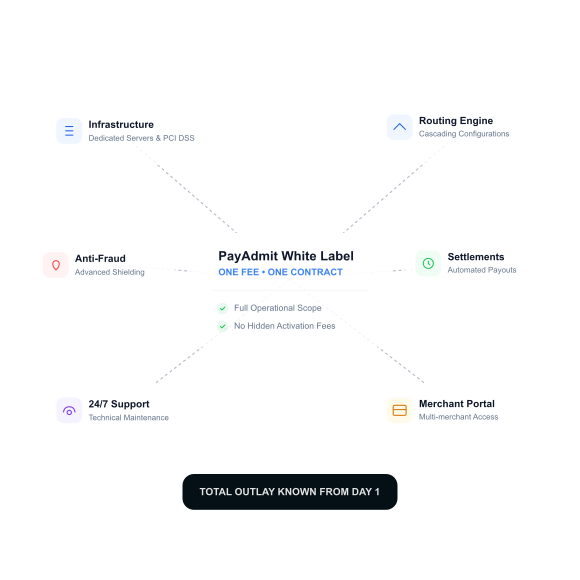
PayAdmit covers the full operational scope under a single white
label payment gateway fee — one gateway fee, one gateway contract.
The gateway fee reflects the complete white label infrastructure — everything a business needs to run a payment operation.

It covers: dedicated servers, own PCI DSS, payment routing engine, payment cascading configuration, anti-fraud, merchant portal, settlement tools, and 24/7 technical support. The operator knows
its total outlay from the first conversation.

How White Label Payment Gateway Fees Are Calculated — and How to Evaluate What You Get

White label payment gateway fees reflect three components — and all three are reflected in how PayAdmit structures its service.

PayAdmit covers all three as a single platform fee —
not separate line items billed as the business grows.

What the White Label Payment
Gateway Service Fee Covers

The white label payment gateway service fee covers the full technical scope
a business needs to operate a branded payment product from day one.

Dedicated Infrastructure

Each client runs on dedicated servers. The white label payment environment is isolated — no shared infrastructure. Server provisioning, configuration, and ongoing maintenance are included. Infrastructure management and ongoing maintenance are both included.

Own PCI DSS Certification

PCI DSS certification for the dedicated white label environment is included. No separate compliance program or independent PCI audit is needed for the payment environment — it is handled as part of what the operator needs to stay compliant. The certification covers card data, transaction processing, and the full technical setup.

Payment Routing Engine

The white label payment routing engine is fully configurable at no additional fee per parameter. GEO, currency, transaction amount, customer trust level, approval rate statistics, and card BIN data all contribute to payment routing decisions. Provider priority and cascade sequences are configurable without extra fees.

350+ PSP and Payment Method Connections

350+ PSP connections and payment integrations are available from day one. Every integration in the network is ready to activate without additional integration cost. Every method is included. When the operator needs a new PSP not in the current network, development is covered by the agreement. There is no per-integration fee — standard integrations are included. New PSP integrations outside the standard network are covered by the agreement. Integration development and integration maintenance are not billed separately.

Anti-Fraud and Risk Management

The anti-fraud layer includes internal rule configuration at the shop level and third-party anti-fraud provider integration. ZignSec and Kount connect as standard. Paydect and any custom provider the business uses integrates through the same pipeline. Anti-fraud capability is included — not a paid upgrade.

Merchant Portal and Back Office

The full merchant management back office is included. Merchant accounts, routing per shop, settlement, reconciliation, and transaction logs are all accessible from an admin panel on the client’s own domain. Multi-merchant management and role-based access controls are part of the base package.

Payment Page Design and Branding

Custom CSS configuration, domain setup, mobile-responsive layout, and initial brand implementation are included. The payment page reflects the client’s brand from the first transaction. Custom payment page development beyond the standard configuration is available on request.

24/7 Support and Onboarding

Onboarding includes dedicated setup assistance, payment routing configuration, anti-fraud rule building, and merchant portal training. Post-launch support covers software maintenance, BIN updates, PSP connection management, and technical assistance. Support is not a paid tier — the service is included from day one. The business gets a complete payment service from the moment it goes live.

Dedicated Infrastructure

Each client runs on dedicated servers. The white label payment environment is isolated — no shared infrastructure. Server provisioning, configuration, and ongoing maintenance are included. Infrastructure management and ongoing maintenance are both included.

Own PCI DSS Certification

PCI DSS certification for the dedicated white label environment is included. No separate compliance program or independent PCI audit is needed for the payment environment — it is handled as part of what the operator needs to stay compliant. The certification covers card data, transaction processing, and the full technical setup.

Payment Routing Engine

The white label payment routing engine is fully configurable at no additional fee per parameter. GEO, currency, transaction amount, customer trust level, approval rate statistics, and card BIN data all contribute to payment routing decisions. Provider priority and cascade sequences are configurable without extra fees.

350+ PSP and Payment Method Connections

350+ PSP connections and payment integrations are available from day one. Every integration in the network is ready to activate without additional integration cost. Every method is included. When the operator needs a new PSP not in the current network, development is covered by the agreement. There is no per-integration fee — standard integrations are included. New PSP integrations outside the standard network are covered by the agreement. Integration development and integration maintenance are not billed separately.

Anti-Fraud and Risk Management

The anti-fraud layer includes internal rule configuration at the shop level and third-party anti-fraud provider integration. ZignSec and Kount connect as standard. Paydect and any custom provider the business uses integrates through the same pipeline. Anti-fraud capability is included — not a paid upgrade.

Merchant Portal and Back Office

The full merchant management back office is included. Merchant accounts, routing per shop, settlement, reconciliation, and transaction logs are all accessible from an admin panel on the client’s own domain. Multi-merchant management and role-based access controls are part of the base package.

Payment Page Design and Branding

Custom CSS configuration, domain setup, mobile-responsive layout, and initial brand implementation are included. The payment page reflects the client’s brand from the first transaction. Custom payment page development beyond the standard configuration is available on request.

24/7 Support and Onboarding

Onboarding includes dedicated setup assistance, payment routing configuration, anti-fraud rule building, and merchant portal training. Post-launch support covers software maintenance, BIN updates, PSP connection management, and technical assistance. Support is not a paid tier — the service is included from day one. The business gets a complete payment service from the moment it goes live.

Why White Label Payment Gateway
Fees Differ From SaaS

The white label payment gateway differs fundamentally from a SaaS subscription. A SaaS product lacks dedicated payment gateway infrastructure — it is not a white label payment gateway product.

SaaS 

Shared environment 
Standardized costs
One system for many clients
No infrastructure ownership

A SaaS product serves many businesses from a shared environment. SaaS costs are standardized because the infrastructure is shared.

White Label Gateway 

Dedicated infrastructure 
Individual setup 
Isolated environment per client
Full infrastructure control 

A white label payment gateway runs on dedicated infrastructure per client.  The fee reflects that: individual server setup, individual PCI DSS certification, individual routing configuration, and individual technical support.

Each client operates in their own environment and pays for that isolation — not a share of someone else’s.

WHO THIS WHITE LABEL PAYMENT SOLUTION IS BUILT FOR

1

Payment transaction volume 

2

Number of merchants 

3

Target payment markets

4

Integration
requirements 

The fee is scoped to what the operator actually needs, how the operator needs it structured,
and what scale the operator needs — no features billed that the operator does not need.

Who Needs a White Label Payment Gateway and What It Covers for Them

Why PayAdmit White Label Payment Gateway Delivers More Value

The white label payment gateway market has providers at different rates. Rate alone does not determine value — what the payment service covers, and how each provider delivers the service,
determines whether the investment makes sense.

PayAdmit delivers more payment value
per fee for three reasons.

White Label Payment Gateway: Build vs. Buy

Component
Infrastructure setup
PCI DSS certification
Payment gateway software
PSP connection (per provider)
Anti-fraud setup
Time to first live payment
Maintenance team
First-year total
PayAdmit white label
Included
Included
Included
350+ included, new PSPs handled
Included
2–3 weeks
Managed by PayAdmit
Single fee
Build from scratch
$10K–$300K
$50K–$150K + 6–12 months
$200K–$500K
$5K–$20K each
$20K–$250K
18–24 months
Full DevOps + security team
$500K–$1M+
Infrastructure setup
PayAdmit white label
Included
Build from scratch
$10K–$300K
PCI DSS certification
PayAdmit white label
Included
Build from scratch
$50K–$150K + 6–12 months
Payment gateway software
PayAdmit white label
Included
Build from scratch
$200K–$500K
PSP connection (per provider)
PayAdmit white label
350+ included, new PSPs handled
Build from scratch
$5K–$20K each
Anti-fraud setup
PayAdmit white label
Included
Build from scratch
$20K–$250K
Time to first live payment
PayAdmit white label
2–3 weeks
Build from scratch
18–24 months
Maintenance team
PayAdmit white label
Managed by PayAdmit
Build from scratch
Full DevOps + security team
First-year total
PayAdmit white label
Single fee
Build from scratch
$500K–$1M+

How to Get White Label Payment Gateway Pricing — and How the Fee Is Built

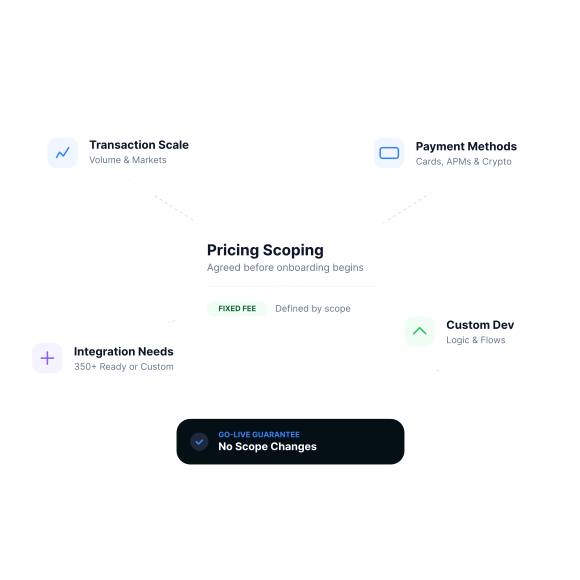
PayAdmit does not publish standard rates — the fee is based on scope. Pricing is agreed before onboarding begins. The white label payment gateway fee is scoped based on what the operator needs. The conversation covers four areas.

Everything Is Defined

Before the Fee Is Set

Transaction volume and expected payment transaction scale — across merchants, markets, and transaction types — the full transaction scope. Payment methods the operator needs to offer — card networks, APMs, and crypto methods required from day one.

Integration requirements — how many integrations the operator needs and whether the standard 350+ network covers what it needs, or whether custom PSP integration work is required. Custom development — any proprietary routing logic, checkout flows,
or settlement structures the operator needs to build.

PayAdmit works with each operator to define what it needs before scoping the fee. No scope changes after go-live — the fee covers the agreed scope, and any additions are agreed before development begins.

FREQUENTLY ASKED QUESTIONS

Is white label payment gateway pricing published? Toggle Icon

No fixed rate card is published. The fee depends on what the operator needs — and every operator needs a different scope. PayAdmit works with each operator to define what it needs before scoping the fee. White label payment gateway pricing is not standardized — pricing depends on transaction volume, number of merchants, target markets, and integration requirements. All of these shape what the operator needs from the gateway. The first conversation covers these points and results in a scoped pricing proposal.

What is included in the white label payment gateway fee? Toggle Icon

The fee covers everything a business needs to run the gateway: dedicated infrastructure, own PCI DSS, the routing engine, 350+ PSP connections, anti-fraud, merchant portal, page branding, API infrastructure, and 24/7 support — with no add-on fees for standard features a business needs.

How does white label payment gateway cost compare to building a custom payment gateway from scratch? Toggle Icon

Building a white label payment gateway from scratch costs $500,000 to $1,000,000 for the gateway MVP alone, with 18 to 24 months before the first live payment transaction. With PayAdmit, the white label payment gateway goes live in 2 to 3 weeks for a fraction of that cost — with 350+ integrations, PCI DSS, and a dedicated support team included from day one.

Does the fee change as volume grows? Toggle Icon

Fees scale with volume as the business needs evolve. Transaction volume, number of merchants, and active markets contribute to how the white label service is structured and how pricing is adjusted. The operator knows what to expect and what it needs to budget as it grows. Growth in volume does not mean unexpected pricing increases — any adjustments are agreed in advance.

Are PSP integrations and connections included in the fee? Toggle Icon

The 350+ PSP integrations in the PayAdmit network are included in the white label gateway fee. When the operator needs a new connection, or needs a PSP not in the current network, development is covered by the agreement. There is no per-integration surcharge — standard integrations are included. New integrations outside the standard network are covered by the agreement. Integration development and integration maintenance are not billed separately.

How long does setup take and is onboarding included? Toggle Icon

Setup and full onboarding — server provisioning, PCI DSS activation, routing configuration, anti-fraud rules, and merchant portal training — takes 2 to 3 weeks. Everything the operator needs to go live is included as part of the service. No separate charge for the onboarding, training, or configuration the operator needs — it is all included.