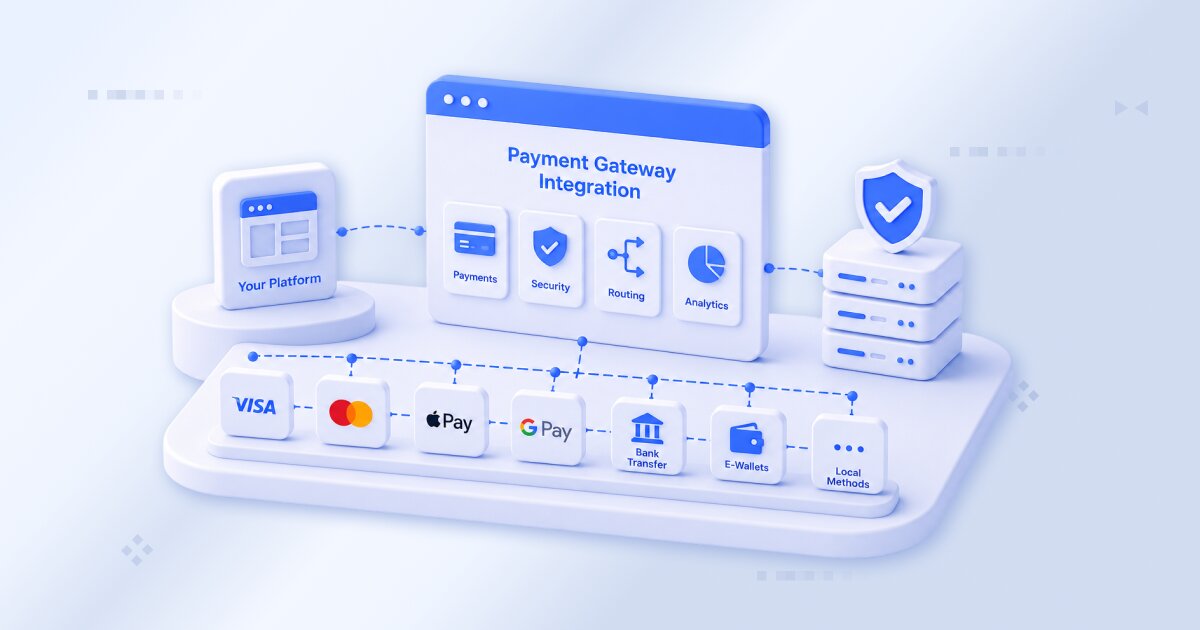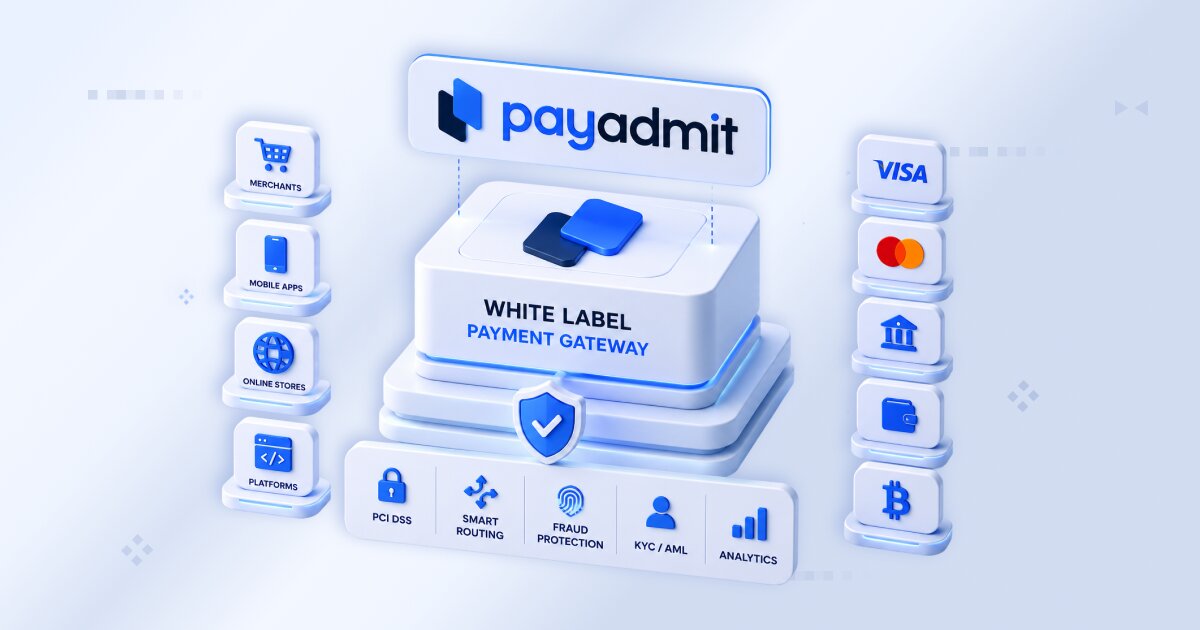

Owning a payment gateway means more than having a checkout form on your website.
TL;DR. To set up an online payment operation you need four parts working together: a secure gateway, connections to payment providers, intelligent routing, and a compliant cardholder data environment. This guide walks through each part, the real cost and timeline of a from-scratch build, and the faster route most businesses take. PayAdmit gives you a production ready, branded payment platform you control, live in weeks instead of years.
Every business now competes on the smoothness of its checkout. Customers expect a fast, branded checkout that never sends them to an unfamiliar page. A clunky payment step loses the sale, and a declined card loses the customer. So the pressure to control your payment experience has never been higher.
The market has also fragmented. A single payment provider rarely covers every country, card network, and currency your business serves. Approval rates swing by region and by issuer. A setup that routes every transaction along one path leaks revenue on every decline. That is why more teams want to create online payment infrastructure they control, rather than rent a generic checkout that limits their growth.
The catch is that payment infrastructure is hard. The visible checkout is a thin layer over a deep stack of provider connections, routing logic, fraud screening, and compliance. This guide shows what it takes to build that stack, and how to reach a live branded payment operation without spending two years on it.
Before you set up a gateway, it helps to see the parts. A complete online payment setup has four core layers.
| Layer | What it does |
|---|---|
| The gateway | The software that accepts a payment, tokenises the card, and passes the transaction on for processing. Hosts your branded checkout and exposes the API the product calls. |
| Provider connections | Your gateway connects to PSPs, acquirers, and alternative payment methods. Each connection is a separate integration with its own testing and contract. Wider coverage means more approved payments across more markets. |
| The routing layer | Smart routing decides where each payment goes in real time, choosing the provider most likely to approve it at the lowest cost. Cascading retries a failed payment on the next provider automatically. |
| Compliance & security | Any setup that touches cardholder data must meet PCI DSS. Not a feature you add later. It shapes the whole architecture from the first line of code. |
These four layers turn a checkout button into a real payment operation. Miss one, and the online payment experience breaks where it matters most: at the moment money moves.
The build-it-yourself route gives you full control, and it is the most demanding path. Here is what building the payment infrastructure involves, step by step.
The honest numbers. Building a payment gateway from scratch costs $500,000 to $1,000,000 and takes 12 to 24 months before a single live transaction. Ongoing maintenance then runs at 30 to 40 percent of that spend every year. For most businesses, that budget is better spent on the product than on payment plumbing. Our commercial reference how to build a payment system covers the engineering side in depth.
The most valuable part of any online payment setup is the routing engine, so it deserves a closer look. Routing is the logic that sends each payment to the best provider, in real time, to win approval at the lowest cost.
A naive setup sends every payment along one path. When that provider declines or fails, the payment is lost and the customer sees a failure. A serious payment operation routes intelligently. The engine scores each payment against the card BIN, currency, amount, customer geography, risk profile, and live approval statistics, then sends it to the provider most likely to approve.
Cascading is the safety net underneath. When a payment fails at the first provider, the gateway cascades to the next configured provider within the same checkout session, invisibly to the customer. The shopper completes the purchase. You capture the payment. For an online business processing real volume, a one to two point lift in approval rates from cascading turns directly into recovered revenue.
Flowchart: a cascading payment loop
Customer submits payment → routing engine scores providers in real time → payment sent to optimal provider → approved? → yes: settle and confirm → no: cascade to the next provider in the same session → approved? → yes: settle → no: return a clean decline. Every step runs in milliseconds and stays invisible to the customer.
Building this routing and cascading layer is one of the hardest parts of any payment project. It needs deep payments knowledge, live provider data, and constant tuning. Most teams have never built it, which is why so many home-built checkouts underperform on approval rates. Our payment routing infrastructure page covers the production shape.
No part of building an online payment operation carries more risk than compliance, so treat it as architecture from day one.
Expert insight: PCI DSS is architecture, not paperwork
Treating PCI DSS as a final checklist is the most expensive mistake in payment projects. The standard shapes how your setup captures card data, how it tokenises, where sensitive data lives, and which parts of the platform fall inside scope. A payment operation designed around PCI DSS from the first sprint ships faster and audits cleaner than one that adds compliance at the end. See security and compliance for the baseline posture.
Security has to run through every layer. Strong payment infrastructure bakes in velocity limits, anti-fraud scoring, KYC and KYB checks, and configurable thresholds. PayAdmit screens transactions through providers such as ZignSec, Kount, and Paydetect, with rules you control. You set the thresholds, and the security layer runs the screening in real time as part of the antifraud and risk management service. The cardholder data environment stays inside a certified perimeter, isolated from other operators.
Get security and compliance right, and the rest of the payment build becomes far more predictable. Get them wrong, and they surface late as rework, delay, and exposure.
You do not have to build every layer yourself to control your payment operation. A white label payment platform gives you the same control and branding without the two-year build.
| Factor | Build From Scratch | White Label |
|---|---|---|
| Time to first live transaction | 12 to 24 months | 2 to 3 weeks |
| Cost, year 1 | $500K to $1M plus maintenance | Fixed licence and integration fee |
| PCI DSS certification | Your team owns the audit | Level 1 environment configured under your brand |
| Provider integrations | One development project per provider | 400+ providers through a single integration |
| Ongoing maintenance | Your team on BIN updates, patches, new markets | PayAdmit handles the platform layer |
With a white label setup you get a production ready gateway on dedicated servers, under a custom domain, with a dedicated PCI DSS Level 1 certification. The routing engine, cascading logic, 400+ provider integrations, and merchant tooling arrive configured and branded. The team configures it, brands it, and ships. Related products: white label payment gateway software for the full deployment, or the payment bridge if you already hold provider relationships and want one layer to orchestrate them.
PayAdmit also carries the operational load after launch. Dedicated support staff work around the clock, with software maintenance, security updates, and BIN refreshes that keep the gateway current. Every new provider connection ships with full support, and the platform supports pay-ins, pay-outs, refunds, and recurring billing. Developers get sandbox access and clear documentation. When you enter a new market, support for the extra method lands within one to two weeks. That level of support is hard to replicate in-house.
How do you create an online payment system? You build or deploy four layers: a branded gateway, connections to payment providers, a smart routing and cascading engine, and a PCI DSS compliant cardholder environment. Building each from scratch takes 12 to 24 months. Deploying a white label payment platform like PayAdmit reaches the same result in weeks.
How much does it cost to build a payment gateway? A from-scratch build runs $500,000 to $1,000,000 in the first year plus ongoing maintenance. A white label payment platform removes most of that cost, because the routing, certification, and provider integrations already exist.
Can I make my own payment operation without building a gateway? Yes. A white label platform lets you run your own payment operation under your own brand on infrastructure PayAdmit maintains, so you control the experience without writing the gateway yourself.
Related reading. For the broader business framing see how to create a payment processing company. For the strategy layer see how to build a payment platform.
Ready to skip the two-year build?
See the branded, PCI DSS Level 1 payment gateway you can launch in weeks.