

Card data enters through a hosted field or a hosted page, so it never lands in your application logs or your database.
Payment Gateway Infrastructure: Build or License
Written for PSPs, PayFacs and payment businesses.
Payment gateway infrastructure is the machinery a payment business runs on: intake, tokenisation, authorisation, connectors, routing, merchant management, settlement and the tooling around all of it. This page describes each component honestly, including the parts that are cheaper to build than to buy.

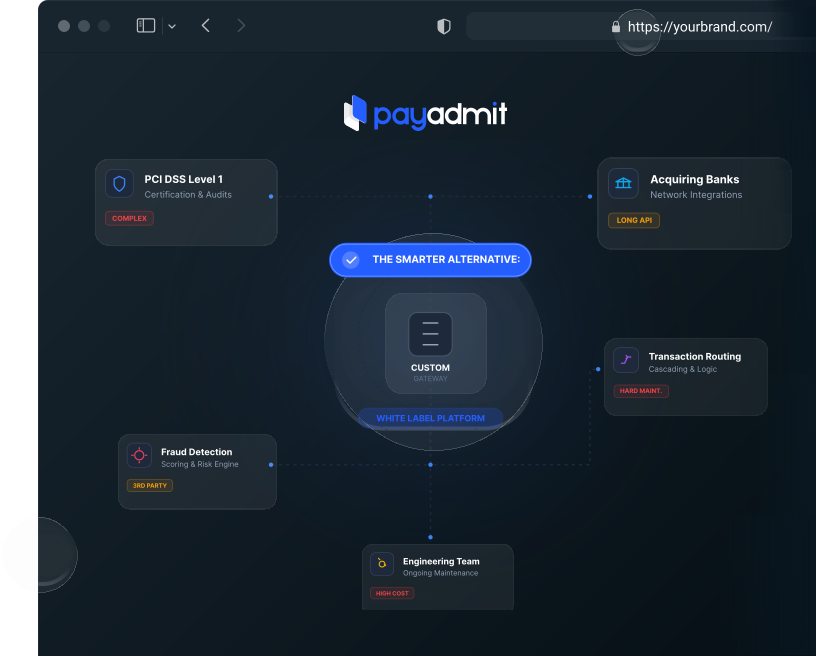
What Payment Gateway Infrastructure Includes
1
Intake and tokenisation
The surface a payment arrives on, and the vault that replaces a card number with a reference before anything else touches it.
2
Transaction core
Authorisation, capture, refund, void and the state machine that keeps every one of them recoverable after a failure.
3
Connectors
One adapter per processor, acquirer or method, each translating your model into a partner's format and back.
4
Routing and orchestration
The decision layer that picks a destination per transaction and retries eligible failures elsewhere. A gateway solution is only as good as the acquiring behind it and the payment data in front of it.
5
Merchant and MID management
Onboarding, limits, fees, descriptors and the mapping of each merchant to the acquiring accounts it may use.
6
Settlement and tooling
Reconciliation, reporting, APIs, webhooks, logs and the observability that makes an incident explainable.
Processor, Acquirer and Payment-Method Connectors
This is where the real cost of infrastructure lives. Each processor and acquirer has its own request format, its own status vocabulary, its own settlement file and its own release schedule. A connector is not written once; it is maintained for as long as the relationship lasts. PSPs comparing a build against a licensed solution should price the connector work over five years, not one.
The engineering discipline that makes this survivable is normalisation. One internal model for a payment, one taxonomy of decline reasons, one settlement shape, and a translation layer per partner that never leaks upward into product code.
Connector maintenance: the recurring work of keeping each provider adapter current as its API versions, adds fields, changes reason codes or alters settlement formats. It is the line item most build-versus-buy models leave out, and on a portfolio of eight or more acquirers it is a standing team rather than a project.
Routing, Cascading and Orchestration
Once more than one acquirer is connected, something has to choose between them per transaction. That choice uses geography, currency, amount, card range, live provider health, cost and historical performance, and it produces a ranked list rather than a single destination.
The first entry is the route; the rest is the cascade. For a PSP, the additional requirement is that this configuration is per merchant rather than global, so each merchant in the portfolio inherits a house default and overrides only what differs. The decision model is on smart payment routing.
Merchant and MID Management
Merchant management is the component that separates payment gateway infrastructure from a gateway integration. Onboarding, KYB records, processing limits, fee schedules, descriptors and the mapping of each merchant to the MIDs it may use all have to be operable by non-engineers. A platform where adding a merchant requires a deployment does not scale past the first dozen, however good its transaction core is.
Weighing a build against a licensed platform?
Tokenization, PCI Scope and Data Security
Where card data goes, and what it costs you at each step. Scope is decided by this path, not by policy documents. Operators keep the acquiring relationships and the merchants; the solution supplies everything between them.

The number is stored inside the certified perimeter and replaced by a token that is useless anywhere else.

Every later authorisation, retry or recurring charge references the token, which is what makes cascading possible at all.

Your PCI obligation follows the data. Keep raw numbers out and the annual assessment stays proportionate. Detail on PCI DSS support.
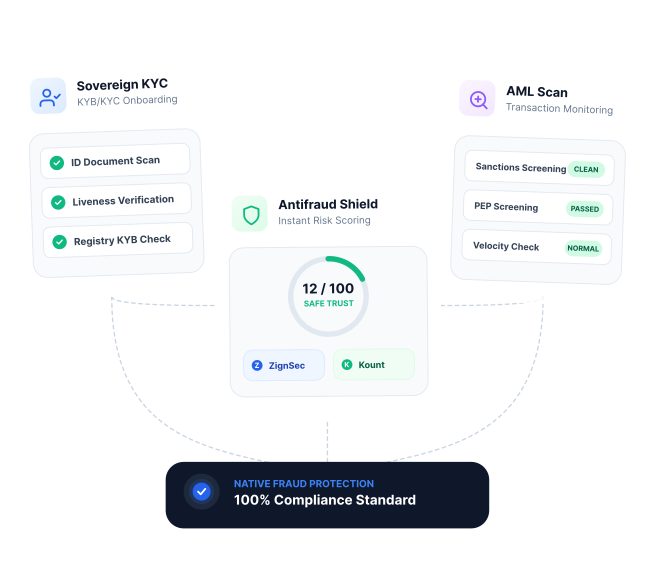
Risk and Fraud Integration Layer
Three ways to attach risk to a gateway, and what each one costs you later.
| Approach | What you get | Where it hurts |
|---|---|---|
| Provider-side rules only | Whatever each acquirer decides, differently per acquirer. | No shared view, and no rules of your own. |
| Bolt-on fraud vendor | One good engine, wired in front of one integration. | Policy duplicated once per connected provider. |
| Risk inside the gateway | Scoring before authorisation, identical on every route. | You own the tuning, which is work but is also control. |
PayAdmit places scoring in the orchestration layer, with third-party engines able to connect into the same decision point rather than beside it. See antifraud and risk management.
Settlement, Reconciliation and Reporting
Five obligations this part of the infrastructure carries, in the order a finance team will ask for them. Every acquiring partner has its own payment dialect, and one translation layer is where that difference stops.
- Match every settlement line from every acquirer to a captured transaction automatically.
- Surface only the exceptions, because a reconciliation that lists everything is a re-count.
- Attribute fees, interchange, reserve held and reserve released per merchant, not per portfolio.
- Produce merchant-facing statements that agree with your own ledger to the cent.
- Keep the audit trail long enough that a dispute from two quarters ago is answerable. A payment business that owns its merchant relationships needs infrastructure that treats their accounts as its own.
API, Webhooks and Developer Tooling
What the merchants on your platform will judge you by, long before they look at your rates.
A stable, versioned API where a breaking change is announced rather than discovered.
Idempotency on every mutating call, so a retried request cannot create a second payment.
Signed webhooks with replay, because a merchant's endpoint will be down at some point.
A sandbox that reproduces declines, timeouts and duplicates, not only the happy path.
Documentation on your own domain, under your brand, matching the API that is actually live. Volume alone does not justify a build; payment logic that nobody else sells does, and processing it yourself is then the point.
Error messages that name the cause, so support tickets resolve without escalation.
Observability and Operations
Three things you will want at two in the morning, and only one of them is a dashboard.

Every attempt recorded with its merchant, route, request, response, timing and the reason a route was chosen. When a merchant asks why one transaction behaved oddly last Tuesday, the answer should be a lookup rather than an investigation, and it should survive long enough to matter.

Approval against each route's own baseline, latency including the tail, timeout frequency and shifts in the mix of decline codes. An uptime check tells you a provider is answering; none of these tell you it is answering well, which is the failure mode that actually costs money.

The same thresholds that page a human should already have demoted the route automatically. An alert whose only outcome is a person logging in to do what the system could have done is a design gap dressed up as an operational process.
Scalability, High Availability and Disaster Recovery
Payment traffic is bursty and unforgiving. Capacity has to be planned against the busiest hour rather than the monthly mean, and every component in the path needs a defined behaviour when the one below it stops answering.
Recovery is the harder half. A payment interrupted mid-authorisation must resolve to exactly one outcome once systems return, which is a data-model problem rather than an availability one. Operators sizing this for gaming traffic specifically should read payment gateway for gaming site.
The conclusion most build plans miss
High availability is not the expensive part. Proving it is. A failover nobody has rehearsed, a restore nobody has timed and a duplicate-payment scenario nobody has simulated are three assumptions, not three controls, and each of them is discovered on the worst possible day.
Build vs Buy vs White-Label Infrastructure
1
Build it yourself
Right when the payment logic is your product and your differentiation. You own the roadmap and you also own PCI scope, connector maintenance and a permanent payments engineering team. Plan in years, not quarters.
2
Buy access to someone else's
Fastest to launch and the least control. You inherit their routing logic, their merchant model and their commercial interests, and your merchants see their brand at the moments that matter.
3
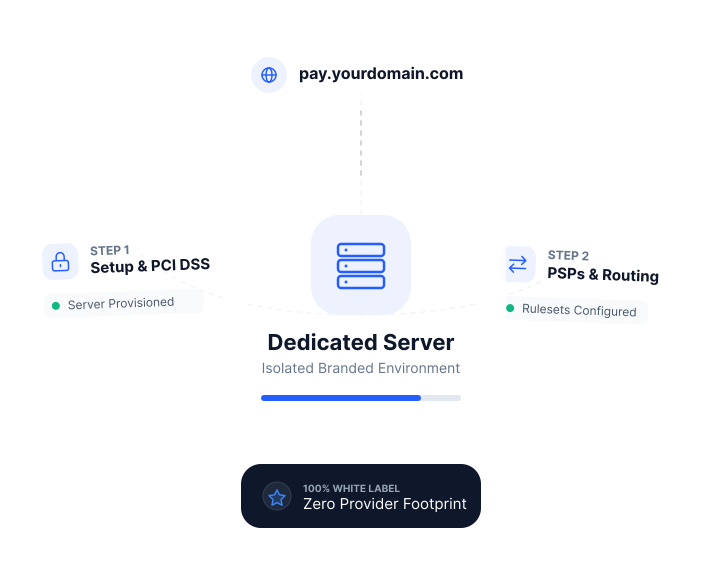
License a white-label platform
The middle path most PSPs take. Dedicated infrastructure under your brand, your merchant relationships and your routing rules, with the vendor carrying maintenance and certification. See white label payment processing and white label payment facilitator.
Frequently Asked Questions
How long does building gateway infrastructure actually take?
Reaching a first live transaction is not the milestone that matters. Reaching merchant management, reconciliation, certification and two maintained acquirer connectors is, and that is a multi-year commitment for most teams rather than a project.
Does licensing mean giving up routing control?
It should not. Ask specifically whether rules, provider priority and cascade order are edited by your team from a back office or by the vendor through a ticket. That single answer separates a genuine white-label platform from a rebranded gateway.
Do PSPs usually build or license gateway infrastructure?
Most license it. The ones that build tend to be businesses whose payment logic is their differentiator; everyone else finds that the acquiring connectors and the certification work consume the roadmap they wanted for their own product.
How quickly can a licensed gateway reach live traffic?
One to two months to live processing in a typical deployment. The pace is set by the acquiring agreements rather than by the software, so operators that already hold those relationships move fastest.
Who holds the acquiring relationships?
You do. PayAdmit is a software vendor and does not act as a PSP, hold merchant accounts or settle funds. Acquirers you already work with connect as routes on the platform.
Is the infrastructure shared with other clients?
Deployments run on dedicated infrastructure per client, which is what makes client-owned PCI DSS scope and independent audit possible. Shared environments generally cannot satisfy an acquirer's isolation requirements.
Who owns the merchant record in a licensed platform?
The client does. Merchants, their payment history and their settlement data belong to the business operating the service, not to the vendor, and that ownership is what makes a licensed solution portable.
Can we migrate merchants without disrupting their payment flow?
Yes. Merchants move in cohorts, their tokens migrate first, and each cohort runs live against a holdback before the next one follows. A migration handled this way is invisible to the merchants and to their customers.