

The customer picks an asset and network, and the processor produces a payment request for a precise amount, valid for a stated window. That window exists because the rate moves; when it expires the request has to be reissued rather than quietly repriced, which is a customer-experience decision as much as a technical one.
White Label Cryptocurrency Payment Processor
Accept crypto under your own brand.
A white label cryptocurrency payment processor gives you branded crypto acceptance without building blockchain infrastructure: a checkout your customers see as yours, confirmation handling, settlement choices and the monitoring that keeps the flow compliant.

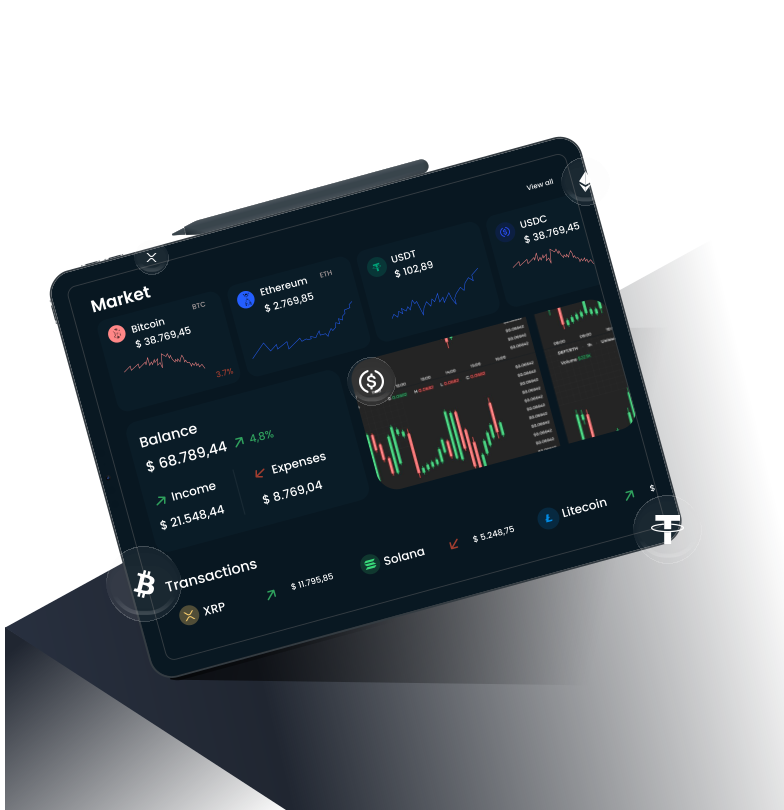
What Is a White Label Crypto Payment Processor?
It is the layer between a customer holding crypto and a merchant balance you can account for. Five responsibilities define it, and a processor that skips any of them has handed the problem back to you.
- Generate a payment request and a branded checkout the customer completes.
- Watch the relevant network and decide when a transaction counts as confirmed.
- Apply an exchange rate at a defined moment, with a defined validity window.
- Credit the merchant balance in whichever asset the settlement model specifies.
- Screen the flow and keep the records a compliance review will ask for.
White label means the merchant and the end customer see your brand throughout, on your domain, with no third-party processor name anywhere in the flow.
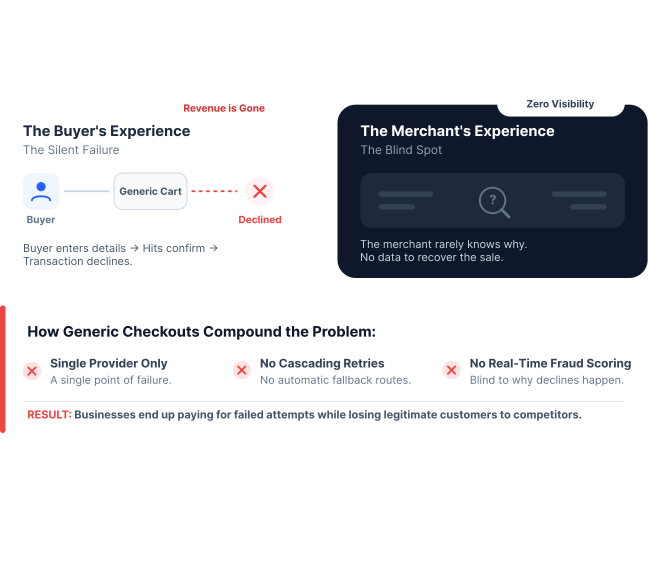
White Label vs Building a Crypto Payment Gateway
What a build actually commits you to, beyond the first working transaction:
- Node infrastructure or a paid provider per network, monitored continuously.
- Reorg handling and a confirmation policy defended per asset.
- Key management, with an operational model for every signing event.
- Rate sourcing, plus the treasury position that a volatile window creates.
- Everything a card stack already needs, listed on payment gateway infrastructure.
What a white label crypto payment gateway gives you instead:
- A branded checkout and merchant dashboard live in 1–2 months rather than quarters.
- Network watching, confirmations and rate handling maintained by the vendor.
- Screening and monitoring already wired into the payment path.
- Your merchant relationships, your pricing and your data throughout.
- The same connector pattern as every other method, described on payment connector.
Crypto Payment Flow
Three stages, and the differences from a card payment matter more than the similarities.

The customer sends the transaction, the processor detects it and then waits for the confirmation depth policy for that network. Detection is not settlement: a payment seen in the mempool can still disappear, which is why the confirmation rule, not the sighting, is what credits a balance.

Once confirmed, the merchant balance is credited according to the settlement model in force, and a webhook tells your platform. Underpayments, overpayments and late arrivals all need defined handling, because on a blockchain the customer decides the exact amount that leaves their wallet.
Supported Asset and Network Strategy
Adding assets is not free. Each one brings a network to monitor, a confirmation policy to defend, a liquidity question at settlement and a compliance position of its own. Most businesses need far fewer than they initially list.
Judge candidates on four things: whether your customers actually hold the asset, whether the network's fees and finality suit your average payment size, whether you can convert it, and whether your compliance stance permits it.
The conclusion to hold on to
Stablecoins on a low-fee network usually carry the volume; the headline assets carry the marketing. Start narrow, watch which requests actually arrive, and expand on evidence. The exact asset and network list available to a given deployment is confirmed during scoping rather than promised in advance, because it depends on the licensing position and the settlement partners involved.
Fiat Conversion and Settlement Models
1
Settle in crypto
The merchant balance stays in the asset received. Simplest operationally, and it moves the volatility question onto the merchant's own treasury.
2
Convert at confirmation
The amount is converted once the payment confirms, so the merchant sees a stable figure and the exposure window is measured in minutes.
3
Convert on a schedule
Balances accumulate and convert in batches, which reduces conversion cost and increases the time the position is held.
4
Pay out to a bank
Fiat leaves through a licensed partner on its own schedule. That partner, not the processor, decides the timing and the compliance checks.
Wallet and Custody Model Considerations
Custody is the first question a regulator, an auditor and an insurer will each ask, and the three arrangements are genuinely different. In a custodial model the operator or its partner holds keys and therefore holds customer funds, which is usually a licensed activity.
In a non-custodial model funds move directly to a wallet the merchant controls, and the processor never has spending authority. In a third-party arrangement a separate regulated custodian holds the assets under its own permissions and its own terms.
Custody: the ability to move someone else's assets, which in practice means holding or co-holding the private keys. Which model applies to a deployment is a licensing decision made with your own counsel, not a software setting, and any provider that treats it as a checkbox is worth a second look.
AML, KYT, KYB and Transaction Monitoring
Crypto acceptance brings an extra layer of screening that card acceptance does not. Transaction monitoring looks at the on-chain history of the funds arriving, scores their exposure to sanctioned or high-risk sources, and produces an outcome your policy defines in advance.
Alongside it, KYB on merchants and KYC on end customers run to whatever depth the jurisdiction and the flow require. The platform supplies the checks, the scoring and the evidence trail; the regulatory obligation stays with your licensed entity.
Working out which crypto model fits your licence?
Security and Key-Management Considerations
In card payments the worst outcome is a chargeback; in crypto it is an irreversible transfer. That single difference should drive every security decision: keys in hardware rather than in configuration, multi-party approval on any outbound movement, withdrawal allowlists, and an operational separation between the people who can approve a payout and the people who can change the approval rules. None of it is exotic, and all of it is cheaper to design in than to add after an incident.
Merchant Dashboard, Reporting and Webhooks
Four things a merchant needs to see, and one thing your platform needs to receive.

Detected, confirming, confirmed, underpaid or expired, with the confirmation count visible rather than hidden behind a spinner.

Which rate was used, at which moment, and what the resulting credited amount was. This is the first thing disputed and the easiest to evidence.

Current balance per asset, conversions performed and payouts requested, each with a status the merchant can read without asking support.

The only authority on final state, carried with an idempotency key so a repeated event cannot credit an order twice.
Payouts and Refund Handling
Where crypto stops resembling card payments entirely. Four cases worth deciding before launch, not during an incident.
| Case | Why it is hard | The policy to write |
|---|---|---|
| Full refund | No reversal exists; it is a new outbound payment. | Same asset or converted, and who bears the rate move. |
| Underpayment | The customer decides the amount, not your checkout. | Credit partially, hold, or return minus network fee. |
| Overpayment | The surplus is real money sitting in your balance. | Credit the surplus, return it, or hold it as balance. |
| Late arrival | Funds land after the request has already expired. | Accept and reprice, or return automatically. |
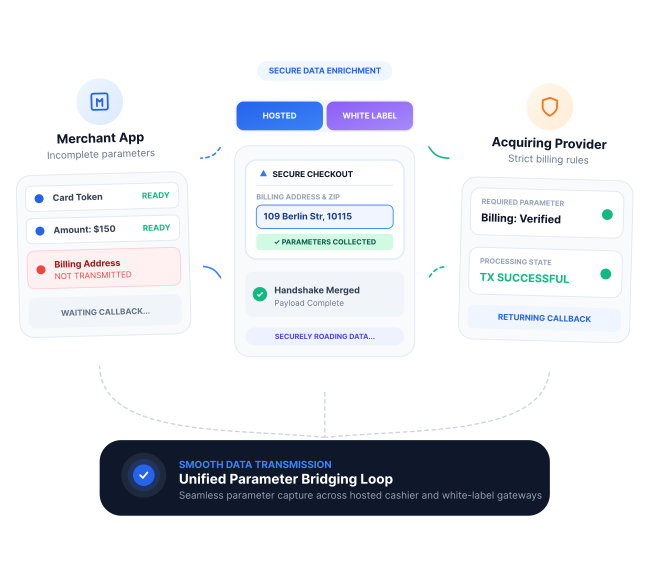
Use Cases
Four profiles where branded crypto acceptance earns its place, and what each one is actually buying.
- PSPs adding crypto to an existing card offer without a second vendor in front of merchants.
- Fintechs whose customers already hold digital assets and expect to spend them natively.
- Digital businesses selling cross-border, where card acceptance is thin in several markets.
- Eligible high-risk sectors where crypto is one of a small number of workable rails.
Eligibility is decided by your licence and by the settlement partners involved, so it is confirmed during scoping rather than assumed.
Launch and Integration Process
Six steps from scoping to live crypto payments, typically one to two months end to end.
Scope the licensing position, the custody model and the settlement partners involved.
Confirm the asset and network list that is actually available for your deployment.
Provision the environment, apply your branding and point it at your own domain.
Integrate one API call plus signed webhooks, the same pattern as any other method.
Test the ugly cases: underpayment, overpayment, expiry, late arrival, duplicate events.
Go live to a cohort, watch the confirmation and conversion data, then open it up.
Where crypto is one method inside a wider branded product, the surrounding build is on white label payment facilitator.
Frequently Asked Questions
Which coins and networks are supported?
The available list depends on the licensing position and the settlement partners for a given deployment, so it is confirmed during scoping rather than published as a fixed set. In practice most volume arrives on a small number of assets, and starting narrow is usually the right call.
Who holds the crypto?
That depends on the custody model agreed for your deployment: custodial, non-custodial or a third-party regulated custodian. It is a licensing decision made with your own counsel, and PayAdmit is a software vendor rather than a holder of customer funds.
How is volatility handled?
By the settlement model you choose and by the validity window on each payment request. Converting at confirmation keeps exposure to minutes; settling in crypto moves the position to the merchant's own treasury.
Can crypto sit alongside cards in one checkout?
Yes. It appears as another method in the same branded cashier, with the same API and the same reporting, rather than as a separate flow with its own dashboard. The layer that holds every method together is on igaming payments platform.
Are crypto payments chargeable back?
No. A confirmed on-chain payment is final, which removes chargeback exposure and replaces it with the opposite problem: any refund is a fresh outbound payment that has to be authorised and controlled properly.
How long does it take to launch?
Usually one to two months. The integration itself is short; the licensing position, the custody decision and the settlement partner agreements set the real pace.