
Payment gateway integration services are the technical and operational work that connects business systems to payment processing infrastructure. This includes API integration, card capture tech setup, routing configuration, webhook implementation, security compliance, and connection to downstream business systems. A complete integration solution covers the full scope of the payment process: from the moment a customer initiates a transaction to the point where settlement data reaches your accounting systems. Professional integration services handle all of this, not just the checkout form.
Payment Gateway Integration Services: What They Are, How They Work, and What to Look For
Payment gateway integration services are the technical and operational work that connects your business systems, your website, app, or platform, to the payment infrastructure that processes transactions. Done well, gateway integration is invisible to your customers. Done poorly, it becomes the most expensive line on your support queue. This guide explains what professional gateway integration services cover, how the tech works, and what businesses should expect from any integration provider.
28.05.2026
Updated:
What Payment Gateway Integration Services Actually Cover
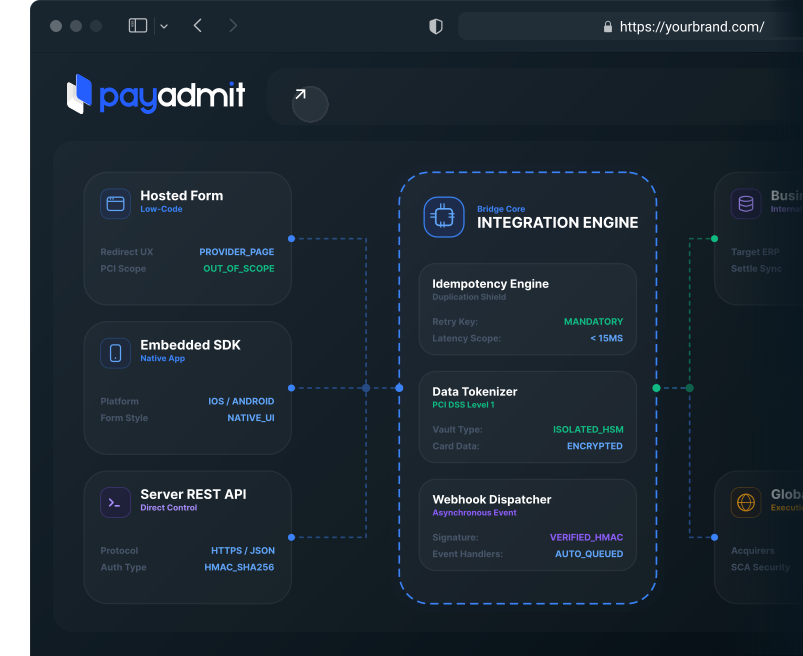
The term ‘payment gateway integration’ is often used narrowly, as if it just means adding a payment button to a website. In practice, professional payment gateway integration services cover a significantly broader technical scope. Integration connects not just your checkout page to a payment gateway, but your entire business tech stack to the payment processing infrastructure that moves money.
Here is what a complete gateway integration service includes:
API connection and authentication
Establishing a secure, authenticated API connection between your platform and the gateway. Every integration starts with API credential management, endpoint configuration, and request/response protocol setup.
Card data capture and tokenisation
Integrating the gateway’s card capture technology, whether a hosted form, JavaScript widget, or native API, into your customer checkout flow. Tokenisation integration ensures card data never touches your servers.
Transaction routing configuration
Configuring the routing rules that direct each payment transaction to the optimal provider, currency handler, or acquiring bank within the gateway. Multi-provider integration requires additional routing logic development.
Refund and chargeback handling
Integrating refund request flows, chargeback notification webhooks, and dispute management processes into your business operations systems, not just your checkout.
Recurring billing and subscription integration
For businesses with subscription models, integration covers the recurring payment engine, stored card tokens, billing cycle triggers, failed payment retry logic, and dunning management.
Reporting and reconciliation
Connecting gateway transaction data to your business reporting systems. This integration layer ensures settlement data, approval ratios, and transaction histories are accessible in your own tools.
Security and compliance integration
Integrating PCI DSS compliant card capture, 3DS2 authentication flows, and fraud screening into your transaction process. Security integration is not separate from checkout integration — it is embedded in every layer.
Where the integration scope crosses multiple providers, a payment bridge approach handles the connectivity layer separately from the merchant-side gateway integration, keeping each workstream cleaner.
The Three Integration Models: Hosted, API, and Embedded
Before any gateway integration begins, businesses must choose an integration model. The model determines how much development work is required, how much control you have over the customer payment experience, and how your security and compliance responsibilities are scoped.
| Factor | Hosted Gateway | API Integration | Embedded / SDK |
|---|---|---|---|
| Customer redirected? | Yes, to provider page | No, stays on your site | No, native in your app |
| Development effort | Low | High | Medium |
| Brand control | Limited | Full | Full |
| PCI DSS scope | Minimal, provider handles it | Higher, your systems handle card data flow | Medium, SDK handles capture |
| Custom checkout UX | Provider template only | Fully custom | App-native custom |
| Best for | Small businesses, fast launch | PSPs, platforms, high-volume merchants | Mobile apps, marketplaces |
Most professional businesses handling significant transaction volumes opt for API integration. The additional development work delivers full brand control over the payment experience, complete ownership of transaction data, and the flexibility to implement custom routing, fraud rules, and reporting logic. Hosted integration is faster to launch but leaves too much business value on the table at scale.
Which Integration Model Is Right for Your Business?
If your primary concern is speed to market with minimal tech overhead, a hosted gateway integration is the right starting point. If you need full customer checkout control, custom transaction routing, and ownership of payment data, API integration is the professional standard. If you are building a mobile-first product or marketplace, SDK-based embedded integration offers the best balance of development efficiency and user experience quality.
How Payment Gateway API Integration Works
API integration is the technical standard for professional payment gateway integration services. Here is how the integration process works from a technical perspective.
Authentication and API Credential Setup
Every gateway API integration begins with authentication. Your tech team sets up API keys or OAuth 2.0 credentials that identify your platform to the gateway. All API requests are authenticated, unauthenticated requests are rejected. Production API keys must be stored securely in server-side environment variables, never in client-side code.
Endpoint Structure and Request Format
A gateway API exposes endpoints for different transaction operations: payment initiation (/payments), refund processing (/refunds), customer management (/customers), and event notifications (/webhooks). Your integration service maps your platform’s payment actions to the appropriate API endpoints. Request and response formats are typically JSON over HTTPS. Error handling must cover the full range of gateway response codes, not just success and generic failure.
Idempotency in Payment API Integration
Idempotency is a critical but often underappreciated requirement in payment gateway integration. If a payment request is retried because of a network timeout, your integration must not create duplicate transactions. Gateway APIs provide idempotency keys, unique identifiers attached to each request, that ensure retried requests return the result of the original transaction rather than processing a new one. Integration services that skip idempotency implementation create a real risk of double-charging customers.
Webhook Integration for Asynchronous Events
Payment transactions generate events asynchronously, a payment that is processing now may receive its final status in seconds or minutes. Gateway webhook integration delivers these events to your platform in real time: payment confirmed, refund processed, dispute created, settlement completed. Your integration service must configure webhook endpoints, implement verification of webhook signatures, and process event payloads reliably. Failed webhook processing is a common source of transaction reconciliation problems.
Sandbox and Production Environments
Every professional gateway integration service runs through a sandbox environment before touching production. The sandbox mirrors the production API but processes test transactions only. Integration testing in sandbox covers all payment methods, all expected response codes, and all error scenarios. Only after full sandbox validation does the integration service move to production credentials and live transaction processing.
Tech Stack Requirements for Payment Gateway Integration
Payment gateway integration services require specific tech capabilities. The requirements vary by integration model, but any professional API integration involves the following tech components:
Server-Side Integration Layer
Card data processing and gateway API calls must happen server-side, never in client-side JavaScript. Your integration must include a backend service that handles payment initiation, receives responses, and manages transaction state. The tech stack choice, Node.js, Python, Java, Go, PHP, matters less than the architectural principle: sensitive payment processing logic belongs on your servers, not in the browser.
Secure Card Capture Tech
For API integration, card data capture typically uses a JavaScript widget or SDK provided by the gateway. This tech component handles card data entry in the browser and submits it directly to the gateway tokenisation service, bypassing your servers entirely. This approach reduces your PCI DSS scope significantly, as card data never flows through your tech infrastructure in raw form.
Payment State Management
Gateway integration requires your tech stack to manage payment transaction states. A payment moves through states, initiated, processing, authorised, captured, settled, refunded, disputed, and your integration must track and respond to each state correctly. Poor state management in payment integration leads to order fulfilment errors, customer service problems, and reconciliation failures.
Integration with Existing Business Systems
Professional gateway integration services connect the payment gateway to your existing tech stack, your order management system, your CRM, your accounting software, your inventory management. Every confirmed payment transaction should trigger the appropriate downstream business process. Integration that stops at the checkout page leaves manual work, and human error, everywhere downstream.
Need payment gateway integration for your platform?
PayAdmit provides full integration support for every white label payment gateway deployment: API documentation, tech team assistance, and sandbox testing.
Security in Payment Gateway Integration
Security is not a separate phase in gateway integration, it is embedded in every integration decision. The security requirements that apply to your payment integration depend on which card data your systems handle, which transaction volumes you process, and which markets you serve.
| Security Requirement | How It Applies to Gateway Integration |
|---|---|
| TLS Encryption | All communication between your platform and the gateway API must use TLS 1.2+. Any unencrypted data transmission in your integration invalidates your PCI DSS compliance. |
| Tokenisation | Card numbers must be tokenised at capture. Your integration must use the gateway’s tokenisation service, never process raw card numbers in your own tech stack. |
| 3DS2 Authentication | Strong customer authentication integration is required for regulated markets. Your checkout integration must handle the 3DS2 challenge flow, redirecting customers for authentication when required. |
| Webhook Signature Verification | Verify the cryptographic signature on every webhook payload before processing it. Unverified webhooks can be spoofed to manipulate transaction states in your system. |
| API Key Security | Production API keys must be stored in secure environment variables, rotated regularly, and never exposed in client-side code, version control, or logs. |
| Rate Limiting | Implement rate limiting on your payment endpoints. Uncontrolled transaction initiation is a fraud vector, attackers use automated scripts to test stolen card data through payment forms. |
PCI DSS Scope and Your Integration
Every integration decision affects your PCI DSS compliance scope. If your tech stack handles raw card data at any point, even briefly in transit, you are in scope for full PCI DSS certification. Using a hosted card capture widget that submits data directly to the gateway significantly reduces your scope. Consult your payment security team before finalising your integration architecture.
Multi-Provider Gateway Integration
Single-provider gateway integration is a common starting point but a business risk at scale. Professional integration services build a unified settlement reconciliation layer that aggregates data from all providers and presents it in a consistent format for your business systems. PayAdmit’s white label payment gateway includes this multi-provider integration out of the box, and Payment Bridge connects existing systems to 550+ providers through a single integration.
Why Multi-Provider Integration Matters
When your payment gateway relies on a single provider, that provider’s downtime becomes your downtime. Their approval ratio problems become your conversion rate problems. Their commercial disputes become your operational crisis. Multi-provider integration eliminates single points of failure by distributing transaction volume across multiple payment service connections.
Smart Routing in Multi-Provider Integration
The commercial value of multi-provider gateway integration comes from smart routing. Your gateway evaluates each payment transaction and routes it to the provider most likely to approve it at the lowest cost. Routing decisions can be based on card network (Visa vs. Mastercard), card-issuing geography, transaction currency, merchant category, and historical approval data. This routing logic is configured in the gateway and applied transparently, your customer’s payment experience is unchanged.
Cascade Integration
Cascade integration is the automatic retry layer in multi-provider setups. When a transaction is declined by the primary provider, the gateway’s cascade logic evaluates whether to retry and, if so, which provider to route to next. This process happens in milliseconds and is invisible to the customer. Integration services that implement cascade logic for clients typically recover 5–15% of transactions that would otherwise stay declined.
Settlement Across Multiple Providers
Multi-provider integration creates reconciliation complexity that single-provider setups avoid. Settlement data arrives from different providers in different formats on different schedules. Professional integration services build a unified settlement reconciliation layer that aggregates data from all providers and presents it in a consistent format for your business systems.
Integration for Different Business Types
Payment gateway integration requirements vary significantly by business model. Here is how integration priorities differ across the verticals PayAdmit serves:
iGaming and Online Gaming Integration
An iGaming payment gateway integration must handle high transaction volumes with minimal latency. Every second of delay at the player deposit screen costs conversions. Integration for gaming platforms requires multi-provider routing to maintain approval ratios across different player geographies, AML monitoring integration for high-value transactions, and chargeback management integration, dispute rates in gaming are typically higher than other verticals.
E-commerce Platform Integration
An e-commerce payment gateway integration prioritises checkout conversion. Every friction point in the payment process reduces completed transactions. Professional integration for e-commerce includes express checkout implementation (one-click payment for returning customers), mobile-optimised card capture, and local payment method integration that shows customers their preferred payment options based on geography.
SaaS and Subscription Platform Integration
A payment gateway for subscriptions is primarily a recurring billing problem. Your gateway integration must handle card storage, billing cycle management, dunning sequences for failed payments, and customer self-service for payment method updates. A subscription integration that handles the initial charge well but fails on renewal is not a successful integration, it is a delayed churn generator.
Marketplace Integration
A marketplace payment gateway integration must handle split payment flows, collecting from buyers and distributing to multiple sellers. Each seller may have different fee structures, different settlement schedules, and different compliance requirements. Integration for marketplace platforms requires a merchant management layer that sits on top of the core payment integration.
PSP Platform Integration
This requires white label integration: the ability to deploy a white label gateway for PSP under the PSP’s own brand, with custom merchant onboarding and individual merchant configuration. This requires white label integration, the ability to deploy the gateway solution under the PSP’s own brand, with custom merchant onboarding and individual merchant configuration.
Common Payment Gateway Integration Failures
The most expensive problems in payment integration are not exotic edge cases, they are predictable failures that occur repeatedly across different businesses and tech stacks. Here are the integration mistakes that cause the most damage:

Ignoring error handling beyond success/failure
A payment integration that only handles ‘approved’ and ‘declined’ responses will fail in production. Soft declines, referral responses, timeout errors, and processing failures all require specific handling. Each response code type demands a different customer message and business process response.
Skipping idempotency implementation
Network timeouts cause payment requests to be retried. Without idempotency key implementation, retried requests create duplicate transactions. Customers get charged twice. Support tickets follow. This is one of the most preventable and most common integration errors.
Processing card data server-side
Any integration that routes raw card numbers through your own servers, even temporarily, dramatically increases your PCI DSS compliance scope and security risk. Use gateway-provided JavaScript widgets for card capture to keep card data out of your tech stack entirely.
Not testing webhook failure scenarios
Webhook endpoints fail. Servers go down. Message queues back up. Integration that does not handle webhook delivery failures, through retry logic, queue management, and reconciliation processes, loses transaction state updates permanently.
Single currency, single provider thinking
An integration built for one currency and one provider works until your business expands geographically. Re-architecting a payment integration for multi-currency and multi-provider is significantly more expensive than building it in from the start.
No integration monitoring
Payment integrations need their own monitoring. Unusual transaction volume patterns, sudden approval ratio drops, webhook delivery failures, and API error rate spikes need automated alerting. Integration health is business health.
Testing Your Payment Gateway Integration
Testing is the difference between a payment integration that works in demo and one that works in production. Professional integration services execute a structured testing programme before any live transaction processes through the integration.
Sandbox Testing
Every gateway integration must be fully tested in the provider’s sandbox environment before production. Sandbox testing covers all payment methods, all transaction types (one-time, recurring, refund, partial refund), and all expected response codes. Do not move to production until sandbox testing has confirmed correct handling of both happy path and error scenarios.
Security Testing
Integration security testing validates that card data does not flow through your servers, API keys are not exposed in client-side code, webhook signatures are verified correctly, and rate limiting is in place. A security review of your integration code by someone other than the original developer is standard practice before launch.
Load Testing
Your integration must handle peak transaction volumes without degradation. Load testing simulates concurrent payment requests at expected peak volumes, Black Friday traffic, gaming deposit spikes, subscription renewal batches. Integration components that perform acceptably at low volume often fail under realistic load.
End-to-End Customer Flow Testing
Test the complete customer payment experience, from entering card details to receiving a confirmation. This includes the 3DS2 authentication flow where applicable, error message display for declined transactions, and the full mobile checkout experience. Technical integration success does not guarantee a good customer experience.
Payment Gateway Integration Checklist
Before going live with any payment gateway integration, confirm you have covered the following:
- API credentials stored securely server-side, not in code repositories or client-side scripts
- All card capture handled via gateway-provided tech (JS widget or SDK), no raw card data in your tech stack
- Idempotency keys implemented on all payment initiation requests
- Webhook endpoints configured, signatures verified, and event processing confirmed across all payment event types
- 3DS2 authentication integrated and tested for all relevant markets
- Full response code handling implemented, not just success and generic decline
- Refund and chargeback workflows connected to your business operations systems
- Settlement reconciliation integration live and confirmed against sandbox settlement data
- Monitoring and alerting configured for API error rates, approval ratios, and webhook delivery
- Load testing completed at projected peak transaction volumes
- Security review of integration code completed by a second developer
- PCI DSS compliance scope documented and signed off by your security team
PayAdmit Payment Gateway Integration Services
When your business launches a white label payment gateway or cashier service with PayAdmit, our tech team handles the integration work: API configuration, payment method connection, routing setup, security layer, and merchant management system.
What PayAdmit Integration Includes
Complete API documentation and sandbox access from day one. Integration of 550+ payment methods including Visa, Mastercard, Apple Pay, Google Pay, SEPA, local APMs, and crypto. Smart routing and cascade logic configured for your markets. 3DS2 authentication integration. AML/KYC compliance workflows. Real-time reporting and settlement reconciliation. 24/7 tech support from payment integration specialists.
PayAdmit also provides payment gateway integration services for businesses that already have existing infrastructure. Our Payment Bridge solution connects your current systems to 550+ providers through a single integration, without rebuilding your existing tech stack.
When those integrations start to multiply, a dedicated middleware layer becomes the cleaner answer: our overview of payment middleware and gateway integration explains how one abstraction can absorb dozens of PSP connections.
FREQUENTLY ASKED QUESTIONS
What are payment gateway integration services?

How long does payment gateway integration take?
Simple hosted integration can go live in a day. Full API integration with a custom tech stack typically takes 2 to 8 weeks depending on the complexity of your existing systems, the number of payment methods being integrated, and the development capacity of your team. Multi-provider integration with custom routing logic and cascade solution development adds additional time to the process. Businesses that choose a platform with pre-built integrations reduce the development timeline significantly because the solution already handles provider-level tech complexity.
What tech skills are needed for payment gateway API integration?
Backend development experience in any major language, understanding of REST APIs and webhook architecture, basic security knowledge covering TLS, API key management, and idempotency, and familiarity with PCI DSS scope concepts. Frontend development is needed for custom checkout UI. Payment domain knowledge including response codes, 3DS2 flows, and settlement processes is valuable but can be acquired through gateway documentation. For businesses integrating a white label solution rather than building from scratch, the tech requirements are lower because the core development work is already done.
Is payment gateway integration the same as payment processing?
No. Integration is the technical development work of connecting your platform to a payment gateway solution. Processing is what happens after integration is complete: the actual movement of transaction data through the payment network, the authorisation process at the acquiring bank, and the settlement of funds to your merchants. Integration is a development project with a defined scope and completion point. Processing is an ongoing operational function that continues for every customer transaction your gateway handles. Both are essential parts of a functioning payment solution, but they require different skills and different ongoing management.
Can I integrate multiple payment gateways through one API?
Yes. This is exactly what payment gateway aggregation platforms and white label gateway solutions provide. A unified integration solution connects your business to multiple payment providers through a single API, eliminating the need to manage individual provider connections. PayAdmit’s platform gives you a single API integration that connects to 550+ payment providers and methods. Your tech team completes the development process once and gains access to the full payment method library. Adding new payment methods or providers does not require additional integration development work on your side.
What is the cost of payment gateway integration services?
Integration costs depend on the complexity of your existing tech stack, the integration solution model chosen, and the number of payment methods and providers being connected. Hosted integration requires minimal development. Full API integration with custom checkout, multi-provider routing, cascade solution development, and downstream business system connections is a substantial development project involving weeks of engineering time. The security layer, compliance configuration, and testing process each add to the overall development scope. PayAdmit includes full integration support in every deployment, with dedicated tech team assistance throughout the entire process. For businesses that choose a pre-built platform solution rather than a fully custom development approach, the integration cost is significantly lower because the core tech work is already complete.
ADDITIONAL RESOURCES

How to Own a Payment Gateway
Owning a payment gateway means more than having a checkout form on your website.
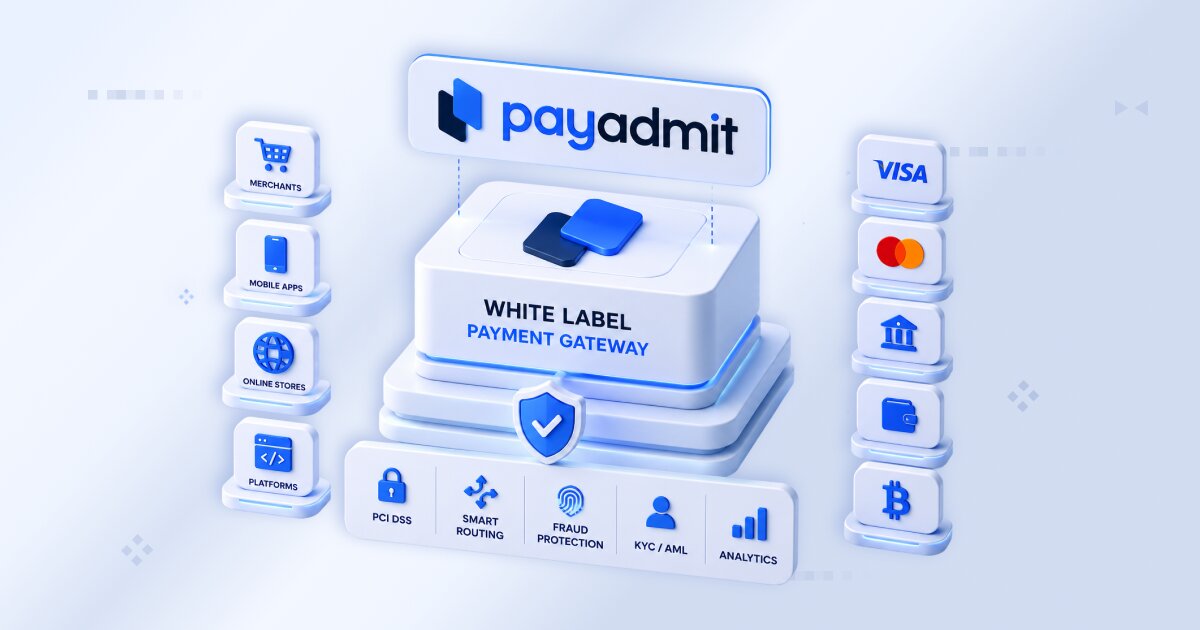
What Is a White Label Payment Gateway
In plain terms: someone else builds the engine. You put your name on the hood, set the rules, and keep the revenue.
How to develop payment gateway
Developing a payment gateway is one of the most technically demanding projects in fintech.