

Logo, palette, typography and iconography applied across every surface, including the ones customers only see when something goes wrong.
White Label Payment App Under Your Own Brand
Your name on it. Not ours.
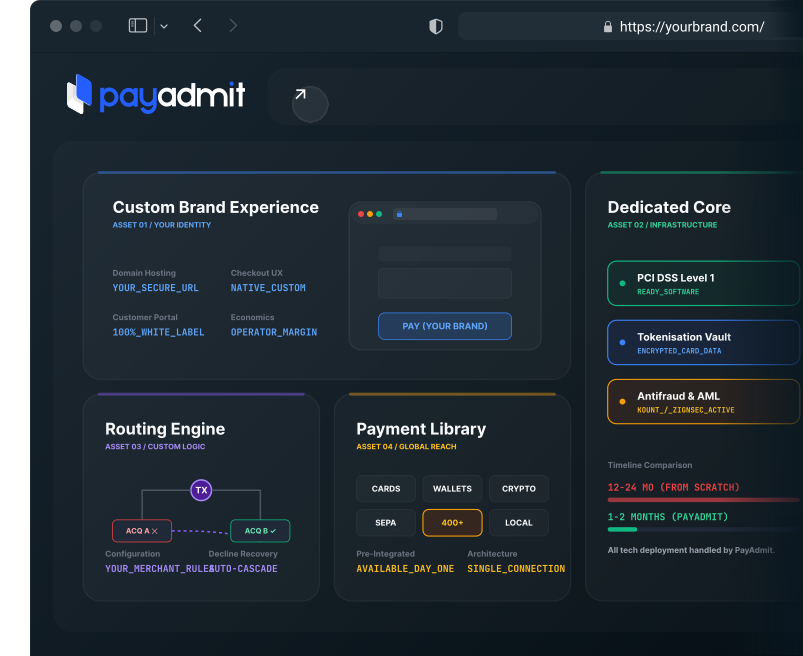
A white label payment app is a branded product your customers use to pay, top up and check what they were charged, running on infrastructure you licence rather than build. This page covers the journeys, the branding, the compliance line and what launching one actually involves.

Who Can Launch a Branded Payment App
Fintechs that already own a customer base and want payment to stop being a redirect. PSPs that need a front end their merchants can hand to their own users. Payment businesses adding a self-service surface to an offer that is currently account-managed, often alongside the sub-merchant model described on white label payment facilitator.
And merchant ecosystems, marketplaces and platform businesses whose users already transact with them daily, where a branded payment product is a retention feature rather than a new line of business.
White label: software built by one company and sold under another company's brand, with the end customer unaware of the supplier. It is distinct from a reseller model, where the supplier's brand stays visible, and from custom development, where you own the code as well as the brand.
Core User Journeys
Four journeys carry almost all the value. A customer signs in and is recognised. A customer pays, either with a saved instrument in one tap or with a new one that gets saved. A customer looks up what they were charged and when. A customer asks for money back.
Everything else is secondary until those four are boring. The common failure is a product that handles the first payment beautifully and the second one exactly the same way, which is where saved instruments and a remembered method quietly decide whether the app is used twice.
Onboarding, Login and Money Movement
Ask for identity once and only as much as the flow legally needs. A customer who has to prove who they are before they can see anything will not come back to finish. Verification belongs at the point it is actually required, which for most products is before the first withdrawal rather than before the first login, and the app should say plainly why it is being asked.
Branding and UX Customization
How a generic product becomes yours, in four passes. Most of it is configuration; the last one is not.

The product runs on your domain, with your certificate. A redirect to somebody else's address is where trust and sessions are lost.

Every string is yours: confirmations, errors, emails and the descriptor that appears on a customer's statement.

Method ordering, screen composition and which features appear at all. Beyond that sits custom development, scoped separately.
Payment Methods and Provider Connectivity
What each method family gives your customers, and what it costs you to support.
| Method family | Why customers use it | What it costs you |
|---|---|---|
| Cards | Familiar everywhere, and savable for one-tap repeats. | Interchange, scheme fees and chargeback exposure. |
| Wallets | Fastest checkout, with device authentication built in. | A card or bank rail underneath, plus the wallet's own fee. |
| Instant bank rails | No card needed, and often the local default. | Refunds are slower and disputes work differently. |
| Vouchers and prepaid | Reaches customers who will not link a bank or a card. | Payouts back to the same instrument rarely work. |
| Crypto | Preferred by a specific audience, not by a general one. | Volatility handling and an AML posture of its own. |
Want to see the product with your brand on it?
Merchant and User Management
Behind the customer-facing product sits the console your own team works in. Five things it has to do from day one.
- Find any customer and see their full payment history without a database query.
- Set limits per customer and per segment, and change them without a release.
- Approve, hold or reject a payout inside a queue rather than by email.
- Issue a refund with a reason code that reaches your reporting.
- Restrict what each internal role can see and do, with every action logged.
Security, Authentication and Compliance
Six controls that belong in the product rather than in a policy document nobody opens.
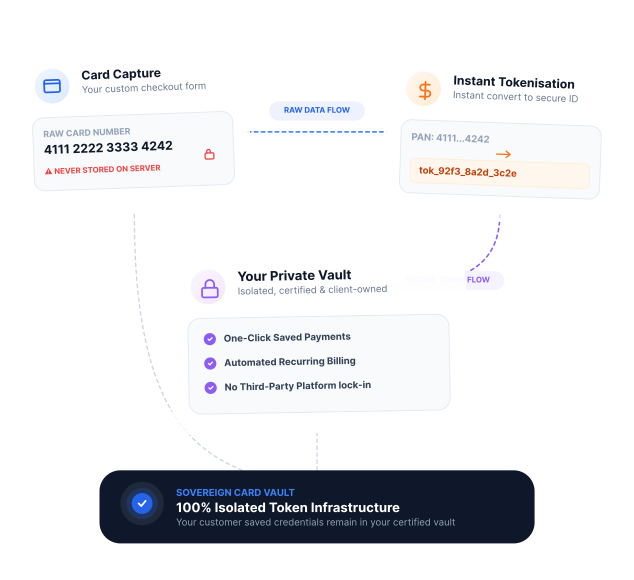
Card data tokenised at the platform edge, so raw numbers never reach your own systems.
Strong customer authentication applied where the market mandates it, with exemptions where allowed.
Session and device controls, so a lost phone does not become a payment instrument.
Risk scoring before authorisation, with three outcomes rather than approve or decline.
KYC and AML checks configurable per jurisdiction, with escalation paths recorded.
An audit trail per action, retained long enough to answer a dispute two quarters later.
The regulated obligations stay with your licensed entity; the platform supplies the controls that let you meet them.
Notifications, Reporting and Support Workflows
Three surfaces that decide how much your support desk hears from customers.

A confirmation when a payment succeeds, a clear reason when it does not, and a visible status while a payout is in flight. Most support contacts are people asking where their money is, and a status they can read themselves removes the ticket before it is opened.

Approval, cost, payout timing and dispute ratios split by market, method and provider rather than pooled. A portfolio average stays flat while one segment quietly fails underneath it, which is why the split matters more than the dashboard design.

Support needs to look up one customer, see every attempt with its route and response, and act without escalating. When that lookup takes one screen, a dispute becomes a conversation instead of an investigation across three systems.
Backend APIs and Integrations
The branded product sits on the same API everything else uses: one payment endpoint, a separate payout endpoint with its own lifecycle, and signed webhooks that are the only authority on final state.
Around it, connectors carry providers, and your own systems subscribe to the events they care about. Nothing in your stack needs to learn a provider's dialect, which is what keeps a new market inside a configuration window. The components under all of it are listed on payment gateway infrastructure.
The rule worth hard-coding
Credit a balance from the signed webhook, never from a browser returning to your success page. Carry an idempotency key so a repeated notification cannot pay twice. Nearly every double-credit incident in a new payment product traces back to one of those two rules being treated as optional, and both cost nothing to get right on day one. The layer underneath is described on payment processing infrastructure.
Web, iOS and Android Delivery Options
1
Branded web product
The standard delivery. Runs on your domain, works on every device without an install, and updates without an app store review.
2
Embedded in your product
The payment surfaces sit inside an application you already ship, reached through the API rather than as a separate destination.
3
Native shells
Store-published iOS and Android builds are a custom development question, scoped per project rather than assumed as included.
4
Decide honestly
Ask what a store listing buys you that a branded web product does not. For many payment products the honest answer is a push channel.
Launch and Configuration Process
Provisioning first: a dedicated environment, your domain, your certificate and the card vault activated. Then branding, then the provider connections you already hold, then the rules that govern limits, methods and payouts.
Testing runs against declines, timeouts and duplicate notifications rather than the happy path, and the product goes live to a small cohort before it goes live to everyone. Typical elapsed time is one to two months.
Provisioning: standing up the isolated environment a single client runs on, separate from every other client's. It is what makes client-owned PCI scope and an independent audit possible, and it is the step that has to complete before any branding work can be seen on a real domain.
Use Cases
A fintech replacing a third-party checkout that was costing it sessions at the last step. A PSP that needs a branded surface its merchants can put in front of their own users without building one each.
A marketplace turning payouts into a product feature rather than a support queue, on the layer set out on igaming payments platform. And a payment business moving from account-managed service to self-service, where a branded product is the only way to serve smaller customers profitably.
Frequently Asked Questions
Will our customers know the software is not ours?
No. The product runs on your domain under your brand, and every string a customer reads is yours, including confirmations, errors and the descriptor on their statement.
Do you publish native apps to the app stores?
Standard delivery is a branded web product on your domain, plus payment surfaces embedded in an application you already ship. Store-published native builds are scoped as custom development rather than assumed as part of the package.
Who owns the customer data?
You do. Customers, their payment history and their records belong to your business, not to the vendor, and that ownership is what keeps the arrangement portable.
Can we use our existing acquirer?
Yes. Acquirers and PSPs you already hold connect as routes on the platform and are ranked alongside anything added later, on the model described on smart payment routing. PayAdmit is a software vendor and does not hold merchant accounts or settle funds.
How much can we change without custom work?
Branding, wording, method ordering, limits, which features appear and the rules behind them are all configuration. Reshaping a journey or adding a screen that does not exist is custom development, scoped separately.
What happens if we outgrow it?
Tokens are portable where the outgoing provider permits it, and the transaction history is yours to export. A licensed product you can leave is worth more than one you technically own but cannot migrate off.