

Intake, tokenisation, the authorisation engine, capture and refund handling, and the state machine that keeps every payment recoverable after a failure. This is the part most teams build well, because it is the part they can specify precisely before they start.
Payment Processing Infrastructure Explained
Payment processing infrastructure is the full stack a payment business runs on, from the moment a transaction is initiated to the line item a merchant reads in a settlement report. This page walks every layer and says which ones are worth building yourself.

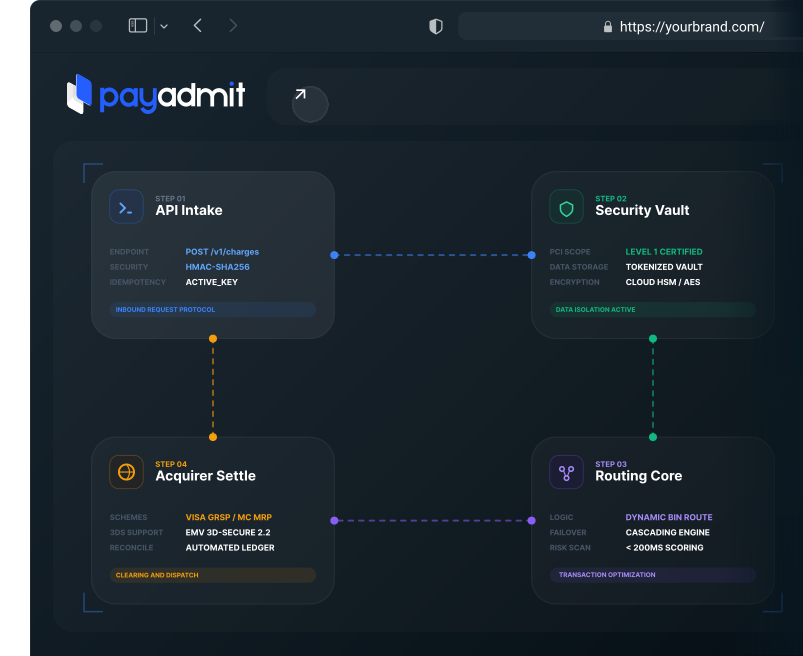
What Payment Processing Infrastructure Includes
Three groups of components. A business ends up owning all of them, whether or not it bought them together.

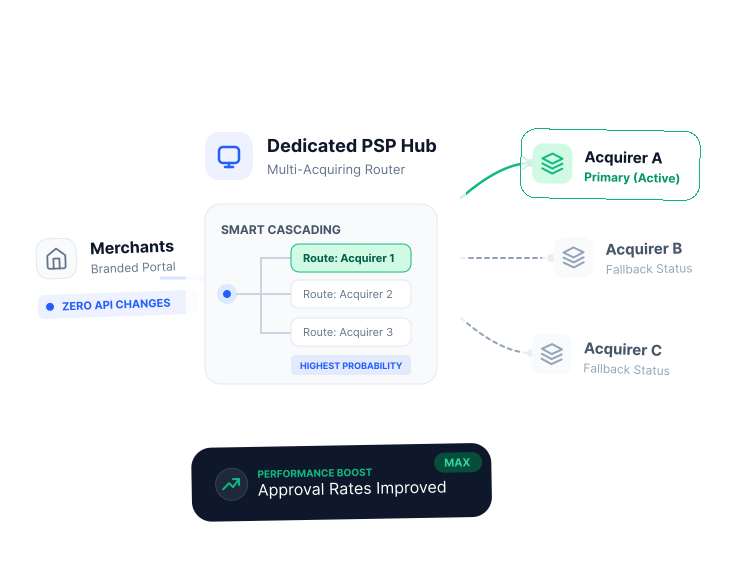
Gateway, processor and acquirer connectivity, plus the routing and retry logic that decides which of them receives each payment. It is where the permanent maintenance lives, because every partner changes its API on its own schedule and never on yours.

Merchant management, the ledger, settlement and reconciliation, reporting, and the observability that makes an incident explainable. This is the part that gets deferred in a build and then decides whether the platform can serve a hundred merchants or a dozen.
End-to-End Transaction Lifecycle
A payment is initiated at a checkout or through an API call, tokenised immediately, screened for risk and then authorised against a chosen provider. Capture follows, either at once or later, and the funds are promised rather than moved.
Movement happens at settlement, days later, net of fees and reserve. Between those two points sit refunds, chargebacks and representments, each of which reopens a payment that your ledger had already treated as finished.
The conclusion most build plans miss
Authorisation is a request. Settlement is money. Infrastructure that models them as one event will produce a ledger that disagrees with the bank, and the disagreement will surface in month three, when there is enough volume for it to matter and enough history for it to be expensive to unpick.
Gateway, Processor and Acquirer Connectivity
1
Gateway
Carries the authorisation request out of your platform. It holds no acquiring risk and settles nothing, which is why it is the easiest layer to replace.
2
Processor
Handles the technical authorisation against the card networks on the acquirer's behalf, and returns the reason code your taxonomy has to understand.
3
Acquirer
Holds the licence, carries the chargeback risk and settles the money. This is the relationship that takes months to secure and minutes to lose.
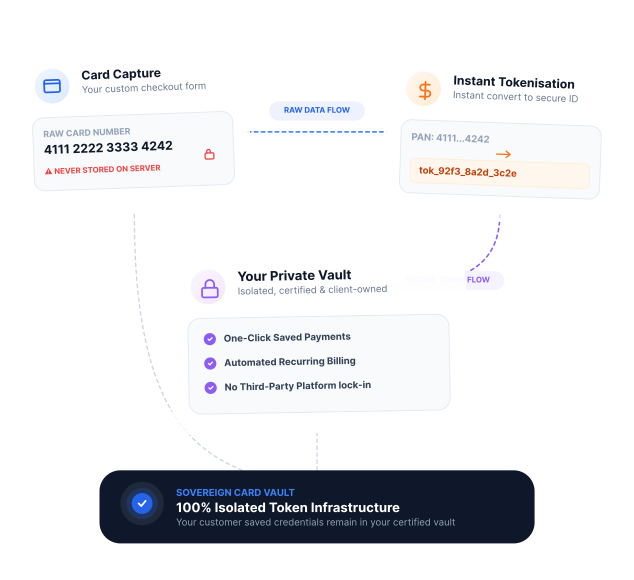
Tokenization and Payment Data Layer
Card data enters through a hosted field or a hosted page, is stored inside the certified perimeter and is replaced everywhere else by a token that is useless outside it. Every later authorisation, retry or recurring charge references that token.
The data layer around it holds far more than card references: customer records, payment metadata, provider payloads, decision logs. All of it has a retention policy, and a platform that has not decided those policies before launch will decide them later under audit pressure.
PCI scope: the set of systems that store, process or transmit cardholder data, and therefore fall under annual assessment. Scope follows the data, not the org chart: one service that logs a full card number pulls your entire logging pipeline into the assessment.
Merchant Management
Onboarding, KYB records, processing limits, fee schedules, descriptors and the mapping of each merchant to the accounts it may use. None of it is glamorous and all of it has to be operable by people who do not deploy code.
This is the component that separates infrastructure from an integration. A platform where adding a merchant needs a release will not pass its first dozen, however good the transaction engine underneath it happens to be. The operator-facing version of the same console is on igaming payments platform.
Risk, Fraud and Compliance Integrations
Risk belongs in the orchestration layer rather than in each connector. Score before authorisation, allow three outcomes instead of two, and apply the same policy whichever provider is about to receive the payment. Anything else means maintaining the same rules in as many places as you have partners, and discovering the drift between them during an incident.
Want your processing stack mapped layer by layer?
Ledger, Settlement and Reconciliation
Four stages between an approved payment and a number your finance team will sign off.

Every authorisation, capture, refund and chargeback written to a double-entry ledger as it happens, not reconstructed later from provider reports.

Settlement files from every acquirer pulled automatically, in whatever format each one publishes them, and normalised into one shape.

Each settlement line tied to a captured payment, with fees, interchange and reserve attributed per merchant rather than pooled.

Only the exceptions shown to a human. A reconciliation that lists everything is not a reconciliation, it is a second count.
Reporting and Operational Analytics
Five numbers, who reads them, and how often they have to arrive to be worth anything.
| Metric | Who acts on it | Useful cadence |
|---|---|---|
| Approval by segment | Payments team | Daily, split by market and provider |
| Decline reasons | Payments and risk | Daily, in one normalised taxonomy |
| Cost per approved payment | Finance and commercial | Weekly, including failed attempts |
| Chargeback ratio | Risk and compliance | Weekly, against scheme thresholds |
| Settlement exceptions | Finance operations | Daily, exceptions only |
APIs, Webhooks and Developer Tooling
Merchants judge infrastructure by its API long before they read the rate card. Five things separate a platform developers recommend from one they tolerate.
- A versioned API where a breaking change is announced rather than discovered.
- Idempotency on every mutating call, so a retry cannot create a second payment.
- Signed webhooks with replay, because a merchant endpoint will be down at some point.
- A sandbox that reproduces declines, timeouts and duplicates, not only success.
- Error messages that name the cause, so support tickets close without escalation.
Observability, Reliability and Incident Handling
Six capabilities you will want at two in the morning, and only one of them is a dashboard.
A trace per payment: merchant, route, request, response, timing and why that route was chosen.
Provider health read against each route's own baseline rather than against an uptime check.
Alerts wired to the same thresholds that already demoted the route automatically.
A runbook per failure mode, written before the failure rather than during it.
Replayable events, so a missed webhook is recoverable without a manual ledger fix.
Retention long enough that a dispute from two quarters ago is still answerable.
Scalability and Multi-Region Architecture
Payment traffic is bursty and geographically uneven. Three architectural decisions carry most of the weight.

Capacity is planned against the busiest hour of the year rather than the monthly mean, because that hour is when the revenue is. Every component in the path also needs a defined behaviour for when the one below it stops answering, which is a design decision rather than a scaling one.

Latency to the acquirer matters more than latency to the customer, since the authorisation round trip dominates. Data residency rules may also decide where records can live at all, and that constraint is far cheaper to design for than to retrofit after a market launch.
A payment interrupted mid-authorisation must resolve to exactly one outcome once systems return. That is a data-model problem rather than an availability one, and it is the reason idempotency keys and status queries belong in the design from the first sprint.
Build vs White-Label Payment Infrastructure
Building is right when the payment logic is your product and your differentiation. You own the roadmap, and you also own PCI scope, connector maintenance and a permanent payments engineering team. Plan in years rather than quarters.
Licensing a white-label platform gives you dedicated infrastructure under your brand, your merchant relationships and your routing rules, with the vendor carrying maintenance and certification. Most PSPs take this path and build only the layer that makes them different.
The honest version
Reaching a first live transaction is not the milestone. Reaching merchant management, reconciliation, certification and two maintained acquirer connectors is, and that gap is where build timelines quietly triple. If your differentiation is not in that list, it is cheaper to license it. The facilitator model built on top of this is covered on white label payment facilitator.
Implementation Roadmap
1
Scope
List markets, methods, providers and the merchant types you will onboard. Every gap becomes a decision rather than a surprise.
2
Connect
Wire the API, the webhooks and the acquirer accounts you already hold. Certification runs in parallel with the integration work.
3
Prove
Run authorisations, declines, retries, refunds and payouts end to end, then repeat the notifications to confirm nothing charges twice.
4
Migrate
Move merchants in cohorts against a holdback, migrate tokens first, and retire the old path only once the numbers agree.
Frequently Asked Questions
How is this different from a payment gateway?
A gateway is one layer of it. Infrastructure means the gateway plus routing, merchant management, the ledger, reconciliation, reporting and the tooling around all of them. The gateway layer on its own is covered on payment gateway infrastructure.
Do we need our own acquiring to run this?
You need access to acquiring, held by you or by a partner. PayAdmit is a software vendor and does not act as a PSP, hold merchant accounts or settle funds, so the acquiring relationship stays with a licensed institution.
Is the environment shared between clients?
No. Deployments run on dedicated infrastructure per client, which is what makes client-owned PCI DSS scope and an independent audit possible. A shared environment rarely meets the isolation standard an acquirer or an auditor expects.
How long does a deployment take?
One to two months to live processing in a typical case. The pace is set by acquirer agreements and certification rather than by the software.
Can we migrate merchants without disruption?
Yes, in cohorts. Tokens migrate first where the outgoing provider permits it, each cohort runs against a holdback, and customers are never asked to re-enter a card.
Who owns the transaction data?
The client. Merchants, their processing history and their settlement records belong to the business operating the platform, and that ownership is what keeps a licensed solution portable.