

Exchanges expanding from pure crypto into fiat conversions need bank rails, KYC, and AML coverage that takes years to build alone.
White Label Crypto Payment Gateway Development for Exchanges, Wallets, and PSPs
Ship a branded crypto payment gateway in weeks. PayAdmit delivers the white label crypto core, the custom development layer, and the compliance baseline every business needs to go live across each major chain market.
Multi-chain by default. PCI DSS Level 1 ready. 1 to 2 month deployment.

What Is White Label Crypto Gateway Development
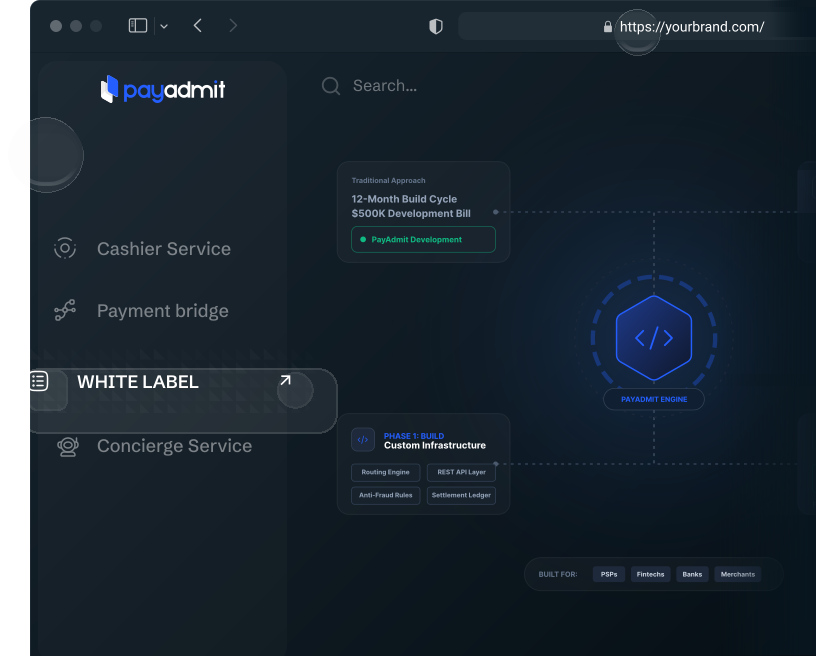
White label gateway development packages multi-chain payment processing, wallet custody, blockchain monitoring, and compliance tooling into a branded payment system the operator runs as its own. The white label model lets any digital asset business go live in weeks instead of the eighteen months a custom from-scratch cycle takes.
PayAdmit packages all four architectural layers into one platform deployment and customises the surface the operator exposes to customers. The result is a production crypto payment gateway with the operator brand on the front and the depth of a mature payment platform underneath.
The four layers, in one platform
- Blockchain layer. Network monitoring, address generation, and on-chain confirmation across Bitcoin, Ethereum, Solana, Tron, and major Layer 2 networks.
- Wallet layer. Custody, key security, and treasury management.
- Orchestration layer. Routes payment transactions across chains and stablecoins by cost and speed.
- Merchant layer. Branded checkout, dashboard, and payment reporting under your domain.
Who Needs a White Label Crypto Payment Gateway
The white label model fits every operator that needs a branded crypto payment product without taking on full blockchain development.

Consumer and business wallet apps adding merchant acceptance need a gateway layer that turns balances into checkout flows under the wallet brand.

Crypto-first iGaming platforms need branded payment infrastructure that handles their volume, fraud patterns, and per-market compliance rules.

Modern banking apps extending into crypto need a branded gateway that integrates with the existing account model, without a separate registration form.

Traditional PSPs adding blockchain rails to existing card acquiring need a partner who delivers the blockchain layer without disrupting the card business.

Early stage operators with a clear vertical focus use white label development to validate the market before committing to in-house blockchain infrastructure.
Why White Label Beats From-Scratch Crypto Development
The blockchain development bottleneck. Custom gateway development needs specialists in node operations, key management, MEV protection, and chain infrastructure. Hiring that team takes longer than the entire white label deployment cycle.
The compliance retrofit trap. Crypto products built without Travel Rule, KYC, AML, and chain analytics from day one face expensive retrofits when the first regulator inquiry arrives. The configured model inherits the compliance baseline immediately.
The custody and key management risk. Custody mistakes lose customer funds permanently. White label development inherits MPC custody, multi-signature schemes, and the disaster recovery design that took years to engineer.
The multi-chain complexity tax. A system built around one blockchain becomes obsolete when the next L2 wins market volume. The white label architecture is multi-chain by default.
PayAdmit White Label Crypto Gateway Services
Gateway development packaged into one engagement that combines the platform core with custom development and an ongoing partnership. New chains, methods, and compliance requirements arrive as part of the standing relationship, so no vendor lock-in moment ever arrives.

Multi-chain processing and routing across Bitcoin, Ethereum, Solana, Tron, and major L2 networks. Stablecoin support for USDC, USDT, and regional alternatives. PCI DSS Level 1 ready platform runs the fiat side.

Checkout, merchant dashboard, embedded widget, and wallet-connect flow all rebrand to the operator identity. End users see only your brand; the PayAdmit core stays invisible.

Hot wallet liquidity, cold storage, MPC key control, and treasury operations that turn incoming crypto into operator-controlled funds. Plug into BitGo, Fireblocks, Anchorage, or use built-in custody.

Built-in Travel Rule, KYC, AML, and blockchain analytics through Chainalysis, Elliptic, and TRM Labs. Configurable per market and per business model, layered with antifraud and risk management.
1 to 2 month integration phase delivers the branded gateway to production. Development continues across the lifecycle, including new chain support and custom work scoped quarterly.
How Crypto Gateway Development Runs
Four phases with defined timelines. Each phase has a dedicated team: delivery lead, blockchain engineer, custody specialist, compliance lead, and development engineer. The team stays consistent through development and launch.

Two week engagement mapping business model, target markets, regulatory perimeter, and chain coverage. Output: a development specification and launch timeline.

Core configures for brand, methods, and chain coverage. In parallel the custom layer ships: branded checkout, dashboard, wallet-connect, and vertical workflows. Runs 3 to 6 weeks.

Travel Rule integration, KYC and AML provider connections, blockchain analytics wiring, and security testing before live traffic. Runs 2 to 3 weeks alongside Phase 2.

Live under your own domain. PayAdmit delivers platform updates, new chain rollouts, and quarterly-scoped custom development.
Crypto Gateway Capabilities Out of the Box
The white label platform ships with the capability set every modern crypto gateway needs. Custom development extends the surface where the business wants differentiation.
Bitcoin, Ethereum, Solana, Tron, and major L2 networks (Polygon, Arbitrum, Base, Optimism) handling stablecoin volume.
USDC, USDT, DAI, and regional stablecoin alternatives across every supported blockchain.
Real-time chain selection based on network congestion, gas costs, and merchant preference. Cascading handles failover when a chain or node provider degrades. See payment routing infrastructure.
HD wallet derivation, MPC key splitting, hot-cold storage split, and automated treasury sweeps.
Travel Rule, KYC, AML, and sanctions screening through Chainalysis, Elliptic, and TRM Labs. Every transaction screens before settlement.

Card processing, account-to-account rails, and a conversion engine routing crypto to fiat through licensed exchange partners.
Real-time transaction visibility, settlement reports, custody balances, and the audit log any compliance team needs.
Reliable webhook delivery, REST API, SDKs in major languages, and documentation any development team integrates against in days.
Developer Infrastructure & Security Baseline
Crypto payment infrastructure has a higher security bar than traditional rails because mistakes are unrecoverable. Engineered for technical buyers who want to ship integrations quickly.
Every payment endpoint accepts an idempotency key. A full sandbox environment mirrors production blockchain behaviour, with test data generation, payment simulation, and staging tools any QA team needs.
Customer and operator funds sit in MPC wallets or multi-signature schemes that no single party can drain. Key management follows institutional custodian practices, with tamper-evident audit trails on every transaction.
Production crypto gateway runs across multiple regions with automatic failover and regulatory-aware data residency. 99.99% uptime SLA matching tier-1 payment processors.
PayAdmit vs From-Scratch vs Generic White Label
Operators considering crypto gateway infrastructure choose between three paths. The differences show up in time, flexibility, and compliance posture.
| Dimension | From Scratch | Generic White Label | PayAdmit |
|---|---|---|---|
| Time to market | 12 to 18 months of gateway development | Weeks, but a fixed feature set | 1 to 2 months, plus a custom development layer |
| Multi-chain flexibility | One chain at launch; technical debt to add more | Coverage limited to whatever the vendor ships | Multi-chain by default; new chains as the market moves |
| Compliance posture | Travel Rule, KYC, AML and analytics all on you | Compliance depth often skipped | Full compliance baseline inherited |
| Custom development depth | Total control, at the cost of years and millions | Customisation limited to colours and logos | Platform core plus custom operator workflows |
Read the table as a development question rather than a pricing one. The from-scratch column buys total control and pays for it in development years; the generic white label column buys speed and pays for it in every payment feature the vendor never shipped. Most operators land in the middle, where a certified platform carries the regulated core and a custom development layer carries whatever makes the business distinctive. That split keeps development effort on the product and off the transaction plumbing.
The two build routes are covered in more depth elsewhere: our guide to building a payment gateway walks the from-scratch path, and custom fintech software development describes the layer that sits on top of the platform core.
Crypto Gateway Use Cases
The white label development model fits every business operator across the crypto landscape, whatever form the payment product finally takes.
A European crypto exchange added a fiat off-ramp through PayAdmit. Deployment ran 9 weeks from contract to live payment withdrawals, with no in-house blockchain development at all.
A consumer wallet app added merchant payments through PayAdmit. End users now pay any partner merchant from the wallet balance without a separate form or a separate transaction flow.
A regulated iGaming operator launched branded crypto deposits and instant transaction payouts in licensed markets, capturing players from each major chain without any in-house development.
A digital bank added a custom custody and payment product through PayAdmit. The branded gateway sits inside the existing neobank app, and the bank ran no blockchain development of its own.
A PSP added crypto acquiring to its existing card relationships. PayAdmit handled the blockchain development; the PSP kept its acquiring relationships and its existing payment business intact.

A B2B marketplace added crypto settlement for international supplier business via the PayAdmit custody layer and payment bridge.
Planning Your Crypto Gateway Development Project
Scope the market before the build. Crypto payment gateway development starts with a business decision no platform can make for any operator: which chains, which stablecoins, and which markets the gateway serves at launch. That answer drives the compliance development work, the custody model, and the settlement format your finance team will live with, and changing it later is a re-development project rather than a configuration change. Teams new to this usually start from how to create a crypto payment gateway, which sets out the development sequence end to end.
Budget in total ownership, not licence fees. Any honest comparison counts the development effort, the compliance programme, and the custody operations together, then adds the ongoing development each new chain and each new payment method demands. Our breakdown of the cost to develop a crypto payment gateway puts numbers against each line, and the gap between a from-scratch build and a white label deployment is usually an order of magnitude.
Decide the asset list deliberately. Coverage is a business decision as much as a development one: every asset adds blockchain monitoring, treasury, and transaction reporting work, and any business that adds assets casually pays for it in operations. A short guide to the most popular types of coins is a reasonable place to start before the development team commits to a chain list.
Design the customer-facing form early. The checkout form, the merchant onboarding form, and the withdrawal form are where most abandoned transactions happen. A crypto payment form has to show the network, the asset, the amount, and the confirmation state without overwhelming any first-time user, and it must render the same way inside an app, a mobile browser, and an embedded widget. Getting the form right is worth more conversion than any additional chain, and it is usually a week of development rather than a quarter.
Plan the app surface alongside the backend. Most operators ship a merchant app, a customer app, or both, and each app consumes the same gateway APIs in a different form. Deciding early whether the app is a native build or a web application keeps the development estimate honest and stops the development team from re-platforming halfway through. Any operator serving merchants and end users at once should budget for two app surfaces, not one.
Treat compliance as a launch requirement. Travel Rule messaging, sanctions screening, and blockchain analytics all need a formal owner before the first live transaction, not after the first audit. Each one is a development workstream in its own right, and each one shapes how transaction data is stored and in what form it is reported. Our practical walkthrough of how to accept crypto payments for business covers the operational side, and the wider crypto payments blog tracks how the market and its rules keep moving.
Frequently Asked Questions
How long does deployment take?
Typical engagement runs 1 to 2 months from contract to live transactions. Deep custom work adds 2 to 4 weeks depending on scope.
What chains does the gateway support?
Bitcoin, Ethereum, Solana, Tron, and major L2 networks (Polygon, Arbitrum, Base, Optimism) ship by default. Additional chains add on request as part of custom development scope.
Does it handle fiat on and off-ramps?
Yes. PayAdmit includes the fiat side: card processing, account-to-account rails, and a conversion engine routing crypto to fiat via licensed exchange partners.
How does PayAdmit handle custody?
Operators choose between built-in MPC custody, multi-signature schemes, or integration with BitGo, Fireblocks, and Anchorage.
Is the gateway compatible with existing stacks?
Yes. The API surface and webhook system integrate cleanly with any existing wallet or banking infrastructure. Custom development handles connector work for vertical-specific tooling. Most operators ship the first integration in days.
Want deeper architecture context?
See our companion guide on cost to develop a crypto payment gateway for the development depth behind the white label package.