
A detailed 2026 breakdown of what it actually costs to build a crypto payment gateway end to end.
TL;DR. Most guides on how to create a crypto payment gateway jump straight to "pick a chain and write a smart contract." This one starts one step earlier. Before you spin up a node or wire up a wallet SDK, decide which cryptocurrencies you actually need on day one, how much of the flow should be custodial, where fiat settlement lands, and which regulatory perimeter you will operate inside. Get those four decisions right and the rest of the build (the transaction pipeline, the merchant app, the reconciliation system) becomes an engineering exercise instead of a rescue project.
A crypto payment gateway is the software layer that lets a business accept cryptocurrency as payment and receive value it can actually use, either the same crypto held on its own balance, a stablecoin, or fiat settled into a bank account. From the outside it looks like a normal checkout: a QR code, a wallet-connect button, an amount, a confirmation. From the inside it is a transaction pipeline that watches one or more blockchains, matches on-chain events to merchant orders, handles the exchange-rate window, and produces a clean transaction record the merchant's finance team can reconcile.
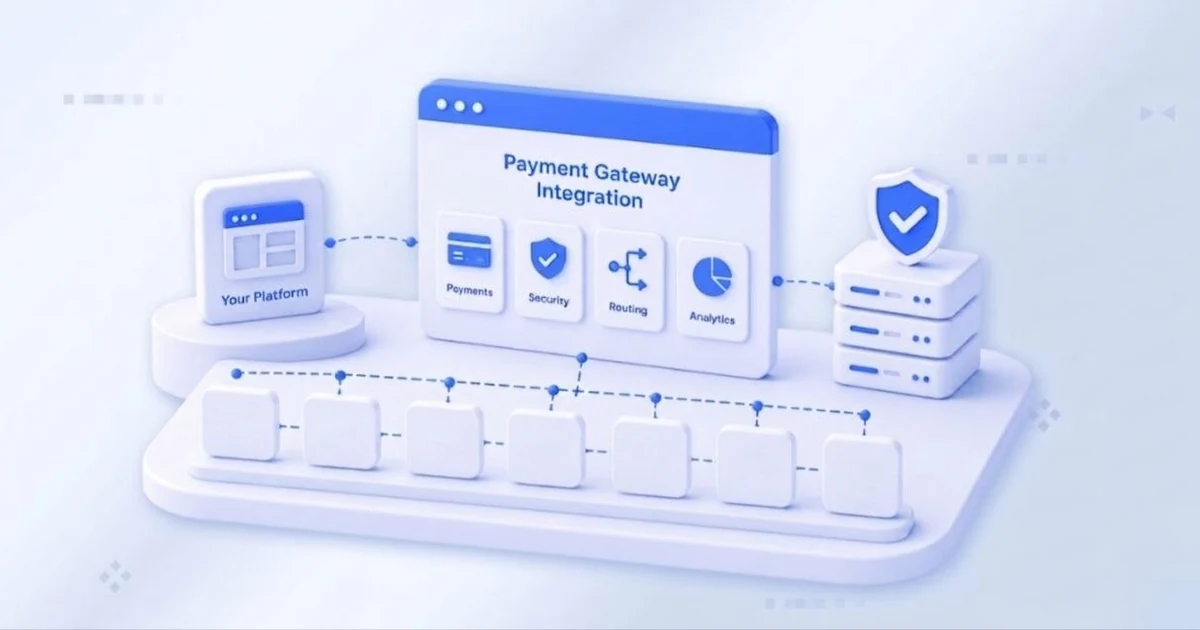
A modern crypto gateway is closer in shape to a small end-to-end payment platform than to a single smart contract. It has a checkout app, a merchant management app, a wallet subsystem, an accounting ledger, a reporting layer, and a compliance workflow. The blockchain integration is one component of the system, not the whole thing. Teams that treat the blockchain as the entire scope of the build ship a demo; teams that treat it as one system among several ship a business.
The end result of a well-designed gateway is deceptively simple: the customer pays in crypto, the merchant sees a transaction in their app within seconds, and one hour later they see the settled amount in their preferred currency. Everything in between (chain selection, network fee optimisation, exchange rate locking, custody, KYC, reporting) is what separates a hobby project from a production system.
The first mistake most teams make when they set out to create a crypto payment gateway is chasing coverage. A day-one gateway does not need forty chains, three hundred tokens and a dozen wallet integrations. It needs one clean end-to-end flow that a real merchant can rely on for real money. Everything else is phase two.
A useful discipline is to write two lists. On the left, everything the roadmap will eventually want to support. On the right, only what the first three merchants demand within their first ninety days. Ship the right column. Nothing else. Every deferred feature buys development time you can put into the ledger, the custody policy, or the compliance workflow.
Six things worth keeping in the MVP
- One or two chains, one or two tokens. Bitcoin and USDT on Tron cover a very large slice of real-world crypto acceptance. Start there.
- A hosted checkout app. Reliable, secure, mobile-first. Embedded widgets and native SDKs come later.
- Deterministic address generation. One address per order, derived from a master key. Prevents cross-order matching mistakes.
- An immutable transaction ledger. Double-entry from day one, so the platform can always answer "where did the money go".
- A merchant app that shows orders, transactions and payouts. Read-only is fine at MVP.
- Automatic fiat off-ramp for at least one settlement rail. Otherwise merchants cannot spend what they earn.
Six things worth cutting
- Advanced multi-chain routing (add once you know which chains actually move volume).
- DeFi integrations that swap in-flight (nice, but a compliance minefield).
- Full-featured mobile app (a responsive web app carries you to twenty merchants).
- Subscription and recurring crypto billing (needs a signing UX that does not exist cleanly yet).
- Card off-ramps at MVP (buy a partner instead of building one).
- NFT and token-gated commerce (a separate product, not a gateway feature).
An end-to-end crypto payment gateway breaks down into roughly seven system components. Each one can be built, replaced or scaled independently, which is what a good architecture buys you.
1. Checkout app. The customer-facing surface. Shows the amount in fiat and crypto, the exchange rate window, the deposit address, a QR code, and a live status. Should feel like a modern payment page, not a blockchain explorer.
2. Order and pricing service. Creates the order, locks an exchange rate for a defined window (usually 10 to 20 minutes), and calculates network-fee buffers. This is where a lot of the platform's economics is quietly decided.
3. Wallet and address subsystem. Derives a fresh deposit address for every order, tracks the private key material through a proper key-management system, and keeps a clean audit trail of every address the platform has ever issued.
4. Blockchain watcher. Runs its own nodes, or connects to a redundant set of managed node providers, and watches the mempool and confirmed blocks for incoming transactions on the addresses issued by the wallet system.
5. Ledger and reconciliation. The immutable record of every movement of value through the platform: incoming customer payments, internal sweeps, exchange trades, fiat payouts. Reconciles daily against on-chain state and exchange balances.
6. Settlement engine. Converts held crypto into the merchant's preferred settlement asset (same coin, a stablecoin, or fiat) and initiates the payout on schedule.
7. Merchant management app. Where the merchant sees orders, transactions, payout history, disputes, and API keys. A crypto gateway lives or dies on how usable this app is.
The custody model is the single decision that shapes everything else in the build. It changes the compliance perimeter, the security requirements, the insurance costs, and the go-live timeline. Get this decision right early or plan on rewriting later.
Custodial gateway. The platform holds customer and merchant funds between deposit and payout. The user experience is closer to a card processor: one click, one confirmation, funds appear in the merchant balance. The trade-off is regulatory: a custodial crypto gateway typically falls inside the perimeter of a virtual-asset service provider (VASP) or money-transmitter regime, with the licensing, capital and reporting obligations that entails.
Non-custodial gateway. Funds flow directly from the customer wallet to the merchant wallet. The platform never has signing authority. The compliance footprint is lighter, but the merchant app is more limited: no held balance, no easy refunds, no automatic exchange to fiat inside the platform.
Hybrid. The most common shape in 2026. The platform is custodial for the settlement window (minutes to hours) and non-custodial the rest of the time. Funds are swept from deposit addresses into a small operational wallet, converted, and paid out. The custodial exposure is quantifiable and short-lived, which is friendlier to insurance and easier to reason about for auditors.
Chain selection is a business decision dressed up as a technology decision. Every chain you add multiplies the operational cost: another node to run, another set of libraries to keep current, another security surface, another compliance policy. Start narrow.
A pragmatic day-one list for a generalist crypto payment gateway in 2026 looks like this: Bitcoin for brand recognition and large-ticket transactions, USDT and USDC on Tron and Ethereum for high-volume stablecoin settlement, and one Layer-2 network (typically Polygon or Base) for low-fee EVM traffic. That covers upwards of eighty percent of merchant demand you will see in the first year.
Network fees deserve their own design pass. A gateway that quotes a customer the wrong fee absorbs the difference on every transaction. A gateway that over-quotes fees loses conversions. The right approach is a live fee estimator per chain, a small buffer that protects the platform, and a clear disclosure in the checkout app so the customer sees exactly what will land on-chain.
Consolidation transfers, sweeping deposit addresses into a hot wallet, also cost network fees, and at high transaction volumes those internal fees are a real line item. Batching sweeps, using UTXO consolidation windows on Bitcoin, and picking chains with cheap internal transfers all show up in the unit economics later.
Compliance is where the difference between a crypto payment gateway that operates in the real world and one that quietly gets shut down becomes obvious. The regulatory landscape in 2026 is more settled than it was two years ago, but it is not permissive. Every serious build assumes VASP-equivalent obligations from day one.
Merchant KYB. Every merchant onboarded to the gateway needs Know Your Business verification: company documents, beneficial owner identification, sanctions and PEP screening, and ongoing monitoring. This is table stakes; skipping it makes the platform unbankable regardless of how good the technology is.
Customer KYC thresholds. Depending on jurisdiction, customer-side KYC is required above certain per-transaction or cumulative thresholds. The gateway needs a KYC flow that triggers automatically once a wallet address crosses that threshold, and it needs a policy engine that can vary the threshold per merchant, per country and per asset.
Travel rule. Transactions above a threshold (commonly $1,000 or €1,000 equivalent) require the originating and receiving VASPs to exchange counterparty information. A production crypto gateway integrates with at least one travel-rule protocol (Sumsub, Notabene, Shyft) so it can send and receive that data automatically.
Chain analytics. Every incoming and outgoing transaction should be screened against a chain-analytics provider such as Chainalysis, Elliptic or TRM Labs. Transactions that hit blacklists get held, flagged and escalated. This is one of the concrete places where a serious crypto gateway earns its keep versus a bare wallet integration.
Recordkeeping. Regulators expect a full audit trail of every deposit, sweep, conversion and payout, retained for years. Design the transaction store for that from the start; retrofitting audit-grade recordkeeping onto a live system is painful.
How to build a crypto payment gateway in a way that survives production traffic and a first-year audit? The following sequence is the one experienced fintech teams follow. Skip a step and you pay for it later.
Step 1: Discovery and legal scoping. Sit down with a crypto-aware lawyer before you write any code. Confirm the licensing perimeter, the target markets, the acceptable business categories, and the custody model that fits. The output is a one-page compliance brief that the whole development team refers to for the rest of the project.
Step 2: Architecture and threat model. Sketch the seven system components listed above, mark the trust boundaries between them, and run a threat model with a security engineer. Decide where the private keys live, how they are protected, and who can sign what. This is the single highest-leverage design session on the project.
Step 3: Wallet and node infrastructure. Set up the key-management system (HSM or a KMS with hardware-backed keys), the address-derivation service, and the node fleet for each chain you support. Redundancy is not optional here; a single node outage should not stop payments.
Step 4: Transaction pipeline and ledger. Build the order service, the blockchain watcher, and the immutable double-entry ledger. Model deposits, sweeps, exchange trades, refunds and payouts as first-class transaction types. Every one carries an idempotency key and a deterministic identifier.
Step 5: Merchant app and API. Ship the merchant management app and a clean REST API with webhooks. A single canonical transaction ID follows a payment across the API, the app, the ledger and the on-chain record. No dual sources of truth.
Step 6: Compliance, testing and go-live. Integrate KYC, KYB, chain analytics, travel-rule messaging, and reporting. Run end-to-end tests against testnets and, once stable, against mainnet with capped exposure. Only after that does the platform open to real merchants.
The technology choices behind a modern crypto payment gateway have converged in the last two years. There is no single correct stack, but the shape below reflects what most production systems actually use in 2026.
| Layer | Common technology choices |
|---|---|
| Backend services | Go and Java for the transaction pipeline, Node.js for BFF and webhooks, Python for analytics and reporting. |
| Checkout and merchant app | Next.js or Remix on the web, React Native for a native app, native Swift/Kotlin only where UX demands it. |
| Blockchain integration | Self-hosted Bitcoin and Ethereum nodes, Tron and Layer-2 nodes via managed providers, WalletConnect for wallet UX. |
| Key management | HashiCorp Vault, AWS KMS, or a dedicated HSM, depending on custody model and jurisdiction. |
| Data and observability | PostgreSQL for the transactional store, Kafka for events, ClickHouse for analytics, OpenTelemetry for tracing. |
| Compliance and screening | Chainalysis or Elliptic for chain analytics, Sumsub or Onfido for KYC/KYB, Notabene for travel-rule messaging. |
| Cloud and platform | AWS or GCP as the primary cloud, Kubernetes for orchestration, Terraform for infrastructure-as-code. |
How much does it cost to create a crypto payment gateway, and how long does the build actually take? Realistic 2026 numbers, split by delivery model:
| Delivery model | Timeline | Approximate budget (USD) |
|---|---|---|
| Full custom build | 12 to 18 months | $700K to $2M end to end |
| White-label deployment on a licensed core | 1 to 3 months | $120K to $350K plus platform fees |
| Hybrid: white-label core plus custom UX layer | 3 to 6 months | $250K to $600K plus platform fees |
| Steady-state annual operating cost | Ongoing | 20 to 35% of the initial build cost |
Team shape matters as much as headcount. A dedicated crypto payment engineering team typically looks like this: one architect who owns the ledger and the wallet subsystem, three to five backend engineers, one or two mobile and web app developers, a security engineer with hands-on cryptography experience, a compliance-minded engineer who owns the KYC and chain-analytics integrations, and a product manager who can speak fluently to both merchants and regulators. Anything smaller and something falls off the plate; anything larger and coordination overhead starts to eat the gains.
The hidden cost: regulatory time. Building the software is one line item. Getting the licence, the banking relationship, and the insurance you need to operate is often a longer path than the development itself. Build those workstreams in parallel; do not wait for the code to be finished before you start the paperwork.
Nearly every crypto payment gateway that fails in the first year fails for one of a small number of reasons. All of them are avoidable if you know what to look for.
Treating the blockchain integration as the whole product. The chain-listener is maybe ten percent of the codebase. The ledger, merchant app, and compliance system are the rest. Teams that spend nine months on the smart contract layer and three weeks on the merchant app ship a demo, not a business.
Underestimating custody risk. A single-signature hot wallet holding significant balances is a headline waiting to happen. Multi-sig, HSM-backed keys and clear operational segregation are non-negotiable from day one.
Skipping the ledger. A crypto gateway that logs on-chain events but does not maintain its own double-entry ledger cannot answer basic finance questions and cannot reconcile with an exchange or a bank. Reconciliation is not a phase-two feature; it is a launch blocker.
Ignoring the exchange-rate window. Crypto prices move. A gateway that does not lock a rate for the duration of the checkout will either eat the slippage or push it to the customer as a surprise fee. Neither is acceptable in a serious system.
Adding chains too fast. Every new chain doubles the operational surface. Two well-supported chains at launch beat ten half-supported ones every time.
Underinvesting in the merchant app. Merchants judge the platform by the app they use every day. A functional API with a shabby app loses to a slightly weaker API with a first-class app.
Confusing custodial and non-custodial obligations. Every decision to hold merchant or customer funds changes the compliance perimeter. If you are custodial, act custodial from day one; do not assume you can add controls later.
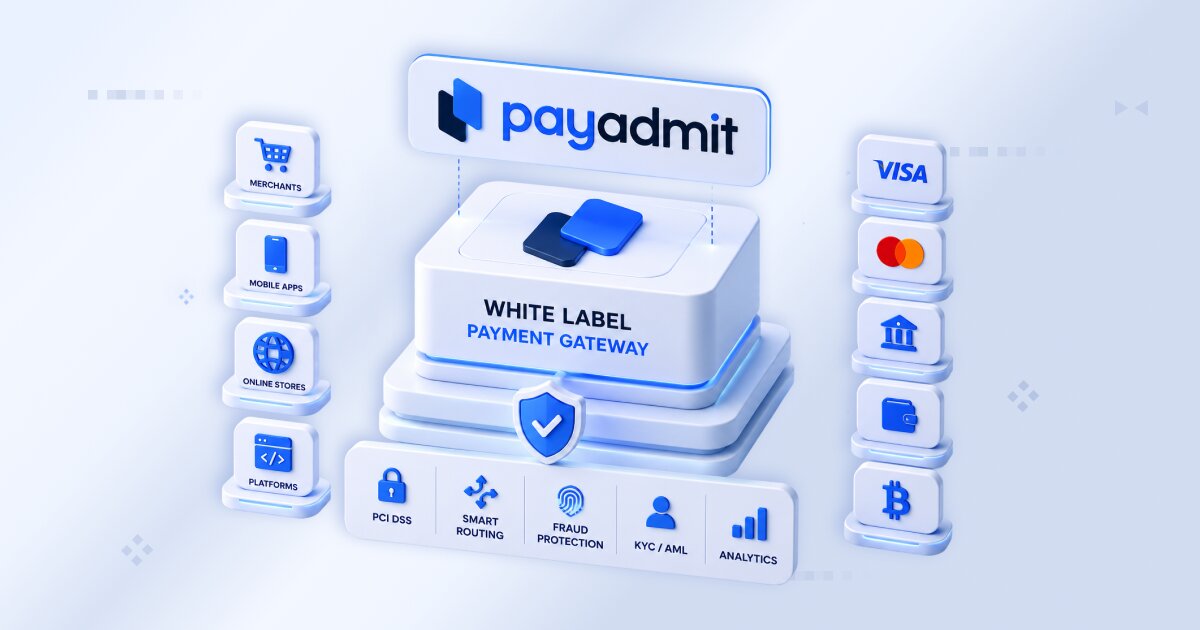
PayAdmit is a white-label payment platform with a purpose-built crypto layer that plugs directly into the same merchant, ledger and compliance systems that power our fiat gateway. Teams that use us to create a crypto payment gateway inherit a hardened core: PCI DSS-compliant infrastructure, an audit-grade ledger, a full merchant app, KYC and KYB workflows, chain-analytics screening, and multi-chain wallet infrastructure ready on day one.
Instead of funding a twelve to eighteen month build, teams typically deploy a branded crypto gateway with us in one to three months, then spend their engineering budget on the differentiating parts of their product, the merchant UX, the routing logic, the reporting features that decide their margin. For a broader look at the numbers behind the build side, our detailed breakdown of the cost to develop a crypto payment gateway is a good next read, alongside our companion guide on how to build a payment platform that covers the wider operating model.
If your roadmap sits at the intersection of crypto and traditional payments, a merchant business that wants both a card gateway and a crypto gateway under one brand, we can supply the platform, the compliance posture, and the engineering support behind both. Our page on white-label crypto payment gateway development covers the specifics of the crypto product.
One last note on scope. A production crypto payment gateway is a system of moving parts (blockchain nodes, wallet infrastructure, a transaction pipeline, a compliance engine, a merchant app, a payout system) and every one of those parts is its own development discipline. Teams that use PayAdmit inherit that system pre-integrated: the blockchain watchers, the wallet subsystem, the transaction ledger and the compliance workflow all use the same platform, so the crypto payment gateway you deploy behaves like one product rather than ten stitched together. That is the practical reason a mature crypto business chooses a specialised platform over a generalist development shop, and it is why our clients ship a working crypto gateway in 1–2 months rather than in years.
For a wider view of the crypto side of our platform, see our crypto payment gateway product page, our detailed cost to develop a crypto payment gateway breakdown, our overview of crypto as a payment method, and our companion post on how to accept crypto payments for a cryptocurrency business. Together they cover the crypto payment gateway from every angle a new operator needs.
A final thing every founder building a crypto payment gateway should keep front of mind: the crypto payment landscape moves fast, but the fundamentals of a crypto payment business do not. Every extra chain you add, every new wallet integration, every new cryptocurrency your gateway supports has to earn its place through real merchant demand and real transaction volume. Teams that use disciplined product development and iterate against genuine crypto business signals ship a payment platform that grows quarter after quarter; teams that use hype as a compass ship a crypto gateway that stalls. Use the development budget on the payment flows and blockchain integrations your customers actually touch, and leave the rest for a later development sprint. That single habit (use real payment data to steer crypto development, not a roadmap deck) is what separates a crypto payment gateway that becomes a real business from one that becomes a case study.
Ready to shortcut the twelve-month build?
See how the white-label core plus custom engineering layer fits the crypto payment gateway you actually want to ship.