

Market, currency, device and payment history decide which methods are shown and in what order, before any provider is chosen.
Gaming Alternative Payment Solution and Local APMs
Cards are the baseline, not the answer.
In most regulated gaming markets the top deposit method is not a card. It is a wallet, an instant bank rail or a voucher the player already uses daily. An alternative payment solution is how an operator reaches those players without a separate integration per method.

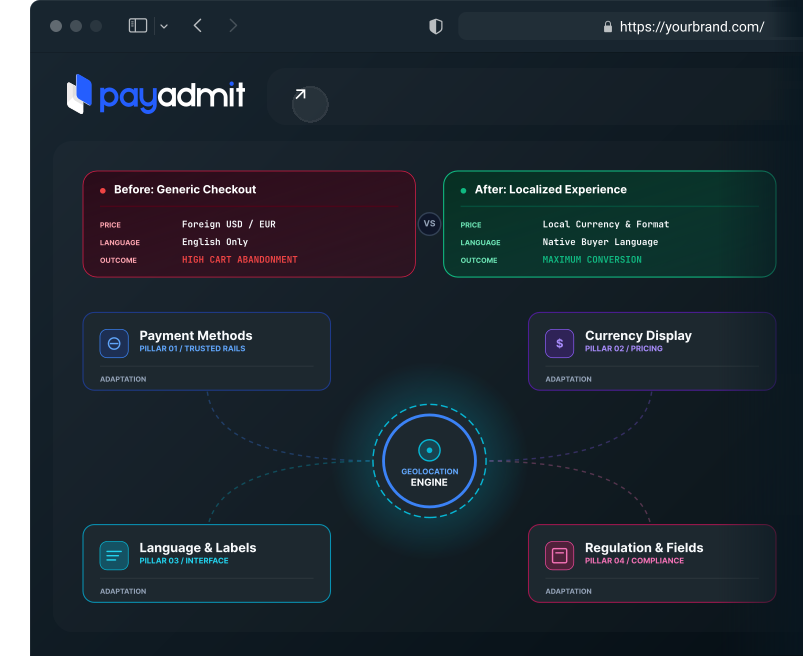
Why Gaming Operators Need Alternative Payment Methods
Card acceptance in gaming is thin in exactly the markets that grow fastest. Issuers decline the category, players do not hold the product, or the local habit simply never involved a card. None of that is fixable with better routing.
The alternative is to meet players on the rail they already use. That is a coverage decision rather than an optimisation, and it moves deposit conversion by more than any change you can make to a card flow.
The takeaway for an operator
Offering the method a player already trusts beats optimising the one they do not. Approval work on cards is worth several points; adding the local rail in a market where cards barely convert is worth a multiple of that. Do the coverage work first, then tune what remains.
APM Categories for Gaming
1
Digital wallets
Fast, familiar and usually available for payouts as well as deposits, which makes them the most complete APM family for gaming.
2
Pay by bank and open banking
Authenticated at the player's own bank, so approval is high and disputes are rare. Refund handling differs from cards and needs its own process.
3
Local bank transfer
The instant domestic rail that carries most volume in many markets. Coverage is national, so each market is a separate connection.
4
Vouchers and prepaid
Reaches players who will not link a bank or a card. Deposit-only in most cases, so a payout rail has to be arranged separately.
5
Crypto where permitted
Relevant for a specific audience rather than a general one, and only where the operator's licence allows it.
One Integration for Multiple Payment Methods
Connecting each method directly means a new build, a new status vocabulary and a new settlement file every time. Ten methods becomes ten maintenance commitments, and the eleventh market stops being a commercial decision.
Behind a platform it is one integration and a growing list. Your product speaks one API, methods arrive as connectors, and the cashier learns about a new option from configuration rather than from a release.
APM: alternative payment method, meaning anything that is not a card scheme, so wallets, instant bank transfers, open banking, vouchers, prepaid and crypto. The name is misleading in most gaming markets, where the alternative is the majority and the card is the minority. The adapter pattern behind each one is on payment connector.
Deposits and Withdrawals
Deposit coverage is the easy half. The trap is a market with five deposit options and one slow payout rail, which produces exactly the support load and the reputation an operator was trying to avoid by adding methods in the first place.
Check payout parity method by method. Wallets usually pay out, instant bank rails often do, vouchers almost never. Where a method is deposit-only, decide the payout route for those players before you switch the method on, not after. The payout side as a whole is covered on gaming payment system.
Localized Checkout and Method Ordering
Show a player the three methods that work where they are, in their language and their currency, with the one they used last at the top. Hide everything unavailable rather than greying it out, because a disabled option reads as a broken site rather than as a regional rule. A cashier that lists twenty methods is not offering choice; it is offering work.
Want your markets checked method by method?
Routing Across Payment Methods and Providers
Routing between providers is well understood. Routing across method families is the part gaming operators actually need, and it works in four steps.

Popular methods are offered by several providers with different approval and availability. The engine ranks them on live data for that segment.

A method failing at one provider is retried at another where eligible. A player abandoning an off-site flow cannot be retried and needs a prompt instead.

Approval and completion per method per market feed back into ordering, so the cashier keeps matching what actually works. See smart payment routing.
Fraud, KYC/AML and Compliance
Alternative methods change the risk profile rather than removing it. Four differences worth planning for.
| Aspect | Cards | Alternative methods |
|---|---|---|
| Dispute exposure | Chargebacks, with scheme thresholds | Rare, but recalls and complaints instead |
| Authentication | 3D Secure, with exemptions | At the player's own bank or wallet |
| Identity signal | BIN and issuer country | Often a verified account name |
| Refunds | Standard and fast | Slower, and sometimes manual |
Reconciliation and Payment Analytics
Every method added is another settlement format and another set of reason codes. Five things to insist on before the count grows.
- Completion rate per method per market, not a blended deposit figure.
- Decline and abandonment reported separately, because they have different fixes.
- Payout timing per rail against your published promise to players.
- Cost per completed deposit, including the attempts that failed first.
- Settlement files from every provider matched automatically, exceptions only to a human.
Detail on the reporting surface sits on payment analytics dashboard.
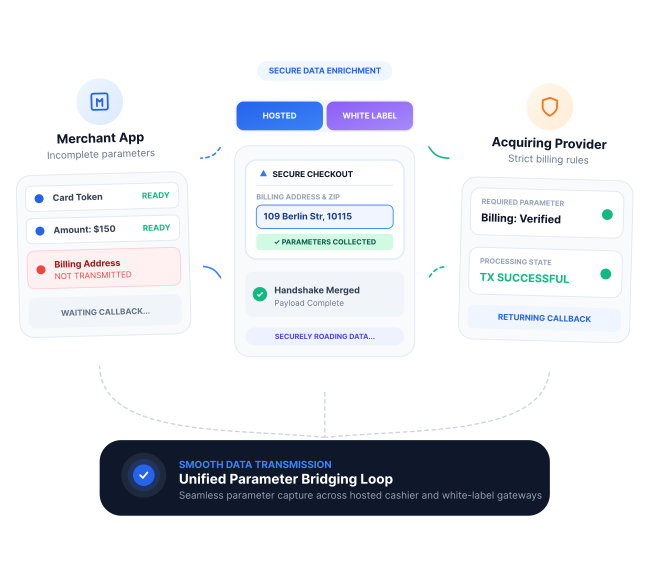
Adding New APMs Without Rebuilding the Checkout
Six properties that keep the eleventh method as cheap as the second.
Method availability held centrally, so the cashier reads it rather than hard-coding it.
One request shape for every method, with provider specifics kept inside the connector.
One status taxonomy, so a new method needs no new handling in your platform.
Assets and labels supplied by the platform, so no design work per method.
Weighted rollout, so a new method takes a small share before it takes a market.
Reporting that includes it automatically rather than after a dashboard change.
Use Cases by Gaming Market
Three market shapes an operator will recognise, and what each one asks of the payment stack.

Where an instant domestic transfer is simply how people pay, cards are a fallback rather than a default. Connecting the local rail moves deposit completion more than any card optimisation, and payouts usually run on the same rail, which keeps the player experience symmetrical in both directions.

Players already hold a wallet balance and expect to top up from it in two taps. Approval is high because authentication happens inside the wallet, and payouts back to the same wallet are usually fast, which makes this the most complete family to lead with where it exists.

A meaningful share of players will not link a bank account or hold a usable card at all. Vouchers and prepaid reach them, but the family is deposit-only, so the payout route for those players has to be decided deliberately rather than discovered at the first withdrawal.
How to Evaluate an APM Solution
Ask which methods are live in your markets today rather than on a roadmap, whether each one supports payouts, and what completion rate the provider sees for gaming traffic specifically rather than across its whole book.
Then ask the operational questions: how a new method reaches the cashier, whether reporting includes it automatically, and what your own team can change without raising a ticket.
The question that separates candidates
How much work is the eleventh method? If the answer involves a release, a design task and a reporting change, the solution is a list of integrations rather than a platform, and the cost of coverage will grow with every market you enter. The deposit-to-settlement context around this sits on igaming payment processing.
Frequently Asked Questions
How many methods should we offer per market?
Three families is the practical minimum: cards, an instant bank rail and a wallet or voucher. Beyond five the cashier starts costing you completion rather than adding it, because choice becomes a decision the player has to make.
Do alternative methods reduce chargebacks?
They reduce card chargebacks, since a bank-authenticated payment is rarely disputed. They introduce recalls and complaint processes instead, which are less costly but need their own handling rather than none.
Can players withdraw to the same method they deposited with?
For wallets and most instant bank rails, yes. For vouchers and prepaid, usually not, so an alternative payout route has to be configured for those players in advance.
How long does adding a method take?
Once the platform is live, a connected method is a configuration change plus a test window. The commercial agreement and the provider's own underwriting of gaming traffic take longer than the technical work.
Will the checkout need redesigning each time?
No. Method availability, ordering and assets come from the platform, so the cashier picks up a new option without a front-end release.
Are all methods available to gaming operators?
No, and this is the filter most often missed. Some providers will not underwrite the category regardless of volume, so availability for gaming specifically is confirmed per market during scoping. The same question applies when choosing a payment gateway for gaming site.