

Gambling traffic is coded MCC 7995. A generic solution either blocks it or throttles it once volume is visible. A gaming solution earns its name in the transaction it recovers, not in the one it processes first.
Payment Gateway for Gaming Sites: Setup and Options
What to ask before you sign anything.
A payment gateway for a gaming site has to do one thing a general-purpose gateway will not: keep taking money from players in a category most acquirers avoid. This page is the practical checklist, not the theory.

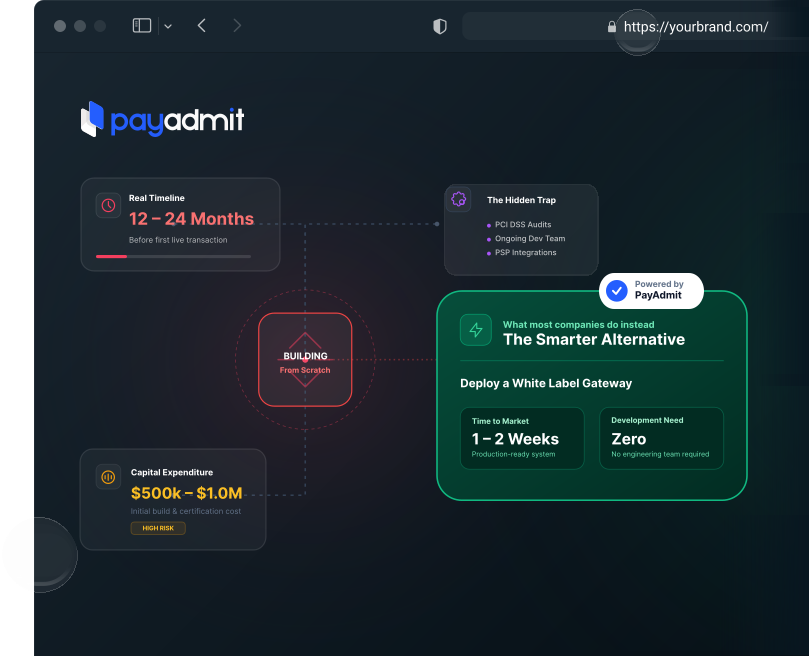
Why Gaming Sites Need a Specialized Payment Gateway
Four points where a general gateway stops behaving and a gaming payment gateway keeps going.

One acquirer is a single point of failure. Gaming solutions assume several and switch between them automatically.

Withdrawals run on separate rails with their own approval step. Retail gateways treat them as refunds, which they are not.

Acceptance has to stop at the edge of your licence. That is a gateway-level control, enforced per player and per market. Generic solutions are built for a cart; a gaming platform is built for a session that ends when the payment fails.
How the Gaming Payment Gateway Works
One deposit, five hops, about two seconds. The full cycle from here to settlement is on igaming payment processing.
| Hop | What happens there |
|---|---|
| Checkout | The player picks a method; card data is tokenised on the spot. |
| Gateway | Risk runs, a route is chosen, the request is normalised and sent. |
| Provider or acquirer | The request is translated into the network's format and presented. |
| Issuer or bank | Funds are held or refused, with a reason code attached. |
| Response | A signed callback settles the state and credits the balance. |
Player Deposits and Withdrawals
Five questions to put to any gateway provider about the two flows, in this order.
- Which deposit methods are live in each of our markets today, not on a roadmap?
- Do payouts run on the same connection as deposits, or on separate rails? Any offer you shortlist should show transaction data for game traffic in your own markets, and say how it processes a decline there.
- Is there an approval queue our risk team can work, with limits per player?
- What are the payout cut-off times, and what does the player see while waiting?
- Can a declined deposit be retried on another provider inside the same session?
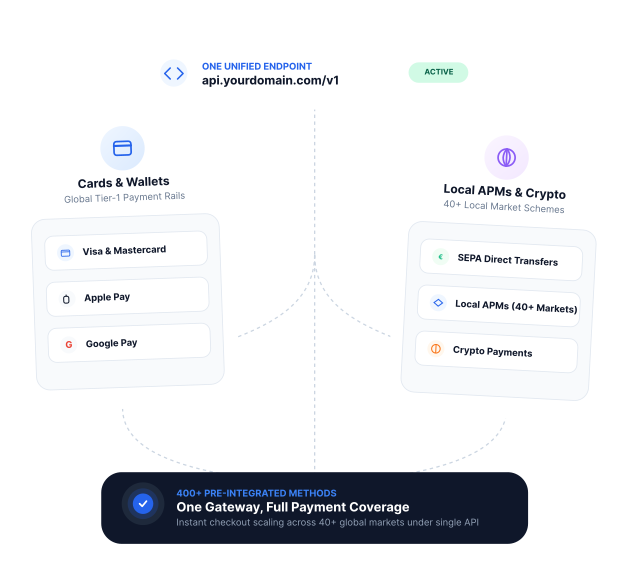
Payment Methods and Multi-Currency Support
Six things worth confirming per market before the contract, because adding them later is a negotiation rather than a setting. The payment solution and the game platform are separate purchases that have to behave as one product.
Cards as a baseline, with local acquiring wherever a domestic route exists.
An instant bank rail, which is the top deposit method by volume in most regulated markets.
A wallet or voucher for players who will not use a card or a bank transfer.
Crypto where the licence permits it, inside the same cashier rather than a separate flow. iGaming solutions differ from retail ones mainly in how they process a decline, and no two solutions handle that the same way.
Pricing in the player's currency, with settlement into the currency your treasury holds.
Payout parity, so every market with deposit choice has more than one way out.
The current catalogue is listed on payment methods.
Gaming Checkout Experience
Three decisions in the cashier that move deposit completion more than any redesign will.

Put the player's last successful method first and rank the rest by what actually converts in that market. Hide anything unavailable rather than greying it out, because a disabled option reads to a player as a broken site rather than as a regional restriction they should understand. A solution that processes deposits well and payouts badly is half a solution, whatever the rest of the offer looks like.

Every hop to a third-party payment page is a place where the session ends. A gateway that supports a branded in-app cashier keeps the deposit inside your product, and keeps the support conversation that follows a failure inside your product too.

Return a clear result rather than a spinner, and where a decline is recoverable, re-present it elsewhere without asking the player to do anything again. What they should experience is a slightly longer wait, never a refusal followed by a second form.
Payment Routing and Cascading
The capability that decides the rest
A gaming payment gateway that can only reach one provider will eventually cost you a weekend of deposits. Ask specifically whether routing rules are yours to edit, whether a declined transaction is automatically re-presented to another provider, and whether a degrading route is demoted before a human notices. The mechanics of the retry are on cascading payments.
Comparing gateways for a gaming site right now?
Fraud Prevention, 3DS and Chargeback Controls
1
Screen before authorising
Velocity, device and risk scoring run first, with three outcomes rather than two: approve, decline, or step up.
2
Authenticate proportionately
3D Secure where a market requires it, exemptions where the rules allow, so routine top-ups are not challenged.
3
Catch the dispute early
Alerts into support let a refund pre-empt a chargeback, which keeps the case off your ratio entirely.
4
Watch the ratio weekly
Scheme thresholds arrive faster than a monthly report. Weekly reads leave time to act; monthly ones do not. Because the game is live, every payment the platform cannot process now is a payment lost, not deferred.
Gateway Integration Options
Hosted checkout is the fastest route and keeps your PCI scope at its lightest, because card data never reaches your application. Most gaming sites launch this way and keep it for mobile web.
Server-to-server gives you the cashier inside your own product, with tokens stored against the player account and repeat deposits in one tap. Connectors and webhooks handle everything behind both.
Tokenisation: replacing a card number with a reference that is useless if stolen and reusable across providers. It is what lets a gaming site offer one-tap repeat deposits and switch gateway providers later without asking every player to re-enter their card.
Performance, Uptime and Scalability
Gaming traffic is not evenly distributed. A fixture or a tournament turns a month of deposits into a few hours, and a solution sized for the monthly average will meet that hour with timeouts.
Ask what happens at ten times normal volume, whether provider health is measured against each route's own baseline rather than an uptime check, and how quickly a degraded route is taken out of rotation. Offers made to gaming operators are judged on recovery, and recovery is a processing capability rather than a commercial one.
Reporting and Reconciliation
Ask for one screen showing approval rate, decline reasons, payout timing and cost per approved payment, split by market, method and provider. Any solution that can only show you a portfolio total is a solution you cannot tune, because the market that is failing will never move the average enough to be visible.
Gaming Use Cases
The same gateway, four different binding constraints.

Small deposits, high frequency. Cashier friction and approval rate decide the session, and everything else is secondary.

Everything happens around fixtures. Provider redundancy is the requirement; a cap reached mid-match is lost revenue.

Money moves constantly in both directions, so payout throughput matters more than deposit conversion.

Looks like retail commerce until a market reclassifies it. Eligibility is checked per jurisdiction, not per product.
Migration and Implementation Checklist
Five stages, and what has to be true before you move on from each. Every game vertical loads the payment path differently, and a single transaction profile will not describe all of them; a casino game and a live game behave nothing alike.
| Stage | What you do | Done when |
|---|---|---|
| Scope | List markets, methods, providers and licence limits. | Every market has a named route and a fallback. |
| Connect | Wire the API, webhooks and existing provider accounts. | Callbacks verify and states reconcile automatically. |
| Test | Run deposits, declines, retries and payouts end to end. | No duplicate charges under repeated notifications. |
| Shift | Move a small traffic share, keep a holdback for comparison. | The moved share beats the holdback over a full week. |
| Complete | Migrate tokens and retire the old integration. | Players keep saved methods and nothing needs re-entry. |
Where the gateway is one component of a wider build, the surrounding parts are covered on gaming payment system.
Frequently Asked Questions
What is the best payment gateway for gambling sites?
There is no single answer, because the right one depends on your licence scope and your markets. The useful filter is whether it supports several providers at once, owns payouts properly and lets your team change routing without a ticket.
Do we need a merchant account as well?
Yes. The gateway carries the transaction; the merchant account settles the money and holds the acquiring risk. The requirements for one are set out on online gaming merchant account.
Is a gaming payment solution different from a general payment platform?
Yes, in the parts that matter. A general product processes a transaction and stops; a gaming solution assumes several acquirers, owns the payout side and lets your site switch between providers mid-session. Because the game keeps running, a failed payment has to be retried while the player is still there.
Can one solution cover both casino and sportsbook traffic?
Usually yes, but the tuning differs. A casino site is optimised for small repeat deposits; a sportsbook solution is sized for the peak around a fixture. The same payment solution serves both, provided the routing rules are set per game vertical rather than globally.
Can we launch with one provider and add more later?
You can, but plan the second one before you need it. Adding a provider is configuration on the platform side; the commercial agreement and underwriting take longer than the integration does.
Is PayAdmit an acquirer?
No. We supply the gateway, cashier, routing and reporting layer. Acquiring and settlement stay with the licensed institutions the operator contracts with.
How do we compare two gaming payment offers fairly?
Score them on the same list rather than on their demos. Live markets, transaction approval by card range, payout rails, gateway uptime during peaks, and what your team can change without a ticket. Two providers that look identical in a deck usually separate on the third question.
What does an iGaming gateway integration usually take?
One integration against the platform API plus webhook handling, then configuration per provider. Most of the elapsed time is commercial rather than technical, because the underwriting behind each payment solution takes longer than the code that processes it.