
Cards plus two or three local methods covers most markets. The right number is whatever captures the dominant local behaviour without leaving methods on the cashier that nobody selects, because every live method still has to be reconciled and supported.
TL;DR. Which payment methods you offer decides how much of a market you can actually reach, and the right list is national rather than global. This guide compares cards, digital wallets, bank and open banking rails, vouchers and crypto on reach, speed, cost, reversibility and whether each one can carry a payout, then shows how to choose the mix per market. PayAdmit connects those methods through one integration, so adding a country is configuration rather than a development project.
On This Page
- Introduction: iGaming Payment Methods
- Main Types of iGaming Payment Methods
- Cards, Wallets and Bank Rails
- Crypto Payments in iGaming
- Deposits vs Withdrawals
- Payment Method Comparison
- Choosing Methods by Market
- Security, Fraud and Compliance Considerations
- Checkout UX and Payment-Method Ordering
- How Orchestration Simplifies a Large Method Mix
- Operator Selection Checklist
- Related Reading
- Frequently Asked Questions
Introduction: iGaming Payment Methods
iGaming payment methods are the ways a player can move money into and out of a gaming account: card payments, digital wallets, bank transfers and open banking rails, vouchers and prepaid products, crypto where a license allows it, and the local payment options that dominate individual countries. The list a brand offers is not a technical detail. It is the single largest determinant of how much of a market that operator can actually convert.
The reason is simple. Payment behaviour is national, not global. A player in Poland reaches for a bank-based option, a player in Germany expects a bank transfer or a wallet, a player in Brazil looks for the instant local rail, and a player in the United Kingdom will usually reach for a card. A business presenting the same four choices everywhere is competing at full strength in some markets and barely competing in others, without any interface problem to point at.
The second reason is that payment methods behave differently once money starts moving. Some are reversible and carry chargeback exposure; some are final. Some can carry a withdrawal; many cannot. Some settle within seconds and some take days. Some cost a fixed fee per transaction and some a percentage. These properties matter more than the logo on the cashier button.
This guide takes each category in turn, compares them on the dimensions that decide which to enable, and sets out how to choose a mix per market rather than per brand. For the wider stack these methods plug into, see iGaming payment solutions. It assumes a licensed business now deciding what to put in front of its players.
Definition An iGaming payment method is any instrument a player uses to fund a gaming account or receive a withdrawal, from card payments and bank rails to wallets, vouchers and crypto.
Main Types of iGaming Payment Methods
Six categories cover essentially everything you will evaluate. They differ on reach, on cost, on reversibility and on whether they can carry money in both directions:
- Card payments. Visa and Mastercard dominate recognition and reach, and card volume is where most operators start. Cards are reversible, which means chargeback exposure, and gambling card funding is restricted in some markets
- Digital wallets. A stored-value account the player funds separately. Wallets deposit instantly, usually accept payouts, and shield the player's card or bank details from the operator
- Bank transfers and open banking. Payment straight from the player's bank account. Modern banking rails authorise in seconds, cost less than cards and cannot be charged back
- Vouchers and prepaid. A code bought with cash or card elsewhere and redeemed at the cashier. Popular with players who keep gambling away from their main banking relationship, but almost never usable for withdrawals
- Crypto. Direct settlement in digital assets where the license permits it. Fast, final and global, with volatility and wallet-screening obligations attached
- Local alternative methods. The national rails, instant-payment schemes and country-specific wallets that frequently out-convert every international option in their own market
Most gaming businesses run three of these categories at minimum: cards for baseline reach, one bank or wallet route for the players cards fail, and one payout route. What happens to a payment after the player picks one is covered in iGaming online payments. Everything beyond that should be added market by market, on evidence of use rather than on the assumption that more choice converts better.
Cards, Wallets and Bank Rails
The three categories that carry most gaming volume, and what each is genuinely good and bad at.
Card payments
The widest recognition of any payment method and the checkout players expect by default. Card deposits are instant to the player and settle to the operator on the acquirer's cycle.

Highest reach, lowest friction
Chargeback exposure sits here
Approval rates lag retail in gaming
Digital wallets
A funded account the player controls, which deposits instantly and accepts payouts. Wallets keep card and banking details away from the operator entirely.
Works in both directions
Popular with repeat players
Coverage varies sharply by country
Bank transfers and open banking
Payment initiated directly from the player's bank account. Banking rails are final, cheaper than cards and increasingly instant across Europe and beyond.
No chargebacks to defend
Lower cost per transaction
Strong where card funding is blocked
Crypto Payments in iGaming
Crypto sits apart from every other category, and operators either treat it as central or ignore it entirely. Where a license permits crypto, it solves problems no banking rail solves: settlement completes in minutes, the payment reaches players whose banking options exclude gambling, and crypto payments cannot be charged back. For operators in markets where card funding is restricted, crypto is frequently the difference between serving a country and not.
The trade-offs are real and they are not technical. Crypto prices move, so an operator either converts on receipt and accepts the spread or holds the asset and carries the volatility on its own balance sheet. Most gaming businesses convert immediately and treat crypto purely as a payment rail rather than a treasury position, which keeps the accounting close to how they handle any other currency.
Compliance is the heavier obligation. Crypto deposits require wallet screening against sanctioned and high-risk addresses, and a documented source-of-funds process that satisfies the regulator in each licensed market. This is not a payment integration question. It belongs to the compliance function, and it needs answering before the first crypto deposit rather than after.
Operationally, crypto works in both directions, which puts it in the small group of options that can carry a payout as well as a deposit. Withdrawal to the same wallet the deposit came from is the normal control, mirroring the card-scheme rule and closing the obvious laundering route. Stablecoins have taken most of the practical volume from volatile assets for exactly this reason: they behave like a currency rail and remove the pricing argument entirely.
Crypto is not a substitute for banking coverage. Players who pay for everything else from a bank account will keep doing that, and a crypto-only cashier narrows a market rather than widening it. The sensible position is crypto alongside cards and banking rails, enabled per market where the license allows, and measured on the same conversion and cost basis as everything else.
Deposits vs Withdrawals
iGaming businesses routinely evaluate payment methods as though money only travels one way. It does not, and the two directions have almost nothing in common commercially.
Deposits are frequent, small and conversion-sensitive
A player deposits many times, in small amounts, and abandons quickly if the method they want is missing. Deposit coverage is a marketing decision as much as a payment one, and the cost of a failed deposit is the whole player relationship, not the transaction fee.
Withdrawals are rarer, larger and trust-sensitive
A player withdraws less often, in larger amounts, and judges the operator entirely on how long it takes. Payout speed drives reviews, retention and word of mouth. The commercial cost of a slow withdrawal is reputational rather than transactional.
The two lists are not the same list
Vouchers and most prepaid products cannot carry a payout at all. Several card schemes restrict gambling payouts to the original card. Bank transfers work in both directions but at different speeds. Wallets are the one category that behaves consistently either way, which is why operators lean on them for payouts even when deposits arrive elsewhere.
The key conclusion Build the deposit method list for reach and conversion, and the payout list for speed and certainty. A business assuming one list serves both ends up manually processing withdrawals through rails that were never designed to send money back.
Payment Method Comparison
Seven dimensions decide whether a payment option belongs on the cashier. Working through them in order stops a decision being made on brand recognition alone.
01 Reach in the target market
What share of players in that country hold and use it? Something used by three per cent of a market is a support obligation, not a payment route, regardless of how well it performs elsewhere.
02 Speed to credit
How long until the balance updates? Cards, wallets, crypto and modern banking rails are effectively instant. Legacy bank transfers and some voucher redemptions are not, and any delay has to be spelled out in the cashier.
03 Conversion at the point of payment
How many players who start a payment actually finish it? This is where card payments underperform in iGaming, and where a well-chosen local rail frequently doubles the result.
04 Reversibility and chargeback exposure
Cards can be disputed months later. Bank rails, vouchers and crypto generally cannot. A business carrying heavy card volume needs a dispute process; one running mostly on bank payments needs far less.
05 Payout capability
Can it send money back, to whom, and how quickly? This question eliminates more candidates than any other and should be asked before integration rather than after the first payout request.
06 Cost per completed transaction
Percentage rates, fixed fees, currency conversion and scheme charges combine differently per method. Compare cost against completed payments, not against attempts, or a cheap rail with poor conversion will look better than it is.
07 Friction for the player
Redirects, app switches, one-time codes and manual reference numbers all cost completions. Something technically cheap that demands four extra steps will underperform a pricier route finishing in one.
Choosing Methods by Market
Market-level selection beats any global ranking. Four questions decide the list for a country.
Local behaviour first
the deciding factor
What do people in this market use to pay for everything else? The answer usually names the one or two methods that will carry most of your deposit volume, and it is rarely the same answer as the neighbouring country.
Regulation second
a hard filter
Some markets restrict card funding for gambling, some require particular authentication, some prohibit crypto outright. Anything illegal or restricted under your license is out, regardless of how well it converts.
Currency and banking rails
the practical constraint
A rail that only settles in a currency you do not hold adds conversion cost to every payment. Check the currencies supported natively before assuming coverage.
Provider availability
the reality check
Anything your payment provider cannot connect to in that country is theoretical. Confirm live coverage per market rather than reading a global list.
Security, Fraud and Compliance Considerations
Each payment method carries a different risk profile, and the controls that matter follow the rail rather than the brand.
- Card payments need 3D Secure applied sensibly, clear billing descriptors and a working representment process, because this is the only category where funds can be pulled back months later
- Bank and open banking payments need account-name verification where the scheme supports it, since the chargeback protection that cards give the player does not exist here
- Wallets need attention to account takeover, because a compromised wallet is a payout route as well as a deposit route
- Vouchers need velocity and reuse checks, as codes are traded and resold outside the operator's view
- Crypto needs wallet screening against sanctioned addresses and a documented source-of-funds process, which is a compliance function rather than a payment one
- Every method needs the same KYC standard applied before the first withdrawal, or the control is only as strong as its weakest route
The common failure is applying card-shaped controls to non-card rails. Fraud rules tuned for card testing catch nothing useful on a bank rail, and a wallet compromise looks like a perfectly ordinary deposit until the payout request arrives.
Reversibility. A reversible payment can be pulled back by the payer's bank after settlement, which is exactly what a card chargeback is. Irreversible methods such as bank transfers, vouchers and crypto shift the risk: the operator keeps the money, but a genuine dispute has to be resolved commercially rather than through a scheme process.
Checkout UX and Payment-Method Ordering
The cashier is where all of this either pays off or quietly fails. Businesses that spend months negotiating coverage and then present it as an unordered grid of nineteen logos give most of the benefit back at the last step.
Ordering should follow likelihood of use in that specific market. The two or three that will carry most of the volume belong above the fold, selected by default where the platform allows, with the rest behind a clearly labelled expansion. Players do not browse; they look for what they already trust and abandon if they cannot see it quickly.
Remembering the previous choice matters more than any other single improvement. A returning player who deposited by wallet last week should see that wallet first, pre-selected, with the amount field focused. This one behaviour removes more friction than any redesign of the payment form itself.
Ordering by cost is the common temptation and usually a false economy, and the real cost base is broken down in gaming merchant account costs. Pushing players towards a cheaper rail costs completions, and a lost deposit is worth more than the few basis points saved. Where the difference is genuinely material, incentivise the cheaper route openly rather than by hiding the alternative.
Finally, the cashier has to be honest about timing. If a payment credits in seconds, say so. If it takes an hour, say that too. Players tolerate a slower option they chose knowingly; they do not tolerate a balance that has not appeared and a page that promised instant.
How Orchestration Simplifies a Large Method Mix
A list that is correct per market is, by construction, long overall. An iGaming business serving eight countries may end up with twenty-five live payment methods across five providers. Managing that directly from the gaming platform is where complexity becomes unmanageable.
Orchestration collapses it. The platform integrates once, and everything is configured behind that interface: what appears in which market, which provider carries it, what happens when one becomes unavailable. Adding a country becomes a configuration exercise instead of a development project.
The point in one line The value of orchestration is not that it adds payment options. It is that it breaks the linear relationship between how much you offer and how much engineering and reconciliation you carry.
It also makes the method list reviewable. When every payment flows through one reporting layer, an iGaming business can see what is used, what converts, what costs most per completed deposit and what has quietly stopped working in a market. Without that view, decisions rest on vendor claims rather than your own payment data.
Operator Selection Checklist
A short sequence for deciding whether a payment route earns a place on the cashier.
01 Name the market
Decide per country, never globally. The same rail can be essential in one market and irrelevant next door, and a single global list guarantees you are wrong somewhere.
02 Check the license permits it
Confirm it is allowed for gambling under that license, in that jurisdiction, for the currencies you settle in. This is a compliance answer, not a commercial one.
03 Confirm provider coverage is live
Ask the provider whether it is live in that country for iGaming merchants specifically, not whether it appears on a global list. The two answers differ more often than operators expect.
04 Decide the payout role
Establish now whether it can carry withdrawals, and if not, what will. Documenting the mapping before launch avoids improvised manual payouts later.
05 Model the full cost
Include the percentage rate, fixed fees, currency conversion, refund charges and any minimums, then divide by completed deposits rather than attempts.
06 Set a review date
Diarise a check three months after launch. Anything carrying under a threshold share of payment volume in that market should be removed, because unused routes still consume reconciliation and support effort.
Related Reading
Payment coverage sits inside a wider set of decisions. If you are still mapping the overall stack, the iGaming payment solutions guide covers gateways, acquiring, payouts and orchestration together.
For the mechanics of what happens after a player selects a method, covering authorisation, declines, approval optimisation and settlement, see iGaming online payments. If the commercial side is the current question, gaming merchant account costs breaks down rates, reserves and per-transaction charges without inventing figures.
Frequently Asked Questions
How many payment methods should a gaming operator offer per market?
Which payment method converts best for deposits?
The one players in that country already use for everything else. In practice that is cards in some markets, pay-by-bank in others and a wallet or voucher elsewhere. There is no globally best option.
Can players withdraw to any method they deposited with?
No. Vouchers and many prepaid options are deposit-only, and some card schemes restrict gambling payouts. Operators normally map each deposit method to an allowed payout method and explain the rule in the cashier.
Are crypto payments worth supporting?
Where the license permits crypto, it settles fast, reaches players banking rails cannot, and carries no chargeback risk. Against that sit volatility, wallet-screening obligations and source-of-funds checks that a compliance team has to own.
Why do card deposits fail more often in gaming than in retail?
Issuers score gambling merchant codes more cautiously, cross-border card traffic adds another risk signal, and some banks decline gambling card funding as policy. Local acquiring recovers part of the gap but not all of it.
Do bank transfers work for instant deposits?
Modern pay-by-bank schemes authorise in seconds and are effectively instant. Legacy manual bank transfers are not, and should be treated as a separate, slower method rather than a variant of the same option.
How should payment methods be ordered on the cashier?
By likelihood of use in that player's market, with the top two or three visible without scrolling. Ordering by the operator's cost tends to reduce conversion by more than it saves.
What does adding a payment method actually cost?
Integration is only the first part. Each live method adds reconciliation, support cases, refund handling and monitoring, which is why a curated method list usually outperforms a long one.
Should the same method mix run across every brand?
Only where the markets match. Method preference is national rather than corporate, so a multi-brand operator normally configures the cashier per market and per license instead of per brand.
How are payment methods evolving in iGaming?
Towards bank-based rails and wallets, away from card dependence. Open banking coverage keeps widening, and regulators in several markets are tightening card funding for gambling, which pushes both operators and players in the same direction.
CHOOSING A PAYMENT METHOD MIX?
Tell us which markets you are licensed in and we will map the methods your players actually use against what we can connect.
SIMILAR ARTICLES

The whole stack behind gaming deposits and withdrawals, and how the pieces fit together.
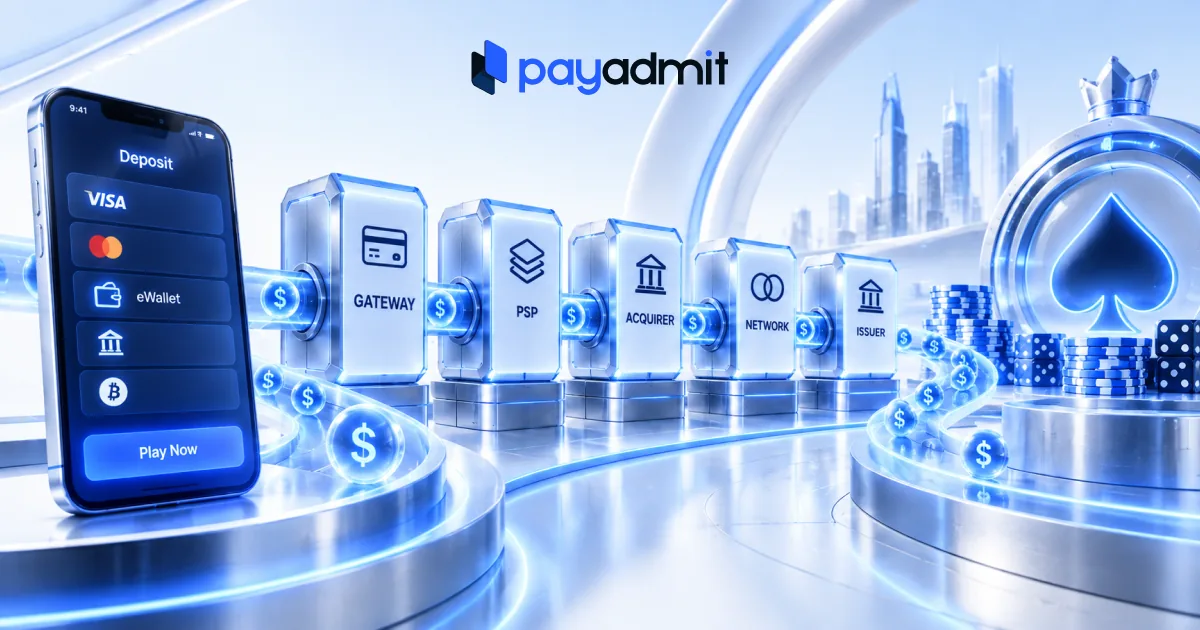
How a deposit travels from cashier to settlement, and where approval rates are won or lost.

Rates, reserves and per-transaction charges, and how to compare provider quotes honestly.