

With portfolios of small and medium businesses that want to upgrade their payment service without re-engineering it.
White Label Payment Solution for MSPs and Their Merchant Base
Launch a branded platform under your provider brand without the engineering cost of building one. PayAdmit delivers the payment platform stack, the merchant onboarding flow, and the operational support that any provider needs to serve its merchant base at scale.

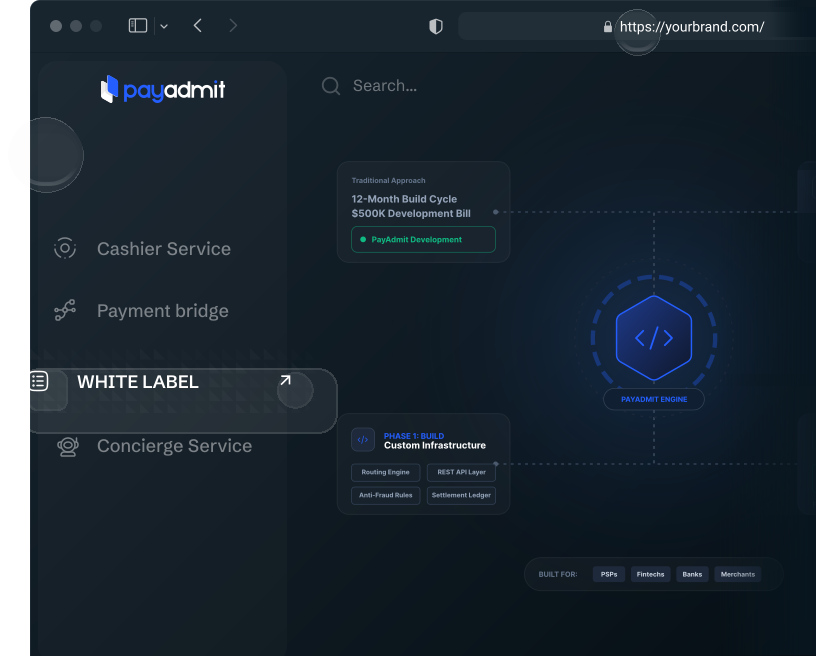
What Is a White Label Payment Solution for MSPs
A platform for providers is the white label payment stack that a Merchant Service Provider delivers to its business base under its own brand. The MSP owns the merchant relationship; the payment platform sits underneath and runs the payments.
The solution covers four layers: the branded merchant-facing dashboard where businesses see transactions and settlement, the payment gateway that handles every transaction, the onboarding workflow that turns prospects into live businesses, and the operational support that keeps the business running.
Why MSPs adopt a branded platform
PayAdmit packages all four layers into one platform. MSPs that adopt a branded platform differentiate against direct processors and protect merchant relationships across the lifecycle. Related product: white label payment gateway software.
Who Needs a Payment Platform
The platform fits any provider, ISO, or payments reseller serving a defined business base. Each profile buys for a different reason; the same underlying platform delivers each outcome.

That need a white label dashboard and modern gateway to compete with direct processors on more than just price.

Serving a specific industry that want a transaction solution tailored to that vertical (healthcare, hospitality, iGaming, and similar).

Adding payment capabilities to a SaaS business without engineering payments in-house.
Why the Market Needs a Payment Platform
Providers without a modern platform face four problems. The gap between operator capabilities and merchant expectations widens every quarter. A modern platform closes the gap with a single integration.

Direct processors undercut providers on price. Without a branded platform that differentiates, providers compete on price alone.

Businesses leave for processors with better dashboards, faster onboarding, and richer reporting. An outdated solution drives merchant attrition.

Providers that handle payments service manually spend more on operations than on growing the payments business. The right solution automates the heavy lifting.
Building a gateway from scratch costs millions and takes 18 months. Most providers cannot afford that timeline against the market window.
PayAdmit White Label Payment Solution Services
The payment platform packaged into one service engagement. Every layer configured, branded, and running under the provider brand from launch.
Merchants log into a dashboard carrying the provider brand. They see transactions, settlement reports, dispute queues, and configuration in a white-label experience the provider controls.

Every payment runs through the gateway and payment bridge under the provider brand. Supports 400+ methods, multi-acquirer payment routing, and antifraud and risk management.

KYC, KYB, document verification, and the underwriting flow that turns prospects into live businesses. Runs under the provider brand from first form to live transaction.

Reporting gives the provider visibility across the business base. Tier-one merchant queries handled by the support service so the provider team focuses on growth.
How the Payment Platform Rolls Out
Three phases. Shorter than a typical enterprise engagement because most of the payment technology is already built and certified.

Two-week phase mapping the provider brand, merchant segment, and integration requirements. Output: a delivery plan and a branded platform configuration.

Platform configures for the provider brand, payment methods, and merchant onboarding workflow. Runs 4 to 6 weeks and delivers the branded portal plus the live gateway.
Merchants onboard onto the new solution. PayAdmit continues platform updates and merchant support across the engagement lifecycle.
Capabilities of the White Label MSP Payment Portal
The platform ships with the capabilities any modern MSP needs. Each matures together as part of the same white label platform.
Custom branding across every merchant-facing surface, from onboarding to reporting.

Cards, alternative methods, account-to-account rails, and regional options across 40+ markets.
Smart routing across multiple acquirers for the best authorisation rate on every transaction.

Every transaction screens through the fraud service before authorisation, with configurable rules per merchant.
Built-in compliance tooling for merchant onboarding and ongoing monitoring, configurable per market.

Automated settlement reports and reconciliation across the business base.
Real-time transaction visibility for both the provider and its businesses, with configurable exports.
Developer-Friendly Infrastructure & Security Baseline
The solution exposes a clean technical surface for providers with engineering teams. REST APIs with idempotent endpoints, signed webhooks, and predictable error handling. SDKs in Java, Python, Node.js, Go, and PHP. A full sandbox environment that mirrors production behaviour. MSP engineers work with PayAdmit engineers directly rather than through a support queue.
Security is built into the platform from day one. PCI DSS Level 1 ready infrastructure. Tokenisation at the earliest payment touchpoint. Every field at rest uses HSM-managed keys; every wire uses TLS 1.3. Multi-region deployment with automatic failover and regulatory-aware data residency. Service commitments matching tier-one processors.
PayAdmit vs Alternatives
Providers comparing platform options choose between three paths. The differences show up in time, customisation depth, and merchant experience.
| Path | Trade-off |
|---|---|
| From-Scratch Build | 18 months and millions of dollars before first live merchant. If you truly need it, our build a payment gateway guide walks the deep path. Rarely justified for providers focused on merchant relationships. |
| Generic White Label | Cheaper than from-scratch but limited customisation and weak vertical fit. Merchants often notice the generic experience. |
| PayAdmit | A platform that combines deep custom fintech software development with a 6 to 10 week time to market and a development partnership across the lifecycle. |
Use Cases for the Payment Platform
Four operator profiles where the branded platform pattern delivers measurable results.
A 20 year provider launched a modern branded dashboard through PayAdmit in 8 weeks. Business churn dropped 30%.
An ISO with 500 business accounts moved off a legacy processor onto the PayAdmit gateway. Authorisation rates improved 4%.
A reseller serving healthcare businesses launched a HIPAA-aware solution under its own brand. The branded dashboard differentiates against generic processors.
A SaaS business serving small operators added payment service through PayAdmit. The branded solution sits inside the SaaS app without a separate registration form.
Frequently Asked Questions
How long does the payment platform take to deploy?
Typical engagement runs 6 to 10 weeks from contract to live businesses.
Can the branded MSP dashboard be customised?
Yes. Custom branding, custom workflows, and vertical-specific fields are part of the standard engagement.
Does PayAdmit handle merchant onboarding compliance?
Yes. KYC, KYB, AML, and sanctions screening are built into the payment platform.
Can the solution integrate with our existing CRM?
Yes. The API surface and webhooks integrate cleanly with any existing CRM or merchant management system.
What methods are supported?
400+ payment methods across cards, account-to-account rails, alternative methods, and regional options.
Where can I read more?
See our companion guides on how to create a payment processing company and how to build a payment platform.