
White label payment software changes the dynamic. The bank provides the branded payment service.
Business clients receive card acceptance, payment routing, and portal access entirely under the institution’s name.
WHITE LABEL PAYMENT GATEWAY FOR BANKS
PayAdmit is a payment gateway provider for banks and financial institutions. We provide the software, the dedicated infrastructure, and the PCI DSS environment, so your bank delivers a branded payment service to business clients under your own name.

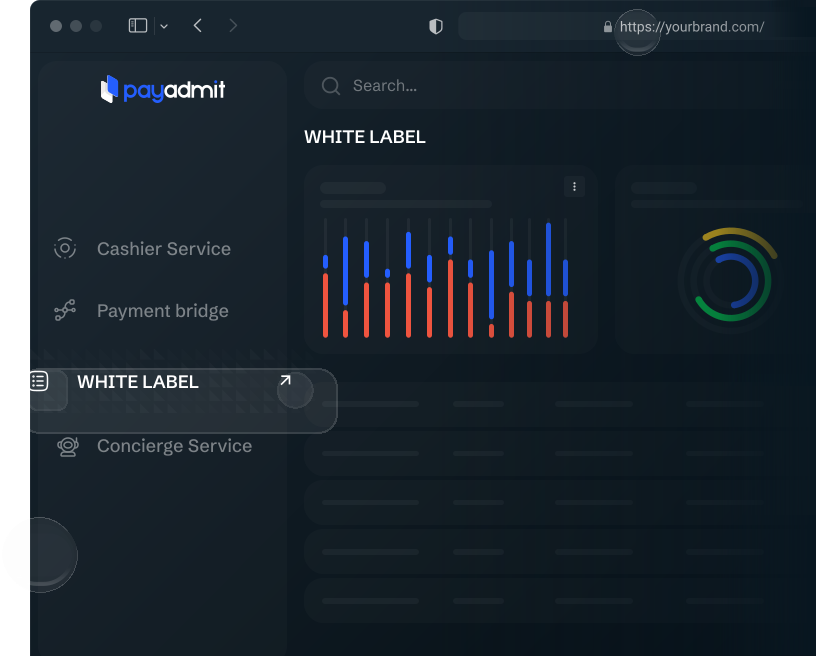
WHITE LABEL VS. STANDARD PAYMENT INTEGRATION
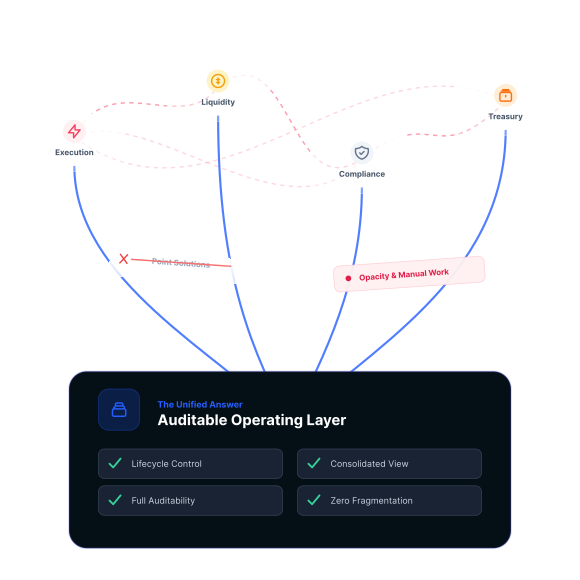
A standard payment integration connects the bank’s clients to a third-party payment provider. The third party owns the infrastructure, the compliance scope, and the client-facing experience. The bank is a distribution channel, not a payment service operator.
A white label payment gateway inverts that relationship entirely.
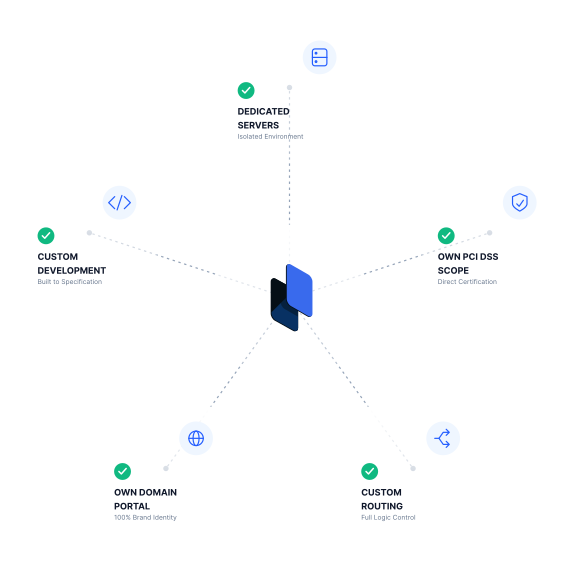
The bank owns the infrastructure layer — dedicated servers, its own PCI DSS certification, and a cardholder data environment that is technically isolated from other operators. The bank owns the merchant relationships — business clients onboard through the bank’s portal, interact with the bank’s brand, and never encounter a third-party payment name. The bank owns the payment revenue — routing margins, processing fees, and service income flow to the institution rather than to an external provider.
Factor
Infrastructure
PCI DSS scope
Client-facing brand
Routing control
Merchant portal
Payment revenue
Compliance audit scope
Software roadmap dependency
Standard Integration
Shared, third-party owned
Third-party certification
Third-party payment brand
Fixed by provider
Provider's domain
Flows to provider
Shared environment
Provider's priorities
White Label (PayAdmit)
Dedicated per bank, bank-owned
Bank's own certification
Bank's brand throughout
Fully configurable by the bank
Bank's domain
Flows to the institution
Isolated bank environment
Independent, bank-controlled
Infrastructure
Standard Integration
Shared, third-party owned
White Label (PayAdmit)
Dedicated per bank, bank-owned
PCI DSS scope
Standard Integration
Third-party certification
White Label (PayAdmit)
Bank's own certification
Client-facing brand
Standard Integration
Third-party payment brand
White Label (PayAdmit)
Bank's brand throughout
Routing control
Standard Integration
Fixed by provider
White Label (PayAdmit)
Fully configurable by the bank
Merchant portal
Standard Integration
Provider's domain
White Label (PayAdmit)
Bank's domain
Payment revenue
Standard Integration
Flows to provider
White Label (PayAdmit)
Flows to the institution
Compliance audit scope
Standard Integration
Shared environment
White Label (PayAdmit)
Isolated bank environment
Software roadmap dependency
Standard Integration
Provider's priorities
White Label (PayAdmit)
Independent, bank-controlled
For banks operating under financial regulation, the difference is not cosmetic. A shared PCI DSS environment does not meet banking-grade audit requirements. A third-party brand on the payment checkout erodes the client relationship. A provider-controlled routing configuration limits the bank’s ability to manage approval rates and merchant performance independently.
PayAdmit provides the software layer and the technical maintenance. The bank provides the payment service — under its own name, on its own infrastructure, to its own clients.
WHY BANKS NEED A WHITE LABEL PAYMENT GATEWAY SOLUTION
Business clients increasingly expect their bank to provide a complete payment solution — card acceptance and payout management — as part of the banking relationship.
 Banks that rely on third-party payment processors hand over the client relationship and the revenue to an external provider.
The institution controls the service, the pricing, and the client relationship completely.
The payment infrastructure — routing, cascading, anti-fraud, settlement — runs on dedicated servers under the institution’s own PCI DSS certification.
For banks serving fintech companies, this addresses a critical need: these businesses want card processing infrastructure they can integrate into their own products.
A bank that provides this through a white label payment gateway retains both the fintech client relationship and the payment revenue.
WHO THIS WHITE LABEL PAYMENT SOLUTION IS BUILT FOR

Banks serving SME and enterprise clients that need card acceptance, online payment processing, and payout management. The white label payment gateway gives the bank a complete branded payment product to offer business clients — routing, cascading, transaction management, merchant portal access, and settlement — under the institution’s brand and PCI DSS.

Banks with acquiring licenses that process card transactions for business merchants need payment tools to manage merchant onboarding, routing, cascading, and reporting independently. PayAdmit’s solution provides the technical routing layer — smart routing, PSP cascading, velocity controls, anti-fraud integration — that complements the acquiring business.

Banks whose clients include fintech businesses need to provide more than a payment account. These clients need a complete white label solution — card gateway access, management tools and a secure service — that integrates into their own products. The bank that provides this retains the client relationship and the revenue.

Institutions entering the payment gateway business for the first time benefit most from a white label solution. Building a custom payment gateway from scratch requires $500,000–$1,000,000 and 18–24 months. A white label solution delivers a production-ready payment gateway in 2–3 weeks, with all card integrations, secure processing, and merchant management included.
WHITE LABEL VS. STANDARD PAYMENT INTEGRATION
A standard payment integration connects the bank’s clients to a third-party payment provider. The third party owns the infrastructure, the compliance scope, and the client-facing experience. The bank is a distribution channel, not a payment service operator.
A white label payment gateway inverts that relationship entirely.
The bank owns the infrastructure layer — dedicated servers, its own PCI DSS certification, and a cardholder data environment that is technically isolated from other operators. The bank owns the merchant relationships — business clients onboard through the bank’s portal, interact with the bank’s brand, and never encounter a third-party payment name. The bank owns the payment revenue — routing margins, processing fees, and service income flow to the institution rather than to an external provider.
WHAT THE WHITE LABEL PAYMENT GATEWAY FOR BANKS INCLUDES
BRANDED PAYMENT PAGES AND SECURE CHECKOUT
Every payment page runs on the bank's domain with the institution's branding — logo, colors, and layout. Data entry is handled directly in the checkout, without redirecting customers to a third-party service. The institution provides the branded experience. PayAdmit handles the payment gateway processing layer behind it and provides ongoing technical maintenance. Custom CSS and mobile-responsive layout are included.

Dedicated Infrastructure and Bank-Owned PCI DSS
The white label payment infrastructure runs on servers dedicated to the bank. PCI DSS certification covers the bank's specific environment — not a shared scope. Payment data, client records, and cardholder information stay within the certified perimeter. For a bank subject to financial regulation, dedicated infrastructure with owned PCI DSS is not optional — it is a prerequisite for delivering a compliant payment service.
Smart Routing and Multi-PSP Card Processing
The routing engine selects the optimal path for each payment transaction. Transaction scoring includes: card BIN, transaction currency and amount, merchant risk profile, geography, and historical approval rate statistics per PSP. When a payment transaction fails at one provider, the routing engine cascades to the next configured PSP. Cascade sequences, PSP priority, and routing weights are fully configurable. The software executes the logic in real time.
Merchant Portal and Account Management
Business clients onboard, parameters configure, and activity is monitored through a portal on the institution's domain. Each account gets its own view — transaction reports, settlement summaries, transaction data, and payout management. Role-based controls define which team members can manage configurations, view settlement data, or access risk settings. The full client network is manageable from one back office interface.
Anti-Fraud and Secure Transaction Processing
Configurable anti-fraud rules apply per merchant: BIN blocks, spending thresholds, velocity limits per card and customer profile, and behavior-based scoring. Third-party anti-fraud integration feeds directly into the transaction scoring pipeline — ZignSec and Kount are standard. Any anti-fraud integration the bank already uses connects through the same layer — no separate integration work required.
Card and Payment Method Coverage
The white label gateway connects the bank to Visa, Mastercard, Amex, JCB, and UnionPay card networks. Alternative payment method coverage includes 300+ providers: Apple Pay, Google Pay, PayPal, and regional solutions. Cryptocurrency and APM support is available as an additional service. Business clients receive complete card and payment method coverage through a single white label integration — one connection point covering every payment method and payment type.
Processing Limits and Volume Management
Granular volume controls apply per terminal, per account, and at the portfolio level. When a terminal reaches its configured limit, the software deactivates it and redistributes volume to available terminals in the same group. Processing capacity management requires no manual intervention from the bank's team.
Settlement and Reporting
The back office provides settlement data, reconciliation exports, and transaction and settlement reporting at the account level and across the portfolio. Individual clients access their own reports through the portal. Currency conversion using live exchange rate data applies before routing so settlement currencies match PSP requirements automatically.
BRANDED PAYMENT PAGES AND SECURE CHECKOUT
Every payment page runs on the bank's domain with the institution's branding — logo, colors, and layout. Data entry is handled directly in the checkout, without redirecting customers to a third-party service. The institution provides the branded experience. PayAdmit handles the payment gateway processing layer behind it and provides ongoing technical maintenance. Custom CSS and mobile-responsive layout are included.
Dedicated Infrastructure and Bank-Owned PCI DSS
The white label payment infrastructure runs on servers dedicated to the bank. PCI DSS certification covers the bank's specific environment — not a shared scope. Payment data, client records, and cardholder information stay within the certified perimeter. For a bank subject to financial regulation, dedicated infrastructure with owned PCI DSS is not optional — it is a prerequisite for delivering a compliant payment service.
Smart Routing and Multi-PSP Card Processing
The routing engine selects the optimal path for each payment transaction. Transaction scoring includes: card BIN, transaction currency and amount, merchant risk profile, geography, and historical approval rate statistics per PSP. When a payment transaction fails at one provider, the routing engine cascades to the next configured PSP. Cascade sequences, PSP priority, and routing weights are fully configurable. The software executes the logic in real time.
Merchant Portal and Account Management
Business clients onboard, parameters configure, and activity is monitored through a portal on the institution's domain. Each account gets its own view — transaction reports, settlement summaries, transaction data, and payout management. Role-based controls define which team members can manage configurations, view settlement data, or access risk settings. The full client network is manageable from one back office interface.
Anti-Fraud and Secure Transaction Processing
Configurable anti-fraud rules apply per merchant: BIN blocks, spending thresholds, velocity limits per card and customer profile, and behavior-based scoring. Third-party anti-fraud integration feeds directly into the transaction scoring pipeline — ZignSec and Kount are standard. Any anti-fraud integration the bank already uses connects through the same layer — no separate integration work required.
Card and Payment Method Coverage
The white label gateway connects the bank to Visa, Mastercard, Amex, JCB, and UnionPay card networks. Alternative payment method coverage includes 300+ providers: Apple Pay, Google Pay, PayPal, and regional solutions. Cryptocurrency and APM support is available as an additional service. Business clients receive complete card and payment method coverage through a single white label integration — one connection point covering every payment method and payment type.
Processing Limits and Volume Management
Granular volume controls apply per terminal, per account, and at the portfolio level. When a terminal reaches its configured limit, the software deactivates it and redistributes volume to available terminals in the same group. Processing capacity management requires no manual intervention from the bank's team.
Settlement and Reporting
The back office provides settlement data, reconciliation exports, and transaction and settlement reporting at the account level and across the portfolio. Individual clients access their own reports through the portal. Currency conversion using live exchange rate data applies before routing so settlement currencies match PSP requirements automatically.
HOW A BANK DEPLOYS WHITE LABEL PAYMENT PROCESSING
01
SETUP (WEEKS 1–3)
PayAdmit provisions the dedicated server infrastructure, activates PCI DSS for the bank's environment, configures the branded payment pages and portal on the bank's domain, establishes initial PSP connections and integration activation, and builds the routing and anti-fraud ruleset. Full admin access is provided to a production-ready white label payment gateway.
02
CLIENT ONBOARDING
The bank onboards its business clients through the back office. Each client receives a configured payment profile, volume limits, and portal access. Onboarding criteria, limits, and fee structure. PayAdmit provides the technical infrastructure, continues to provide integration updates, and provides BIN maintenance on a regular schedule.
03
ONGOING OPERATION
Client relationships and payment service terms are managed by the institution. PayAdmit provides software maintenance, PCI DSS upkeep, network integration updates, BIN database refreshes, and 24/7 technical support. Additional payment methods, new card integrations, or custom features are delivered on request.
WHITE LABEL PAYMENT GATEWAY FOR BANKS — REAL SCENARIOS
A COMMERCIAL BANK OFFERING PAYMENT SERVICES TO BUSINESS CLIENTS
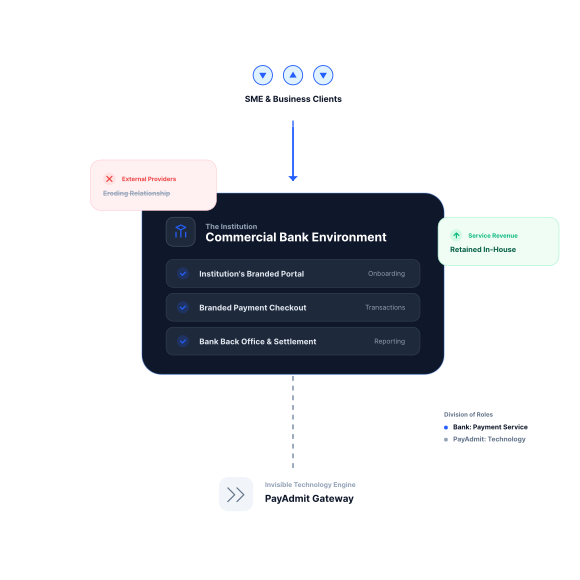
A commercial bank with an established SME and business client base wanted to provide card acceptance as a service rather than directing business clients to external payment providers. Directing business clients to external providers was eroding the banking relationship and the service revenue. PayAdmit’s white label payment software was deployed. Business clients onboard through the institution’s portal.
Transactions process through the branded checkout. Settlement data appears in the back office alongside other banking services. The institution manages the payment service; PayAdmit manages the technology.
AN ACQUIRING BANK BUILDING INDEPENDENT ROUTING CAPABILITY
An acquiring institution handling transactions for business merchants relied on a shared environment that limited routing flexibility. PayAdmit’s white label payment software deployed on dedicated servers. Clients connect to the branded portal.
Routing and cascading logic runs under the institution’s configuration. Routing rules and merchant fee structures are now managed independently.
FREQUENTLY ASKED QUESTIONS
What makes a white label payment solution suitable for banks?

A white label payment solution for banks requires dedicated server infrastructure, bank-owned PCI DSS certification, and full control over payment routing configuration. Shared payment environments do not meet banking audit and regulatory requirements. PayAdmit provides each bank client with a technically isolated environment — the institution’s own servers, own PCI DSS, and brand on every payment touchpoint.
Can the bank manage its own merchants through the white label portal?
Yes. The merchant portal runs on the bank’s domain under the bank’s brand. The bank creates merchant accounts, configures payment parameters, sets limits, and manages fee structures from the back office. Each merchant accesses its own portal with its own payment data. The operator manages client relationships; PayAdmit provides the technical infrastructure.
Does the solution support payment services for fintech clients?
Yes. Banks providing payment services to fintech businesses can provide white label card processing through the same gateway. Fintech clients integrate through the bank’s API and access payment service capability as part of the banking relationship. The solution includes API documentation under the bank’s brand, webhook support, and all standard payment types.
What card networks and payment integrations does the gateway support?
The gateway supports Visa, Mastercard, Amex, JCB, and UnionPay. It connects to 300+ alternative payment methods and can provide cryptocurrency processing as an additional integration. New payment method or PSP additions take 1 to 2 weeks — handled by the PayAdmit technical team.
How long does it take to deploy a white label payment solution for a bank?
Full deployment — server setup, PCI DSS activation, branded checkout, portal configuration, integration activation, and routing ruleset — takes 2 to 3 weeks. The institution goes live with a production-ready white label payment environment within the agreed timeline.
Is the solution compliant with banking regulatory requirements?
PayAdmit provides dedicated infrastructure with bank-owned PCI DSS certification. Payment data stays within the certified perimeter. The software supports role-based access controls, audit logs at the transaction level — every transaction is logged — and data handling in line with PCI DSS requirements. Regulatory compliance obligations at the banking license level remain with the bank; PayAdmit provides the compliant technical infrastructure and will provide documentation and technical support to the compliance team.