

90% merchant reach
Reach the bulk of online merchants through one connector.
PayAdmit Payment Bridge is a PSP connector that plugs into your existing platform and unlocks 400+ payment providers through a single integration. Built for online businesses that want more reach without rebuilding their payment stack.
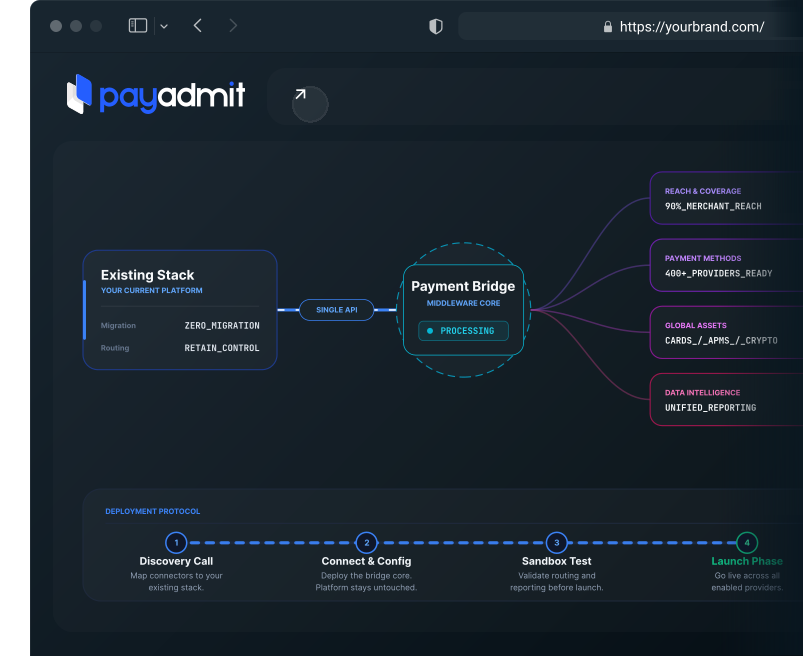
Payment Bridge supports all major gateway networks and extends your payment coverage without rewriting what already works. When you outgrow the bridge and want the full platform, here is how to own a payment gateway.
Reach the bulk of online merchants through one connector.

Pre-built connectors behind one interface.

No lengthy custom development cycles.

Coverage across leading cashier platforms used by online operators.

Lower integration costs, shorter timelines.

Full visibility across every provider.
For teams thinking about building their own gateway from scratch, our blog covers the full development scope.
One integration, then a fully functional system.
You operate a payment stack that opens revenue across markets you previously couldn’t reach.
Four steps from your first call with our team to the moment your merchants start processing.
No replatforming, no parallel infrastructure to maintain.
Tell us which platforms you run, which providers you need, and where you want to grow. We map the connectors that fit your stack.
We deploy the bridge between your existing platform and PayAdmit’s connector network. Your core systems stay untouched.
Run real transactions through every connector in a controlled environment. Validate routing, reporting, and reconciliation before you go live, the same sandbox discipline described in how to make your own payment gateway.
Go live across all enabled providers. Add new connectors on demand without touching your existing integration.
For teams that want to build their own end-to-end product, our white label payment platform delivers the full stack under your domain.
Payment Bridge is configurable for any online business model that relies on multi-provider routing.
Tell us about your operation and we’ll come back with a fit assessment.

Payment Bridge gives PSPs a way to reach merchants who sit behind platforms they don’t yet support.
It works as ready-made middleware, so providers expand their client base without rebuilding integrations from scratch.

Win operators sitting behind platforms you haven’t certified yet.

Get new clients live across providers without engineering bottlenecks.

One ready-made connector replaces a queue of custom builds.
The same connector streamlines connectivity with multiple platforms and reduces technical overhead on both sides.
PSPs onboard merchants faster, merchants integrate once, and both move forward without engineering friction slowing the deal.
Is this the right fit for you?
Payment Bridge works best for businesses with existing PSP relationships looking to extend their reach. For teams that want to build their own end-to-end product instead, our white label payment platform delivers the full stack under your domain.
Every team that needs more PSPs faces the same fork in the road. Here is how the three common paths stack up against each other. For a fuller side-by-side of the options, see our best white label payment gateway comparison.


Five scenarios where teams consistently choose a bridge over building or replatforming.

Every week of delay means lost transactions. A bridge gives you the acquirers and methods you need now, not after a six-month dev cycle.

Validate a region with real traffic before you commit to a permanent integration. Test, learn, then scale based on results.

Add fallback providers, balance traffic loads, and improve approval rates across regions without reconfiguring your existing orchestration.

Outsource the connector grind while keeping full control of your processing logic. Your team focuses on optimization and growth.

If your gateway already performs, rebuilding it for a few missing providers makes no sense. A bridge extends what works.

Add new merchants, new geographies, and new methods on the same integration. Scale up as opportunities arrive.
Get a short walkthrough with our team. No slides, no sales pitch, we look at your stack and tell
you what would change after deploying Payment Bridge.
Payment Bridge fits any team that already processes payments and wants more reach without ripping up what works.
Reach online merchants who run on platforms you haven’t certified. Close deals faster and keep your roadmap focused on what differentiates you.
Add local payment methods in new regions, plug in alternative acquirers for redundancy, and improve approval rates — without rebuilding your gateway.
Give your customers access to providers you don’t natively support. Position your platform as ready for any market, without the integration backlog.
Production-grade infrastructure designed for high-volume payment operations.

One integration handles authentication, webhooks, fields, error handling, and retries across every connected provider.

Route transactions by geography, currency, BIN, or success rate, and layer smart routing and cascading on top of your existing logic.

Track approval rates, declines, and volumes across every provider in one reporting dashboard. No more jumping between PSP back-offices.

Operate inside a PCI DSS Level 1 environment with full tokenization. Sensitive data stays out of your servers.

From signed contract to first live transaction through one structured deployment cycle. Our integration team handles the heavy lifting end-to-end.

A dedicated technical manager who knows your integration, plus direct lines to real engineers when something needs answering. No chatbot loops, no ticket black holes.

Payment Bridge is an extension layer, not a replacement. A full payment orchestration platform asks you to migrate your routing, reporting, and merchant logic onto a new stack. The bridge plugs into the platform you already run and adds the providers you’re missing.
If your current setup works and you only need more reach, the bridge gets you there through a single connector deployment instead of months of rebuild work.
Tell us during the discovery call. We map the connectors that fit your stack and work to add the providers your business depends on. With 400+ pre-integrated providers and methods already in place, most teams find what they need from the start.
They stay intact. The bridge sits on top of your current stack and adds the providers you are missing. You keep your direct agreements, your routing logic, and your settlement flows exactly as they are.
Yes. Once the bridge is connected, you enable new providers on demand without touching your existing integration. Adding a connector takes configuration, not development. You scale coverage as new markets and opportunities open up.
You pay for one integration instead of a queue of custom provider builds. There is no engineering team to staff, no per-provider certification cycle, and no ongoing maintenance load on your side. Costs stay predictable as you add connectors, because the integration itself never changes, since the provider carries the integration and maintenance work, not your team — more on that model on our white label payment gateway provider page.
Most teams move from signed contract to first live transaction in weeks, not months. The timeline depends on how many connectors you enable and your sandbox testing pace. Our integration team handles the technical setup, so your engineers stay focused on their own roadmap.
Tell us which platforms you run and which providers you need. We’ll have a tailored integration
plan back to you within one business day.
